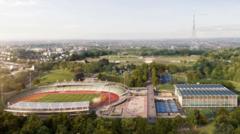
Crystal Palace National Sports Centre was once the beating heart of British athletics. It was where elite athletes trained, international competitions took place, and generations of South Londoners learned to swim. In recent years, though, it turned into an embarrassing symbol of neglect. Pools sat drained for over half a decade. Roofs leaked. Facilities crumbled while politicians kicked the funding can down the road.
That long, painful drought is finally coming to an end.
With a full planning application submitted to Bromley Council by developer Morgan Sindall on behalf of the Greater London Authority, the £130 million transformation of the site is officially locked in. Planning officers have recommended approval, and construction is slated to kick into high gear.
If you're wondering what this massive project actually means for Londoners, local clubs, and the broader sporting scene, here's what's happening.
What Is Changing at Crystal Palace
This isn't a cosmetic coat of paint. It's a top-to-bottom overhaul designed to bring the 15-hectare site up to modern standards while respecting its Grade II* listed heritage.
The original structure, designed by Norman Engleback in the early 1960s, was celebrated for its striking glass pavilion style and iconic concrete A-frames. Years of poor climate control caused severe condensation and structural decay.
The £130 million plan tackles these issues head-on.
The Aquatics Overhaul
For five long years, local swimmers and divers had to look elsewhere because the main pools were out of order. The new masterplan brings all aquatic spaces together under one roof on a single level for the first time.
- The 50-metre competition pool is being fully restored.
- The 10-metre diving pool is returning to operational service.
- The existing 25-metre pool is being relocated into the main hall alongside a new shallow-water pool.
To stop the building's historic moisture problem from damaging the new hall, designers are installing a massive internal glazed wall. This separates the wet pool zone from the dry sports hall, tackling humidity and noise without ruining the open-plan feel.
Modern Sports Facilities
The revamp isn't just catering to traditional Olympic disciplines. It's aggressively adapting to modern community demand.
- A new six-court indoor padel centre.
- Dedicated 3x3 basketball courts.
- Five-a-side football pitches and an upgraded full-sized artificial pitch.
- An enlarged, state-of-the-art community gym and weightlifting zone.
- A 200-metre indoor running track and upgraded indoor sports spaces.
Stadium and Track Restorations
The outdoor athletics stadium—where iconic world records were once broken—is getting its seating bowl completed, pushing capacity up toward 25,000. The goal isn't to compete with Olympic Stadium-scale mega events, but to create an electric, high-energy venue for regional meets, community events, and elite training.
CRYSTAL PALACE REVAMP AT A GLANCE
--------------------------------------------------
Total Investment:  £130 Million
Lead Contractor:   Morgan Sindall Construction
Designers:         FaulknerBrowns & WOO Architects
Planning Status:   Submitted to Bromley Council
Target Reopening:  Late 2028 (Stadium to follow by 2030)
Why This Transformation Took So Long
To understand why this £130m investment feels like a monumental relief, you have to look at the site's messy history.
After hosting 21 FA Cup Finals between 1895 and 1914, the grounds were repurposed for national athletics in 1964. For decades, it thrived. By the late 2000s, political neglect took over.
When the 2012 London Olympics landed in Stratford, funding shifted away from South London. Crystal Palace was left behind. At one point, former Mayor Boris Johnson even explored a scheme to hand over parts of the park and sports centre to a Chinese billionaire developer, a plan that eventually collapsed into inaction.
By the time Mayor Sadiq Khan committed to fixing the complex, the building was practically falling apart. Repairing a Grade II* listed structure isn't as simple as knocking down walls. Every beam, glass panel, and layout adjustment had to pass strict heritage scrutiny through Historic England.
TIMELINE OF NEGLECT & REVIVAL
1964: National Sports Centre opens to world acclaim.
2012: Olympic investment prioritizes East London; CPNSC falls into decay.
2020: Major pool leaks lead to long-term closures.
2023: GLA commits to a comprehensive site revamp.
2025: Morgan Sindall appointed as main contractor.
2026: Full planning submitted; construction prep begins.
2028: Target reopening for main sports complex and aquatics.
The Friction Behind the Plan
Not everyone in South London is celebrating unconditionally. A project of this magnitude naturally creates tension between competing local interests. While the planning submission received roughly 390 letters of support, it also drew around 406 formal objections.
Why the split?
Local sports groups, including the historic weightlifting club and England Athletics, have voiced total backing. They see this as a life-saving upgrade that guarantees their sports a long-term home.
Pitch sports like local hockey and football clubs raised red flags over how outdoor pitch allocations were changing. Indoor climbing enthusiasts raised concerns that plans for a new climbing wall in the former 5-a-side building lacked clear specifics and funding guarantees.
Motorsport historians wanted assurances that the historic 1970s racing circuit running through the park wouldn't be permanently blocked by ground developments. Planning officers confirmed the circuit layout will remain intact and recognizable, but the debate shows just how many layers of history rest on this single plot of land.
A Massive Leap in Decarbonization
One detail that usually gets glossed over in standard news coverage is the project's green engineering.
Sports halls with huge glass faces and swimming pools are notorious energy hogs. The existing centre relied on ancient fossil-fuel systems that leaked heat at an alarming rate.
Supported by £23 million from the Green Finance Fund, the new Crystal Palace NSC is going all-electric.
- Air-source heat pumps will handle heating and cooling throughout the 37-acre footprint.
- Roof-mounted photovoltaic (PV) solar panels will generate clean energy on-site.
- The upgraded building envelope will slash overall carbon emissions by an astonishing 97%.
It sets a direct template for how 20th-century brutalist sports infrastructure can be adapted for modern climate standards rather than demolished.
What to Expect During Construction
If you rely on Crystal Palace for your weekly workouts, you need to prepare for disruption.
Major construction work starts later this year, meaning full or partial closures across the main complex will be unavoidable while Morgan Sindall carries out heavy engineering. The target completion date for the main sports hall and aquatics centre is late 2028, with stadium works continuing beyond that.
If you train at the centre, map out your alternative local facilities now. Southwark, Lambeth, and Lewisham offer nearby leisure centres, but pool space across South London will remain tight until those four Crystal Palace pools are back online. Keep an eye on Bromley Council's planning portal for final condition approvals as ground activity ramps up.