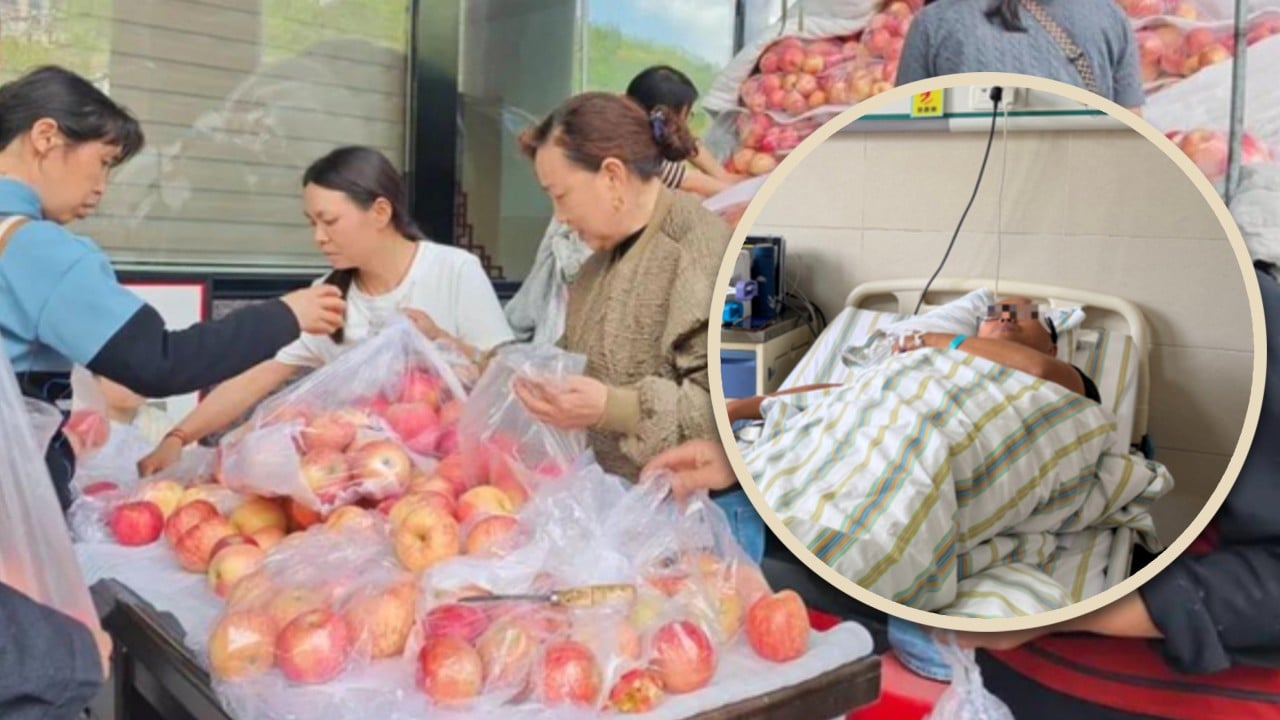
When an elderly farmer collapsed from a stroke in a Shaanxi hospital parking lot, he was sitting on four tons of unsold Fuji apples and a mountain of desperation. Within 19 hours, every single fruit was gone. On the surface, it is the kind of viral feel-good story that local bureaus love to broadcast—a testament to community spirit and the "white coat" heroism of medical staff who traded stethoscopes for crates to clear the man’s inventory. But peel back the skin of this narrative and you find a much more bitter reality. This isn't just a story about a stroke and a sale. It is a stark indictment of a broken rural supply chain and the brutal physical toll of the "last mile" for China’s aging agrarian workforce.
The farmer, identified only as Mr. Zhang, represents a demographic ticking time bomb. At 60-plus years old, he is part of the "left-behind" generation, men and women who remain in the villages to manage small-scale orchards while the youth migrate to Tier 1 cities for tech and service jobs. When the harvest comes, the pressure is immense. For Zhang, the 4,000kg of apples weren't just produce; they were his entire annual income, a liquid asset that stays frozen until a buyer is found. In a year where global logistics and domestic consumption patterns have fluctuated wildly, smallholders like Zhang are increasingly forced to become their own logistics managers, drivers, and sales agents.
The Physical Cost of the Smallholder Hustle
A stroke is rarely a random bolt from the blue. It is often the culmination of chronic stress, sleep deprivation, and physical overexertion. To move four tons of apples, a man in his sixties must engage in back-breaking labor that would challenge a professional athlete.
Consider the mechanics of the "apple hustle." First, there is the picking and sorting. Then, the loading of crates—each weighing roughly 20kg—onto a modified tricycle or a light truck. For Zhang, the journey to the market or a high-traffic area to find buyers involves hours of driving on secondary roads. These farmers often sleep in their vehicles to guard their stock and avoid the cost of lodging. They eat cold mantou and wait. When the body finally gives out, as Zhang’s did in the parking lot of the Xianyang hospital, it is a physiological protest against an economic system that demands 21st-century output from 20th-century manual labor.
The hospital staff's intervention was undoubtedly noble. They used internal messaging groups and social media to alert the community, turning a medical facility into a temporary farmers' market. But the speed of the sale—19 hours—highlights a painful irony. The demand for the product exists. The quality of the fruit was never the issue. The failure lies in the market access. If it takes a life-threatening medical emergency to trigger a localized supply chain, the system is fundamentally dysfunctional.
Beyond the Viral Moment
The "hospital sale" model is not a scalable business strategy. While the staff at the Xianyang hospital cleared the inventory, thousands of other farmers are currently sitting on similar stockpiles without the benefit of a medical crisis to garner public sympathy.
China’s agricultural sector is currently undergoing a massive, painful transition. The government has pushed for "Digital Rural" initiatives, hoping that live-streaming and e-commerce will bridge the gap between the orchard and the urban kitchen. However, there is a massive literacy and technology gap. For a farmer like Zhang, setting up a Douyin (TikTok) shop or navigating the logistics of cold-chain shipping is as foreign as rocket science. They rely on the old ways: driving to where the people are and hoping for the best.
When middlemen or "collectors" don't show up at the village gates—often due to price wars or localized gluts—the farmer is the one who bears 100% of the risk. They are the shock absorbers of the Chinese economy. When the price of fertilizer goes up, they absorb it. When the price of apples drops, they absorb it. And when the logistics fail, their bodies absorb the stress until the arteries snap.
The Myth of the Heroic Consumer
There is a certain "poverty tourism" aspect to these viral sales. People flock to buy the apples because they want to feel like they are saving a life. They are. But this surge of "compassion buying" creates a distorted market. It rewards the tragedy rather than the trade.
True structural health for rural farmers would look like this:
- Regional cooperatives that actually function, allowing smallholders to pool their inventory and negotiate with large supermarket chains.
- Subsidized crop insurance that covers not just weather events, but price collapses and personal health emergencies during harvest.
- Integrated cold-storage facilities at the village level, so a farmer isn't forced to sell his entire life's work in a 48-hour window before the fruit rots or his heart fails.
The hospital staff did a wonderful thing, but we must stop treating these incidents as heartwarming anomalies. They are symptoms of a systemic failure. The fact that the most efficient way for a farmer to sell his crop was to nearly die in a hospital parking lot should be a source of national embarrassment, not inspiration.
The Logistics Gap and the Aging Orchard
We are witnessing the sunset of the independent small-scale farmer in East Asia. As the rural population ages, the sheer physical requirements of the job become impossible. If you cannot lift the crate, you cannot make the sale. If you cannot drive the truck, the fruit stays on the branch.
Investors and tech giants often talk about "disrupting" agriculture, but their focus is usually on high-margin organic goods or luxury exports. The humble Fuji apple, the staple of the Chinese working class, is left to the whims of the traditional market. We see a massive investment in high-speed rail and urban infrastructure, but the "mid-mile" logistics—the specialized transport that moves goods from a rural village to a regional hub—is still largely comprised of individual men in aging trucks.
This creates a bottleneck of vulnerability. When the "logistics manager" is also the "producer," any health hiccup becomes a financial catastrophe. Zhang was lucky. He collapsed at a hospital. If he had suffered that stroke on a lonely mountain road, his 4,000kg of apples would have become his tombstone, rotting alongside him.
The Actionable Reality
For those looking at the Chinese market from the outside, or for policymakers within, the takeaway is clear. The next phase of economic stability won't come from a new app or a flashier city. It will come from solving the Zhang Dilemma.
We need to decouple the physical labor of the farmer from the commercial success of the crop. This means building a layer of professionalized, tech-enabled rural aggregators who handle the "heavy lifting"—literally and figuratively. The goal should be a world where a 60-year-old man can grow a beautiful apple and see it sold at a fair price without ever having to risk a stroke in a parking lot.
The 19-hour sale was a miracle of human kindness. But a society that relies on miracles to sustain its food producers is a society standing on very thin ice. The apples are gone, the money is in Zhang's pocket, and the hospital has returned to its primary mission. But tomorrow, another truck will pull into another lot, driven by a man whose blood pressure is rising in direct proportion to the unsold weight in his trailer.
Stop cheering for the sale and start questioning the struggle that made it necessary.