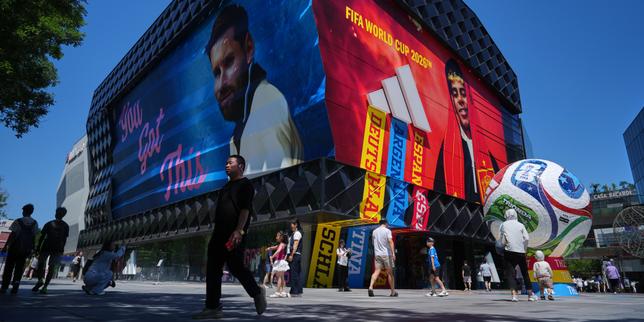
Football is eating itself. We’re currently watching the largest, most bloated World Cup in history unfold across Canada, Mexico, and the United States. While fans celebrate goals and wave flags, the uncomfortable truth is staring us right in the face. This 48-team mega-tournament is tracking to be an absolute environmental disaster, and football’s governing body is completely fine with it.
If you look back to 2021, FIFA proudly signed the United Nations Sports for Climate Action Framework. They promised to slash emissions by 50% by 2030 and hit net zero by 2040. It sounded fantastic on paper. But fast forward to 2026, and those promises look like ancient history. Instead of cutting down on pollution, FIFA expanded the tournament to 104 matches, locked in a massive sponsorship with the world’s biggest corporate greenhouse gas emitter, and forced millions of fans to board short-haul flights across a continent.
The Hypocrisy of Football’s Carbon Footprint
Let's look at the actual numbers. Scientists and environmental groups, including Scientists for Global Responsibility and the Environmental Defense Fund, conservatively estimate that the 2026 World Cup will generate around 9 million tons of carbon dioxide equivalent. To give you some context, that’s like driving 6.5 million cars for a full year.
When you factor in everything—including global TV broadcasts, qualifying rounds, and merchandising—independent initiatives like Play the Game estimate the true footprint could hover closer to 70 million tons.
Estimated Carbon Footprint:
- Conservative Tournament Projection: 9,000,000 tons CO2e
- Air Travel Share: 7,700,000 tons CO2e
- Broader Footprint (Inc. Broadcasts & Qualifiers): up to 70,000,000 tons CO2e
What makes this iteration so frustrating is that we can't blame stadium construction. Unlike Qatar, which built massive, energy-intensive white elephants in the desert for 2022, North America already had the stadiums. The issue here is pure scale and terrible planning. Because the 16 host cities are scattered across thousands of miles, flying is the only viable option for teams, media, and fans. Air travel alone accounts for roughly 7.7 million tons of the tournament's carbon budget.
FIFA knew this would happen. Yet, they chose to expand the field from 32 teams to 48 anyway. More matches mean more travel, more resource consumption, and a massive payday for Zurich, while the planet picks up the tab.
Taking Money from the Ultimate Polluter
The greenwashing isn't just happening in the flight schedules. It's plastered all over the advertising hoardings. In 2024, FIFA signed a massive four-year partnership with Aramco, the state-owned Saudi energy giant. Aramco is single-handedly responsible for more than 4% of global corporate greenhouse gas emissions since 1965.
Think about the sheer contradiction here. FIFA claims they want to protect the future of the game, yet they take hundreds of millions of dollars to turn their flagship event into a giant billboard for fossil fuels.
The players themselves are furious. Over 100 professional women’s footballers signed an open letter blasting the deal. Players like Canada’s captain, Jessie Fleming, pointed out that taking money from a company driving the climate crisis directly endangers the safety of players and the planet. It’s hard to argue with her. FIFA has compromised its integrity for corporate cash, effectively siding with the polluters over the communities that make the sport what it is.
Playing Football in an Oven
The irony of this environmental neglect is that it’s actively ruining the sport on the pitch. Climate change isn't some distant, abstract threat anymore. It's a regular matchday hazard.
Academic studies evaluating the 2026 host cities found that 14 out of the 16 venues are likely to experience average wet-bulb globe temperatures (WBGT) exceeding 28°C (82.4°F) during June and July. For those unfamiliar, WBGT doesn't just measure air temperature; it factors in humidity, wind speed, and solar radiation to evaluate heat stress on the human body.
The global players' union, FIFPRO, has stated that a 28°C WBGT should trigger an immediate match suspension to protect athlete health. When humidity is high, the human body loses its ability to cool itself down through sweat. Running 10 to 12 kilometers in those conditions risks severe heatstroke, organ damage, and worse.
How has FIFA responded? Their official safety protocol only triggers mandatory precautions at an extreme 32°C WBGT. That threshold is dangerously high. It means matches will press on in conditions that are objectively unsafe for outdoor athletic activity. While cities like Houston, Dallas, and Atlanta can slide their stadium roofs shut and crank up the air conditioning, powering those massive cooling systems requires massive amounts of energy. We are literally burning fossil fuels to cool stadiums because we've burned too many fossil fuels outside of them.
Where Does the Beautiful Game Go From Here
If you love football, you don't have to just sit back and watch it get ruined by corporate greed. Change inside sports organizations rarely comes from the top down; it gets forced from the bottom up.
First, fans need to organize and demand an end to fossil fuel sponsorships in sport. It sounds difficult, but we've done this before. A few decades ago, tobacco companies sponsored everything from Formula 1 cars to football tournaments. Once the public health reality became undeniable, those ads were banned. Cities like Amsterdam and Edinburgh have already banned fossil fuel advertising in public spaces. Football clubs and international tournaments need to follow that exact blueprint.
Second, future tournament structures must prioritize regional grouping. The concept of a continent-hopping World Cup is unsustainable. FIFA's upcoming plans for 2030—which involve matches spanning Africa, Europe, and South America—prove they haven't learned a single lesson. Tournaments should be tightly clustered geographically, utilizing existing rail networks and public transport rather than forcing fans into the sky for every group stage match.
If you run a local supporters' group or a community club, start making noise. Push your local club to audit its own energy use, transition away from high-polluting sponsors, and implement sustainable travel policies for away days. The big executives in Zurich only care about the metrics. When fans, players, and local associations collectively push back, the financial risk of staying dirty will finally outweigh the short-term cash flow of corporate greenwashing.