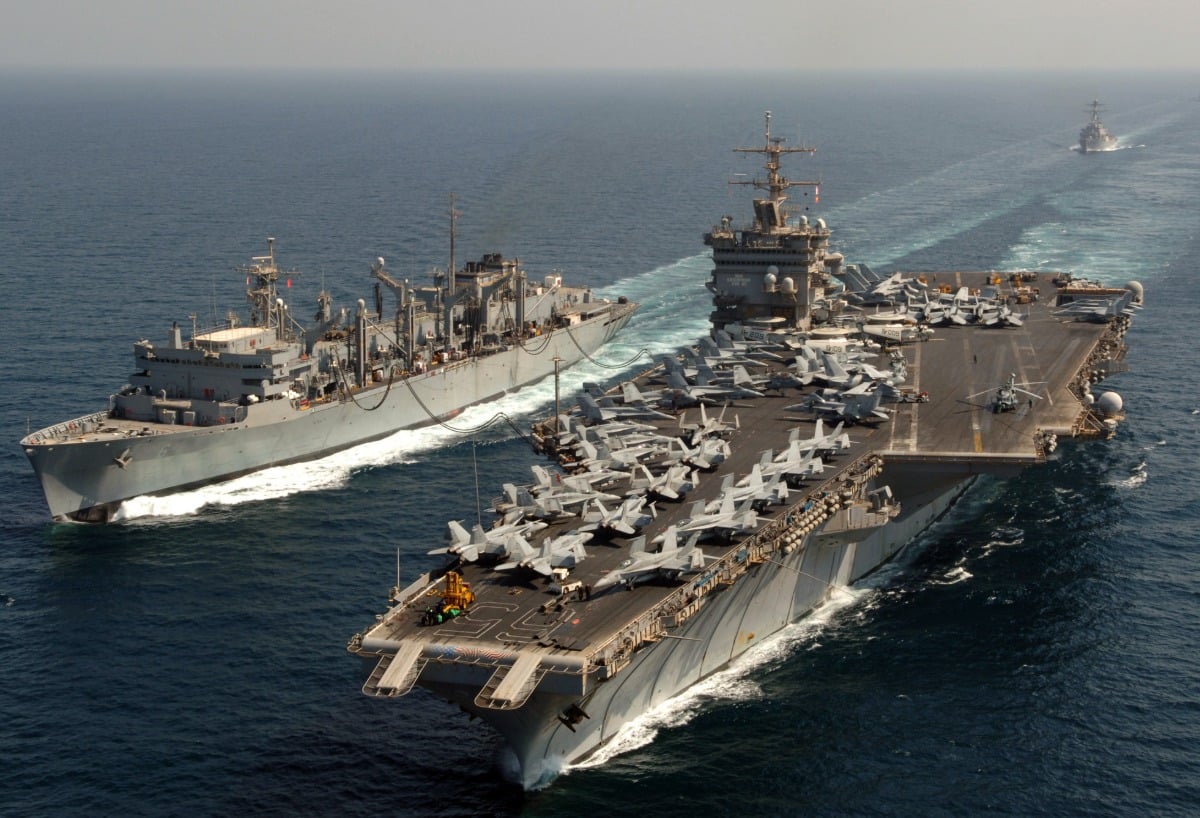
The U.S. Navy is celebrating. After a bitter legal battle over a website glitch, they finally managed to re-award a contract to dismantle the USS Enterprise (CVN-65), the world’s first nuclear-powered aircraft carrier. The spin doctors are thrilled. They managed to beat down Vermont-based NorthStar Maritime Dismantlement Services to a price of $418.5 million—roughly 22% lower than the initial $537 million bid. The media is swallowing the narrative whole, treating this as a massive win for the taxpayer and a masterclass in procurement bidding wars.
They are dead wrong. If you found value in this piece, you might want to read: this related article.
This contract is not a victory. It is a terrifying warning sign of a multi-billion-dollar fiscal trainwreck waiting to happen. The Navy is patting itself on the back for shaving $118 million off a single hull, completely ignoring the reality that this "fixed-price" experiment is highly likely to blow up in everyone's faces. In my years tracking defense procurement and industrial maritime strategy, I have watched the Pentagon play this exact shell game. They squeeze a contractor on paper, declare victory, and then act shocked when the private sector realizes it cannot defy the laws of physics or radiological science.
The USS Enterprise is a radioactive labyrinth. Squeezing the budget on its execution is not smart business—it is an invitation to disaster. For another perspective on this event, see the latest coverage from Business Insider.
The Eight-Reactor Nightmare
To understand why a $418 million budget is a delusion, you have to understand the sheer stupidity of the Enterprise's design.
Modern Nimitz-class carriers operate on two nuclear reactors. The newer Gerald R. Ford-class also uses two. The Enterprise, built in the late 1950s when engineers were still drunk on the possibilities of the atomic age, was packed with eight Westinghouse A2W nuclear reactors.
This was not a brilliant design; it was a desperate, heavy-handed engineering hack to get a 1,123-foot steel mountain moving at 30-plus knots because individual reactor outputs were too weak at the time.
Now, those eight reactors are eight separate, highly radioactive contamination zones nested deep within the ship's double-bottom hull. Taking apart a conventional ship is basic heavy industry: you pull it up to a dock in Brownsville, Texas, and attack it with blowtorches and shears. Taking apart CVN-65 requires:
- Stripping away thousands of tons of non-contaminated steel just to reach the reactor compartments.
- Constructing custom, sealed containment structures over the hull to prevent radiological dust from escaping into the air of Mobile, Alabama.
- Slicing through highly reinforced reactor vessels, packaging them into heavy-shielded transport containers, and shipping them to specialized low-level waste disposal sites.
To suggest that a private contractor can execute this first-of-its-kind, highly regulated radiological demolition project for $418 million over four years is absurd. In the commercial nuclear sector, decommissioning a single, stationary, land-based power reactor easily runs between $500 million and $1 billion. The Navy wants NorthStar to do eight marinized reactors, plus scrap a 90,000-ton warship, for less than the cost of a single civil reactor decommissioning.
The Illusion of the "Fixed-Price" Savior
The Navy’s defense of this lowball figure is that the contract is "firm-fixed-price." They believe they have successfully shifted all financial risk to NorthStar. If the company runs over budget, the taxpayer is protected.
This is defense procurement fan fiction.
When a fixed-price contract meets a highly complex, first-of-its-kind engineering challenge, one of two things happens:
1. The Contractor Files for Bankruptcy
If NorthStar hits unexpected radiological hot spots, structural failures, or regulatory delays that push their costs past the $418 million ceiling, they will not simply absorb hundreds of millions in losses out of patriotism. They will default, file for restructuring, or walk away. The Navy will then be left with a half-sliced, highly radioactive ghost ship sitting in a commercial port in Alabama. No other contractor will touch it without a massive, multi-hundred-million-dollar bailout package.
2. The Great Change-Order Avalanche
The contractor’s lawyers will pore over the contract's technical specifications. The moment they find a single discrepancy between the Navy's 60-year-old blueprints and the actual physical reality inside the hull—and there will be thousands—they will submit a Request for Equitable Adjustment. The "fixed" price will dissolve under a mountain of litigation and change orders.
This is not a theoretical risk. We saw this exact movie play out with the construction of the Gerald R. Ford (CVN-78), where the Navy pushed for fixed-price contracts on immature technologies. It resulted in years of delays and billions in cost overruns. Believing that decommissioning will be any different is willful blindness.
The Looming Carrier Decommissioning Wall
If this were just about one historic ship, we could chalk it up to a one-time gamble. But the Enterprise is supposed to be the blueprint.
Over the next two decades, the Navy faces a tidal wave of retirements. The older Nimitz-class carriers—starting with the USS Nimitz (CVN-68) and USS Dwight D. Eisenhower (CVN-69)—are reaching the end of their 50-year operational lives.
| Vessel | Commission Year | Expected Retirement | Reactors to Dismantle |
|---|---|---|---|
| USS Enterprise (CVN-65) | 1961 | Decommissioned (Active Project) | 8 |
| USS Nimitz (CVN-68) | 1975 | Late 2020s / Early 2030s | 2 |
| USS Dwight D. Eisenhower (CVN-69) | 1977 | 2030s | 2 |
If the Navy establishes $418 million as the baseline expectation for commercial carrier recycling, they are setting up the entire maritime industrial base for failure. No rational commercial shipyard will bid on the Nimitz class if the government demands they take on catastrophic financial risk for lowball margins.
The Navy’s traditional method for handling nuclear cruisers and submarines was the Ship-Submarine Recycling Program (SRP) at Puget Sound Naval Shipyard. It was slow, conservative, safe, and highly expensive. Shifting this to the commercial sector to save a few pennies is a desperate attempt to free up naval shipyard capacity for active fleet maintenance. But treating commercial yards like they have the same endless radiological infrastructure and regulatory insulation as a federal shipyard is a fast track to an environmental or financial disaster.
Stop Squeezing the Margins on Nuclear Waste
The Navy needs to stop celebrating this bid drop. A 22% reduction in a highly complex nuclear contract is not efficiency; it is a red flag that the bidding process has turned into a race to the bottom.
We should not be trying to "disrupt" the cost of nuclear decommissioning by squeezing private operators until they squeak. Instead, we must treat the dismantlement of our nuclear fleet as a core, fully funded national security priority. If we can afford to spend $13 billion to build a new carrier, we must stop pretending we can clean up its radioactive corpse for pocket change.
The bill always comes due. And when it does, $418 million will look like a down payment.