On a Tuesday afternoon in Mid-Levels, the air smells faintly of humidity and exhaust. Mr. Chen—a hypothetical but entirely accurate composite of a modern mainland investor—stands on the balcony of a half-empty luxury apartment. He looks down at the glittering sprawl of Victoria Harbour. He is forty-eight, cautious, and rich. He did not get rich by taking foolish risks. He made his fortune manufacturing precision medical components in Shenzhen. But right now, his chest feels tight.
In his hand is a glossy brochure for a three-bedroom flat priced at thirty million Hong Kong dollars. Six months ago, he would have transferred the deposit via a network of informal clearinghouses with a single phone call. Today, that phone call feels dangerous.
The financial press covers this reality with sterile headlines about capital controls and regulatory headwinds. They treat liquidity like water flowing through a predictable pipe. But on the ground, liquidity is blood. When Beijing tightens the valves, the pulse of Hong Kong real estate skips a beat.
The Invisible Wall
Money has always been restless. For decades, Hong Kong acted as the primary pressure valve for the immense wealth generated inside mainland China. The rules were simple. The mainland kept a strict cap on how much cash individuals could move out of the country each year—officially fifty thousand US dollars. But rules are made of paper. Wealth is a force of nature.
Investors used an intricate web of underground banks, trade misinvoicing, and digital workarounds to bypass the restriction. This gray market infrastructure fueled the legendary spikes in Hong Kong housing prices. It turned cramped concrete boxes in Kowloon into some of the most expensive real estate on earth. To an outsider, it looked like a speculative bubble. To the mainland middle and upper classes, it was an insurance policy. A piece of Hong Kong property was a fortress. It was a tangible asset sitting safely outside the immediate grasp of mainland regulatory courts, denominated in a currency pegged directly to the US dollar.
Then the scaffolding began to shift.
Beijing quietly updated its surveillance architecture. The old loopholes did not just close; they became visible to the state. The central bank implemented tighter cross-border tracking systems, enhanced scrutiny on corporate outbound investments, and leveraged advanced data analytics to monitor large-scale private transactions. Suddenly, moving millions across the border became an exercise in high-stakes evasion.
Consider the mechanism of the underground remittance agency. You hand over yuan in Shanghai; a corresponding entity hands you Hong Kong dollars across the border. It relies entirely on trust and unrecorded matching transactions. Under the new enforcement paradigm, the digital footprints of those matching transactions are being traced backward. The entities managing these channels are vanishing.
For someone like Chen, the risk profile has inverted. The fear of keeping capital inside the mainland system is now eclipsed by the fear of getting caught trying to smuggle it out.
The Rebound That Stumbled
The timing of this enforcement surge is brutal for Hong Kong developers. For the past year, the city has been desperately trying to engineer a housing rebound. The government scraped away long-standing property curbs—abolishing the extra stamp duties that used to penalize foreign buyers and short-term flippers. The response was immediate and loud. Sales offices filled with eager buyers. Bidding wars broke out over sub-divided units. The media declared the dark days over.
But that initial surge was largely driven by capital already resting safely within Hong Kong banks, or by wealthy mainlanders who had secured residency through local talent admission schemes. That pool of money is finite.
A sustainable, long-term property boom in Hong Kong requires a continuous, roaring river of fresh capital from the mainland. The new rules act as a dam.
Walk through the sales office of a new development in Kai Tak—the former airport transformed into a dense forest of glass towers. The sales agents still wear their sharp suits, but their eyes are tired. They speak of mainland clients who want to buy, who have the wealth on paper, but whose funds are trapped in tier-one mainland banks under a mountain of compliance queries. If you cannot get the cash to the closing table within the mandatory thirty-to-sixty-day window, the deal evaporates. The developer keeps your deposit. The market stalls.
The structural tension is obvious when looking at the numbers. While transaction volume spiked by over fifty percent in the immediate wake of the policy relaxation, the actual price recovery has been flat, hovering just a few percentage points above multi-year lows. Volume without price growth is a symptom of an exhausted market. It shows that sellers are eager to exit, while the buyers with deep enough pockets to push prices upward are locked behind a regulatory wall.
The Metaphor of the Ledger
Think of the current financial landscape as an immense, dual-entry ledger managed by two entirely different philosophies.
On one side is Hong Kong’s free-market system. It is open, transparent, and hungry for transaction fees. On the other side is the mainland’s controlled economy, which views the outward flight of private wealth as an existential threat to domestic financial stability. When the mainland economy faces structural pressures—a cooling manufacturing sector, a domestic debt crisis, and a volatile currency—the urge to lock the doors becomes absolute.
Mainland Cash → [ Tightening Valve ] → Underground Channels (Collapsing) → Hong Kong Property Market (Stagnating)
The true casualty of this friction is confidence. Real estate is not merely a calculation of square footage and interest rates. It is an emotional bet on the future. When a mainland buyer looks at a luxury flat in Hong Kong, they are asking themselves a fundamental question: Is this city a bridge to the global economy, or is it merely an extension of the mainland system?
As the regulatory framework aligns more closely with Beijing’s standards, the distinction blurs. The premium investors are willing to pay for Hong Kong asset protection begins to erode. If the capital controls are equally effective in both jurisdictions, the rationale for paying one hundred thousand Hong Kong dollars per square foot disappears.
The Leftovers
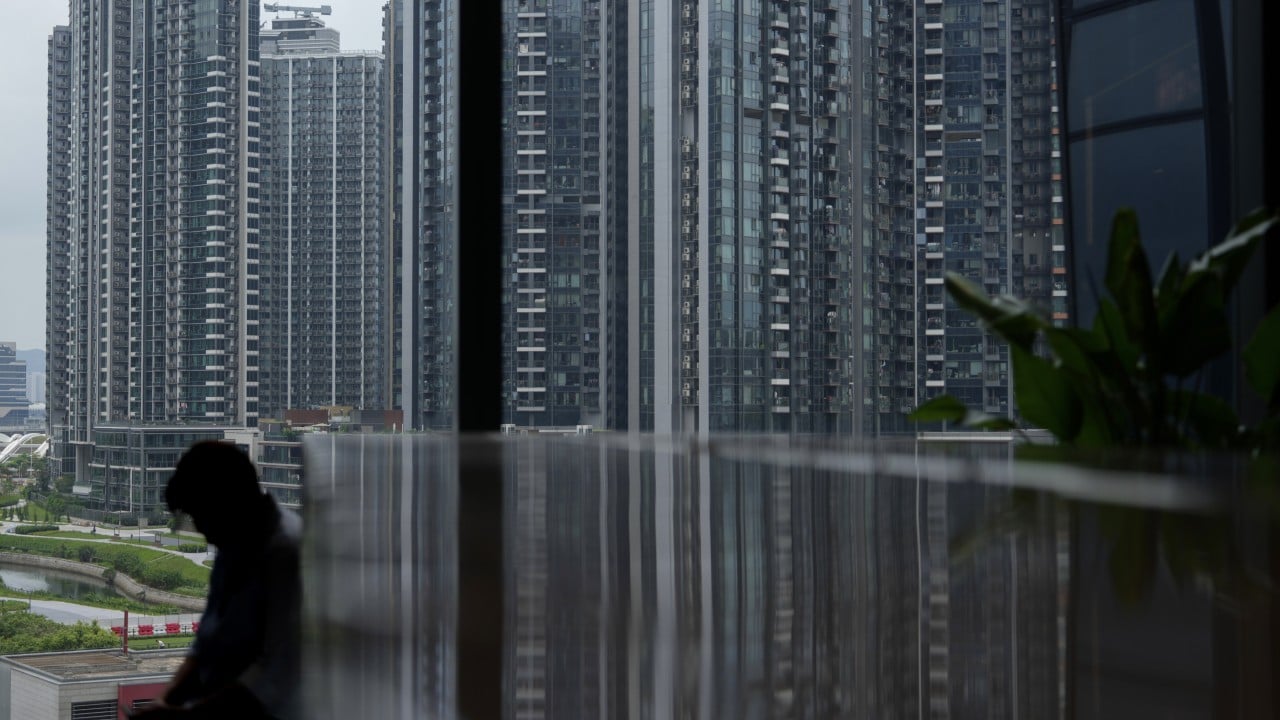
Evening falls over Mid-Levels. The lights inside the luxury towers flick on, one by one. But many windows remain dark, owned by corporations or absent investors who treat these vertical columns of concrete as vaults rather than homes.
Mr. Chen leaves the apartment building without signing the contract. He tells the broker he needs more time to consult with his financial advisors, but both men know what that means. The money cannot move. The risk is too high.
The high-end real estate market here was built on the assumption that the border between Hong Kong and the mainland would always remain financially porous, even as it tightened politically. That assumption is proving to be a historical anomaly. The invisible wall is hardening.
What remains is a market searching for a new identity. Deprived of the frantic, speculative capital from across the border, Hong Kong real estate must eventually adjust to a sobering reality. Prices will have to reflect what local incomes and legitimate international capital can actually support. That transition will not be smooth, and it will not be quiet.
The golden era of the frictionless cash suitcase is over, and the city’s concrete towers are left waiting for a tide that may never return.


