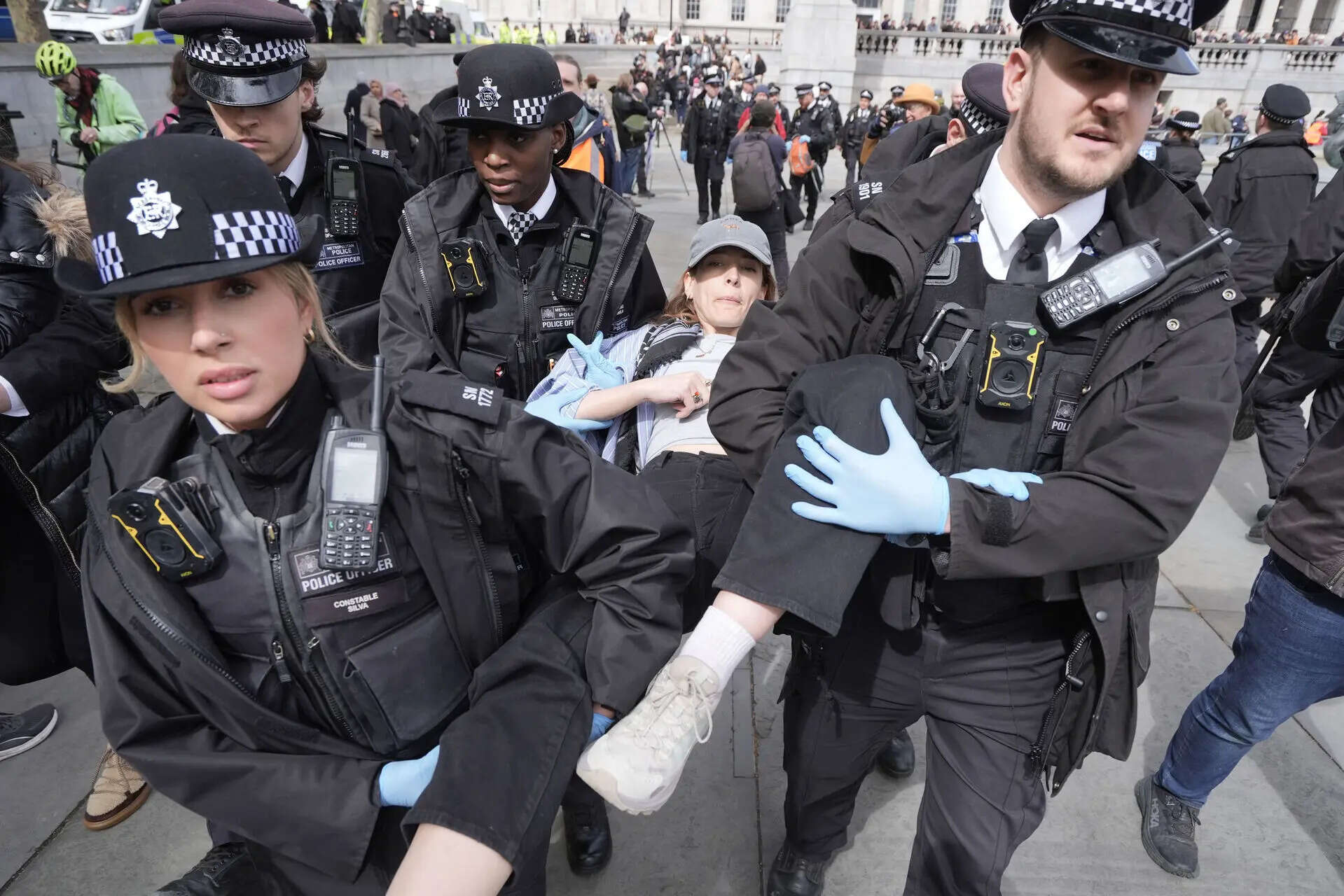
Mass arrests are not a badge of honor. They are a failure of imagination.
The headlines are predictable. "Over 500 Arrested in London Pro-Palestine Rally." The mainstream media frames it as a clash of civilizations. The activists frame it as a heroic stand against an oppressive state. Both sides are wrong. What we witnessed in London wasn't a revolutionary moment; it was a ritualized performance that serves the status quo more than it challenges it.
I have spent two decades watching movements rise and rot from the inside. I have seen groups burn through millions in donations only to end up as a footnote in a police report. When you see 500 people hauled off in plastic zip-ties, you aren't seeing a movement gaining momentum. You are seeing a movement that has traded actual political leverage for the cheap dopamine hit of "awareness."
The Arrest Fetish and the Fallacy of Visibility
The "lazy consensus" among modern organizers is that volume equals victory. If we get enough people in the street, if we block enough bridges, if we get enough people processed through Charing Cross Police Station, the "powers that be" will simply have to listen.
This is a tactical hallucination.
In the current political climate, mass arrests are a solved problem for the state. The Metropolitan Police have a line item in their budget for this. They have a playbook. They have transport ready. They don't fear your arrest; they've commodified it. Every time an activist goes limp and waits to be carried off, they aren't "clogging the system." They are participating in a pre-approved choreography that allows the government to look "tough on crime" while ensuring the actual machinery of foreign policy remains untouched.
Real disruption doesn't look like a crowd of 500 people waiting to be processed. Real disruption is quiet, surgical, and impossible to ignore. If you want to change policy, you don't fight the police; you make the cost of maintaining the status quo higher than the cost of changing it. Arrests are a low-cost tax the state is more than happy to pay.
The Mathematical Failure of Street Theater
Let’s look at the cold numbers. Assume 500 people are arrested. Each person spends roughly 12 to 24 hours in custody. That is 6,000 to 12,000 man-hours of activist energy evaporated in a single weekend. Add in the legal fees, the court dates, and the administrative burden on the organizing groups.
What was the return on that investment?
- Policy Change: Zero.
- Diplomatic Shift: Zero.
- Media Narrative: Fixed on the "chaos" rather than the cause.
The competitor articles love to focus on the "record-breaking" nature of these numbers. They want you to believe that 500 is a big number. It isn't. In a city of nearly nine million, 500 people is a statistical rounding error. By framing the success of a rally through the lens of police intervention, activists have handed the scorecard to their opponents. If the police decide not to arrest anyone next time, does that mean the protest failed? By these metrics, yes. And that is an intellectual trap.
The Institutionalized Protest Trap
We have entered the era of the "Professional Protester," a niche where the goal is no longer to win, but to sustain the movement’s own existence.
I’ve sat in the backrooms where these rallies are planned. There is a specific type of consultant who views a mass arrest as a "fundraising opportunity." They know that a photo of a grandmother being led away by four officers in riot gear will generate more clicks and donations than a 50-page policy brief on arms export licenses.
This is the "NGO-ification" of dissent. When a movement prioritizes its brand over its objective, it stops being a threat and starts being a hobby. The London rallies have become a social calendar event. You show up, you see your friends, you shout the slogans, you get your photo for the 'gram, and if you're feeling particularly "radical," you let a PC take you to the van.
But ask yourself: Who is actually inconvenienced? Not the Cabinet ministers. Not the arms manufacturers. Not the diplomats. The only people inconvenienced are the commuters who have nothing to do with the policy, and the activists who now have a criminal record that will limit their ability to influence institutions from the inside later in life.
Why "Raising Awareness" is a Dead Strategy
The most common defense for these chaotic rallies is that they "raise awareness."
This is the most tired, ineffective trope in the activist toolkit. In 2026, nobody is "unaware" of the conflict in the Middle East. There is no person walking down Oxford Street who says, "Oh, I had no idea there was a war going on until this bus was delayed."
Information is no longer the bottleneck. Power is.
The "Awareness" model assumes that if the public knows about an injustice, they will demand change, and the government will provide it. This assumes a functioning, responsive democracy that prioritizes public sentiment over strategic interests. That is a fantasy.
If you want to move the needle, you have to move the money.
The Contrarian Alternative: Strategic Attrition
So, what does a "superior" strategy look like? It’s not a bigger rally. It’s not 1,000 arrests.
It is the transition from expressive politics to instrumental politics.
Expressive politics is about how you feel. It’s about "speaking truth to power." It’s loud, it’s emotional, and it’s usually useless. Instrumental politics is about getting what you want. It’s cold, it’s calculated, and it’s often boring.
- Targeted Economic Disruption: Instead of a general rally in Central London, imagine 500 people identifying the specific logistics hubs of companies directly involved in the supply chain. Don't get arrested. Just make the delivery of a single component impossible for 48 hours. Repeat.
- Institutional Infiltration: I’ve seen more change happen because three mid-level civil servants decided to leak documents than because 100,000 people marched through Hyde Park. Real power is shifted by those who understand the levers of the machine, not those who throw rocks at it from the outside.
- The "Boring" Work of Law: The 500 people arrested in London would have been more effective if they had spent those 12,000 man-hours crowdfunding and researching targeted judicial reviews. Litigation is expensive and slow, but a high court injunction carries more weight than a thousand cardboard signs.
The High Cost of the Moral High Ground
The hardest truth for activists to swallow is that being "right" is not a strategy. You can be 100% morally correct and still be 100% politically irrelevant.
The London arrests are a symptom of a movement that has mistaken activity for achievement. We see this in every major social upheaval of the last decade. From Occupy to Extinction Rebellion, the pattern is the same: a massive spike in arrests, a flurry of media coverage, and then... nothing. The laws don't change. The money keeps flowing. The arrests become a memory, and the "leaders" move on to the next crisis.
If you are one of the people who thinks 500 arrests is a sign of "strength," you are the reason the movement is stalling. You are valuing the theater of the struggle over the reality of the win.
The state isn't afraid of your arrests. They aren't afraid of your slogans. They are afraid of the day you stop shouting and start organizing where it actually hurts: their bottom line and their legal immunity. Until then, you're just providing the Metropolitan Police with a very expensive training exercise.
Stop seeking the handcuffs. Start seeking the win.