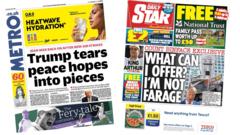
The modern news consumer is forced to live in two entirely different worlds at the exact same moment. On one side of the layout, global annihilation threatens the fabric of civilization as regional conflicts threaten to cross nuclear thresholds. On the other side, an individual dressed as an intergalactic trash can is offering exclusive insights into the democratic process. This is the reality of the British press review, a nightly ritual where existential dread and low-rent political satire fight for the same limited pool of human attention.
When the national press leads with a screaming headline about a Middle Eastern conflict being back on, alongside a feature profile on a joke candidate, it reveals a profound crisis in how information is produced and digested. It is not an accident of layout design. It is a calculated strategy born of financial desperation and a profound misunderstanding of public psychology. The press can no longer afford to present the world as it is, so they present it as an amusement park where the rides are either lethal or deeply ridiculous.
The Economics of Juxtaposition
National newspapers are trapped in an existential fight for survival. The traditional subscription model is largely dead, replaced by an attention economy that rewards extreme emotional volatility. To keep a reader engaged, a publication must trigger a rapid succession of conflicting neurochemical responses. Terror sells newspapers, but absolute terror causes people to look away out of sheer exhaustion.
The industry solves this by deploying a deliberate emotional counterbalance. By placing a story about geopolitical collapse directly next to a lighthearted political caricature, the editors create a psychological release valve. The reader is given a dose of adrenaline, closely followed by a dose of cynical amusement. This mechanism prevents the audience from turning off the screen or putting down the paper. It treats catastrophic international relations and localized political performance art as equivalent products on a supermarket shelf.
This flattening of value has a devastating effect on serious public discourse. When an escalating war is given the same visual weight as a novelty campaign, the serious story is cheapened, and the trivial story is falsely elevated. The audience is conditioned to view both events through the same lens of detached entertainment. War becomes a spectator sport with its own recurring characters and seasons, while domestic politics descends into an outright costume party.
Manufacturing the Endless Crisis
The phrase indicating that a major conflict is back on implies that it was ever truly off. This is the core deception of the rolling news cycle. Geopolitical tensions do not pause when the cameras look away, yet the media requires distinct narrative arcs to maintain audience interest. A conflict must be declared over so that it can be dramatically revived when a slow news day demands a headline that jumps off the newsstand.
+-------------------------------------------------------------------+
|                        THE ATTENTION TRAP                         |
|                                                                   |
|  [ Existential Threat ]   ======>   Creates intense reader panic   |
|          ||                                                       |
|          \/                                                       |
|  [ Absurd Satire ]        ======>   Prevents audience burnout     |
+-------------------------------------------------------------------+
Editors rely on a specific vocabulary to communicate urgency without providing actual substance. They use short, declarative statements that evoke historical trauma while offering zero historical context. By framing complex international disputes as simple, binary grudge matches, the press avoids the hard work of explaining foreign policy, trade routes, or diplomatic failures. It is much easier to print a bold warning of imminent disaster than it is to analyze the economic sanctions or regional alliances that actually dictate global stability.
This approach creates an environment of perpetual anxiety. Readers are left with a vague sense of impending doom but no actual understanding of why the world is unstable. They are given just enough information to feel terrified, but not enough to feel informed. The resulting powerlessness makes the public highly receptive to the second half of the media equation, which is the comforting embrace of total absurdity.
The Weaponization of British Eccentricity
Satirical candidates have a long and storied history in British politics, serving as a vital mechanism for mocking the self-importance of the ruling class. However, the media relationship with these characters has undergone a dangerous shift. What used to be a marginal joke designed to humiliate career politicians has been transformed into a mainstream media commodity.
The press loves these novelty campaigns because they provide easy content that requires minimal investigative effort. Interviewing a person in a fiberglass costume about their fictional manifesto is safe, cheap, and guaranteed to generate social media engagements. It allows news outlets to project an image of self-deprecating wit while completely avoiding the difficult, expensive work of holding real power holders to account.
While the public laughs at the spectacle of a novelty candidate standing on a stage next to a future Prime Minister, the actual structures of governance are left unexamined. The joke candidate becomes a lightning rod that absorbs public anger and channels it into harmless laughter. Instead of demanding better representation, the electorate is encouraged to treat the entire democratic system as a farce. The media profits from this cynicism, building entire broadcast segments around the spectacle while public trust in actual democratic institutions rots away from the inside out.
The Collapse of the Editorial Filter
Decades ago, the line between serious journalism and supermarket tabloids was clearly defined. Broadsheets handled international diplomacy and economic policy, while the tabloids focused on celebrity gossip and human interest stories. That distinction has been utterly obliterated by the need for digital traffic.
Every major news outlet now competes in the same arena, using the exact same metrics to measure success. A high-minded analysis of international relations must compete for clicks with a video of a political stunt. The inevitable result is a race to the bottom, where serious journalism is forced to adopt the sensationalist tactics of the tabloid press just to remain visible in the feed.
- Sensational Headlines: Real events are stripped of nuance to maximize emotional impact.
- Context Flattening: Global crises and local stunts receive identical visual treatment.
- Outrage Cycle: Stories are selected based on their ability to provoke immediate anger or amusement rather than their actual societal importance.
This institutional decline is exacerbated by the shrinking headcount in modern newsrooms. Investigative journalism takes time, money, and legal protection. A profile of a satirical candidate takes an hour and carries zero legal risk. When financial pressures mount, editors consistently choose the path of least resistance, filling their pages with pre-packaged public relations material and superficial spectacles while letting deep systemic corruption go unchecked.
The Deeper Consequences for Public Intellect
The constant exposure to this mixed media diet has fundamentally altered how the public processes reality. When real human suffering is presented as just another item in a fast-moving news feed, society develops a collective numbness. The brain cannot transition from a genuine fear of global conflict to amusement at a political stunt without losing some capacity for empathy along the way.
This desensitization is the true victory of the modern media apparatus. A public that is perpetually distracted, confused, and amused is a public that poses no threat to the status quo. By turning the news into a chaotic variety show, the press has abandoned its historic role as the fourth estate. It no longer informs the public; it merely manages their emotional states to maximize ad revenue.
The solution is not to ban humor or to pretend that the world is not a terrifying place. The solution demands a total rejection of the flattened, sensationalized presentation of reality that dominates current journalism. Audiences must begin to demand a clear boundary between real news and cheap entertainment. If the press refuses to provide that distinction, they will find themselves ruling over an empire of noise, where nothing matters, nothing is true, and everything is just another joke on the front page.