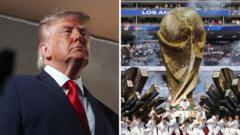
The mainstream sports media is currently obsessing over a non-event, churning out breathless explainer videos and articles asking why Donald Trump isn't sitting in a luxury suite at the World Cup. They treat his absence like a massive political snub or a logistical failure. It is neither.
The entire premise of the question is flawed. It relies on a lazy, outdated understanding of how global sports diplomacy operates and completely misreads the actual relationship between executive political power and international soccer.
Mainstream commentators love to frame a US President's attendance at a major sporting event as a mandatory display of soft power. They trace this back to historical moments where leaders used the pitch for geopolitical posturing. But the modern World Cup is not a 1970s diplomatic summit. The expectation that a polarizing political figure should—or even would want to—occupy a front-row seat at a month-long global tournament misses the mechanical reality of how these massive events are run and who they are actually for.
The Myth of the Mandatory Presidential Fanboy
Let's dismantle the first piece of conventional wisdom: the idea that a nation's leader must show up to validate a tournament.
Historically, American presidents have treated soccer as a secondary concern, usually dispatching vice presidents, first ladies, or low-level diplomatic delegations to handle the ceremonial handshakes. Bill Clinton didn't spend his summer lounging in the stadiums during the 1994 World Cup hosted on American soil, despite his administration heavily backing the bid.
The media's current fixation ignores a fundamental rule of political optics. A stadium filled with eighty thousand unpredictable, international sports fans is a security nightmare and an unpredictable PR environment. For a figure who commands intense, split-screen public reactions, stepping into a venue where the crowd's response cannot be scripted or controlled is an unnecessary liability. The lazy consensus says a leader stays away due to a lack of interest or a diplomatic breakdown. The sharper reality is that the modern executive branch treats these events as high-risk, low-reward environments.
FIFA Runs the Show Not Washington
To understand why any major political figure skips these matches, you have to understand who actually holds the leverage. Hint: It isn't the White House.
FIFA operates as a sovereign entity during the tournament. When a country hosts or participates in a World Cup, they sign strict agreements that essentially hand over control of the venues, marketing, and local ordinances to Zurich. Dictating which politicians get top billing or how they are featured on the global broadcast is entirely within FIFA's purview.
Imagine a scenario where a head of state arrives at a match, expecting the broadcast to center around their presence, only for the governing body's strict production guidelines to minimize their camera time to a brief, five-second cutaway between commercials. Political teams know this. They know that inside those stadiums, the brand of the sport eclipses the brand of any individual politician.
I have watched organizations waste millions of dollars trying to force political messaging into major sporting arenas, only to watch it get swallowed whole by the raw, tribal nature of sports fandom. The crowd does not care about domestic policy; they care about the offside rule.
Dismantling the Soft Power Delusion
The media constantly pushes the narrative that international sports tournaments are the ultimate arena for soft power. They tell you that a leader's presence on the global stage cements alliances and projects national strength.
This is an illusion. True diplomatic maneuvering happens in quiet rooms years before the opening whistle blows. The actual work of bringing a tournament to a country involves intense lobbying, infrastructure deals, and corporate partnerships. By the time the players take the field, the geopolitical transactional value of the event has already been extracted.
Showing up to wave from a VIP box is pure theater. It adds zero value to a nation's strategic standing. Pretending that a leader's absence somehow damages a country's international reputation is a viewpoint held only by people who write op-eds for a living and have never sat in a closed-door negotiation.
The Real Cost of the VIP Circus
When a head of state travels, they bring a logistical circus that disrupts everything it touches.
- The Security Footprint: Secret Service advances, armored motorcades, and airspace restrictions don't just cost millions; they actively infuriate local organizers who are already managing strained transportation networks.
- The Fan Experience: Sweeping stadium lockouts and credential checks alienate the core ticket-buyers who paid thousands to see a game, not a political rally.
- The Media Distraction: The press corps shifts its focus from the athletes to the political narrative, ruining the narrative arc of the tournament itself.
A seasoned political strategist looks at that equation and realizes the smartest move is to stay away and let the event function on its own merits.
Stop Asking the Wrong Question
The public keeps asking "Why isn't he there?" because the media has conditioned them to expect constant, peak-spectacle saturation. The correct question is "Why on earth would he go?"
There is no electoral upside. There is no policy victory to be won on a soccer pitch. The fans don't want the distraction, the organizers don't want the logistical headache, and the political team doesn't want an unscripted crowd reaction broadcast to hundreds of millions of people.
The assumption that global leaders should treat the World Cup like a mandatory corporate retreat is a relic of an era when sports and politics could be easily sanitized for a domestic audience. That era is dead. Stop looking for political significance in an empty stadium seat and realize that sometimes, a sports tournament is just a sports tournament.