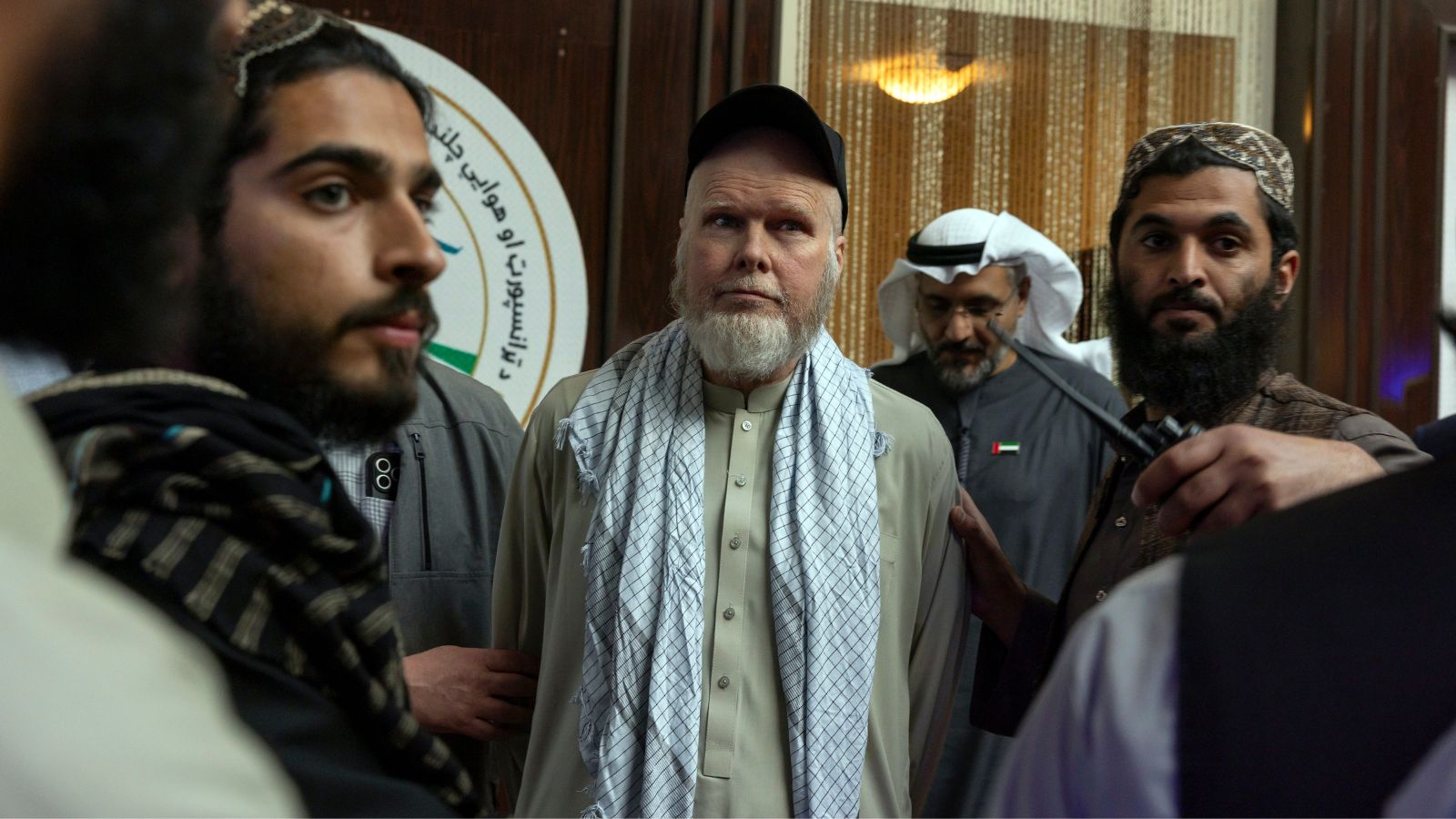
On Tuesday, March 24, 2026, a 64-year-old academic named Dennis Walter Coyle walked onto the tarmac of Kabul International Airport. He was thin, blinking against the harsh Afghan sun, and officially a free man for the first time in 411 days. For more than a year, Coyle—a Colorado researcher who had spent two decades documenting Afghan languages—existed in a windowless basement, his world reduced to a floor mat and the sounds of the Taliban’s General Directorate of Intelligence (GDI) moving through the halls above him.
His release, framed by the Taliban as a "humanitarian gesture" for Eid al-Fitr, is nothing of the sort. It is the conclusion of a cold, calculated transaction in the world of hostage diplomacy. While the Coyle family finally celebrates his return to Pueblo, the mechanics of his release reveal a terrifying blueprint for how the Taliban intends to deal with the West. This was not a legal victory or a sudden burst of mercy; it was a calibrated move by a regime that has perfected the art of using human beings as geopolitical currency.
The Language of Capture
Dennis Coyle was not a spy. He was a man obsessed with the nuance of Pashto and Dari, a scholar who stayed in Afghanistan through the 2021 withdrawal because he believed his work was apolitical. He was wrong. In January 2025, just days after the Taliban released another American, Ryan Corbett, Coyle was snatched from his Kabul apartment.
The timing was deliberate. The Taliban’s GDI, staffed by many former detainees from Guantanamo Bay and Bagram, operates with a long memory. They don't just arrest; they curate a portfolio of assets. By taking Coyle almost immediately after Corbett’s departure, the GDI sent a clear message to the State Department: the door to Kabul is never closed, but the price of entry is a perpetual cycle of negotiations.
Coyle’s "crimes" were never specified in a court of law. Instead, he was held in near-solitary confinement, a "valuable asset" according to internal intelligence sources. For the first nine months, his family didn't even know if he was breathing. When the silence finally broke, it came in the form of a heavily monitored 10-minute phone call. His sisters—Molly, Amy, and Patti—spent the next year navigating a labyrinth of federal bureaucracy and back-channel diplomacy, eventually pushing Secretary of State Marco Rubio to designate Afghanistan as a State Sponsor of Wrongful Detention on March 9, 2026.
The UAE and the Middlemen of Kabul
The Taliban rarely does anything directly. Coyle’s release was facilitated by the United Arab Emirates and Qatar, the two primary conduits for Western interests in a country where the U.S. has no official embassy. Saif Al Ketbi, Abu Dhabi’s special envoy, stood on the tarmac in Kabul as Coyle was handed over.
While the Taliban claims the Supreme Court simply decided Coyle had "served enough time," the reality is far more transactional. Just weeks ago, the Trump administration designated Afghanistan under a new blacklist for wrongful detention. The pressure was mounting. But there is always a "give" for every "take." In previous instances, such as the release of George Glezmann, the U.S. reportedly dropped multi-million dollar rewards for Taliban officials. While the exact price for Coyle remains obscured in the classified briefings of the National Security Council, the presence of former U.S. Special Representative Zalmay Khalilzad in Kabul just days before the release suggests that a broader roadmap for "trust building" was the actual currency.
The Missing Names in the Shadows
While the world watches Coyle fly toward a reunion with his 83-year-old mother, the celebration is haunted by the names the Taliban refuses to acknowledge.
- Mahmood Shah Habibi: A U.S.-Afghan businessman who vanished in 2022. The FBI insists he is in Taliban custody; the Taliban simply denies his existence.
- Paul Edwin Overby Jr.: An author who disappeared in Khost in 2014.
By releasing Coyle, the Taliban attempts to "clear the deck" of a high-profile liability while maintaining a grip on others who provide longer-term leverage. It is a rotating door. As soon as one American is freed, the threat to those remaining—humanitarians, researchers, and dual citizens—intensifies.
The Cost of the Long Game
The Taliban's strategy is working. By holding a gentle academic like Coyle, they forced the highest levels of the U.S. government to engage with them. They turned a basement in Kabul into a bargaining table where they could demand legitimacy, the unfreezing of assets, or the removal of terror designations.
Coyle’s survival is a testament to his own resilience and his family’s relentless advocacy, but his ordeal serves as a warning. The GDI has mapped the American political landscape with precision. They know that a second-term Trump administration is keen on "bringing the boys home," and they are happy to sell those homecomings one by one, provided the price is right.
This isn't just about one man’s freedom. It is about a regime that uses the judicial process as a veil for extortion. They didn't release Coyle because he was innocent; they released him because his utility as a prisoner had been exhausted, and his value as a "goodwill gesture" was currently trading higher.
The plane carrying Dennis Coyle will eventually land in Colorado. He will see the fire towers of Beulah Mountain Park again. He will drink tea that isn't served through a slot in a door. But for the Americans still hidden in the basements of Kabul, the clock has just reset.
Ask yourself what the next "goodwill gesture" will cost.