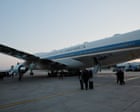
The operational architecture of presidential transport relies on an absolute alignment between threat landscape assessment and hardware capability. When a president alternates between executive airframes during active international operations, public explanations rarely reflect the underlying defensive realities. The decision to repatriate the president from a NATO summit in Turkey aboard a legacy Boeing VC-25A while routing the newly retrofitted interim Boeing 747-8 ("bridge aircraft") separately via RAF Mildenhall demonstrates a calculated risk-mitigation strategy executed under heightened geopolitical friction.
Public narratives frame the aircraft routing as a morale-boosting exhibition for military personnel stationed in the United Kingdom. However, an analysis of the electronic warfare suites, countermeasure gaps, and immediate threat vectors reveals that this logistical pivot aligns with standard military doctrine regarding the preservation of command-and-control continuity. For a different view, see: this related article.
The Core Technical Discrepancy: Legacy VC-25A vs. Interim Bridge Aircraft
The United States Air Force utilizes distinct protocols for outfitting executive transports. Evaluating the two airframes requires analyzing their specific engineering baselines rather than their aesthetic finishes.
The Cold War Baseline: Boeing VC-25A
The legacy Air Force One fleet consists of heavily modified Boeing 747-200B platforms engineered during the late Cold War. Their design prioritizes survival during high-intensity conflict, featuring: Further coverage on this trend has been provided by The Washington Post.
- Nuclear Blast Hardening: The fuselage and wiring are shielded against Electromagnetic Pulses (EMP) to preserve analog and digital flight controls.
- Integrated AN/ALQ-204 Matador Infrared Countermeasures: This system protects the aircraft from heat-seeking surface-to-air and air-to-air missiles by emitting modulated infrared energy to disrupt missile tracking systems.
- Directional Infrared Countermeasures (DIRCM): Automated sensor arrays detect incoming missile plumes and track them with a laser turret to blind the weapon’s optical guidance seeker.
- Airstairs and Autonomous Support: Independent boarding stairs and cargo loaders eliminate reliance on foreign ground support equipment, minimizing tarmac vulnerability.
The Interim Solution: The Qatari-Donated 747-8
The new addition to the fleet is a commercial Boeing 747-8 originally configured for royal transport by the Qatari government. Modified by defense contractor L3Harris Technologies via a $400 million fast-track program, this "bridge" aircraft serves to fill the operational gap left by the multi-year delays confronting the next-generation VC-25B program, which is deferred until at least 2028.
The rapid conversion of the commercial airframe created structural trade-offs. The U.S. Air Force acknowledged that several complex engineering modifications required for the final VC-25B configuration were excluded from the bridge aircraft to speed up its deployment. Photographic evidence and defense analyst reviews confirm notable omissions:
- Fewer Comm Antennas: The skin of the aircraft shows a simplified antenna array, indicating a less redundant communications layout compared to the legacy platform.
- Absence of External Countermeasures: The visible laser turrets and sensor enclosures characteristic of the AN/ALQ-204 and DIRCM suites are missing or minimized, making the airframe dependent on standard commercial-grade safety or restricted, low-profile defensive systems.
Geographic and Geopolitical Threat Mechanics
Air routing from Ankara Esenboga Airport introduces specific tactical vulnerabilities that dictate aircraft selection. Turkey shares a direct land border with Iran, creating a theater where airspace proximity exposes high-value assets to regional tracking and electronic observation.
[Ankara Airspace] ---> Proximity to Border ---> Electronic Surveillance Window
                                  |
                                  +--> [Legacy VC-25A]: Transponder Deactivation (En Route to UK)
                                  +--> [Bridge Jet]: Separate Routing / Commercial Signature
The flight occurred less than 24 hours after the U.S. Military conducted over 80 retaliatory strikes against hostile targets in western Asia following attacks on regional merchant shipping. This escalation altered the regional Electronic Warfare (EW) environment.
A primary indicator of tactical caution during the departure from Turkey was the handling of flight transponders. While allied aircraft from the United Kingdom and Germany operated with active Automatic Dependent Surveillance-Broadcast (ADS-B) signals, the legacy VC-25A carrying the president suppressed its tracking data shortly after takeoff. This operational security protocol is reserved for high-risk airspace entries to deny real-time targeting coordinates to ground-based radar and SIGINT (Signals Intelligence) collection stations.
The Strategic Allocation of Vulnerability
Deploying the bridge aircraft to RAF Mildenhall without the president on board aligns with asset-preservation logic. In high-threat corridors, defensive capabilities take precedence over cabin volume or range.
The legacy VC-25A maintains an onboard operating theater, robust defense networks, and structural EMP hardening, making it the preferred command post when operating near contested borders during active hostilities. The bridge aircraft, lacking these fully realized survivability systems, represents a higher risk profile if forced to operate in proximity to state-level EW networks or radar tracking.
Routing the new aircraft along an independent, lower-risk corridor to Western Europe allowed the administration to manage three operational priorities simultaneously:
- Deterrence Verification: Testing the bridge aircraft’s basic international transit performance in low-threat airspace.
- Information Management: Providing a public, morale-focused justification (the troop tour) to explain why the newest asset was detached from the president.
- Risk Mitigation: Ensuring the head of state remained protected by a mature, fully retrofitted defense suite while transiting airspace near active regional conflicts.
The temporary transition back to the older VC-25A underscores the reality of presidential transport: an executive aircraft is an instrument of national command continuity before it is a symbol of state diplomacy. When regional threat indicators spike, procurement speed and cosmetic updates are set aside in favor of proven survivability systems. L3Harris and the U.S. Air Force will need to determine whether the bridge aircraft requires further structural modifications before it can be deployed as the primary asset in non-permissive international environments.