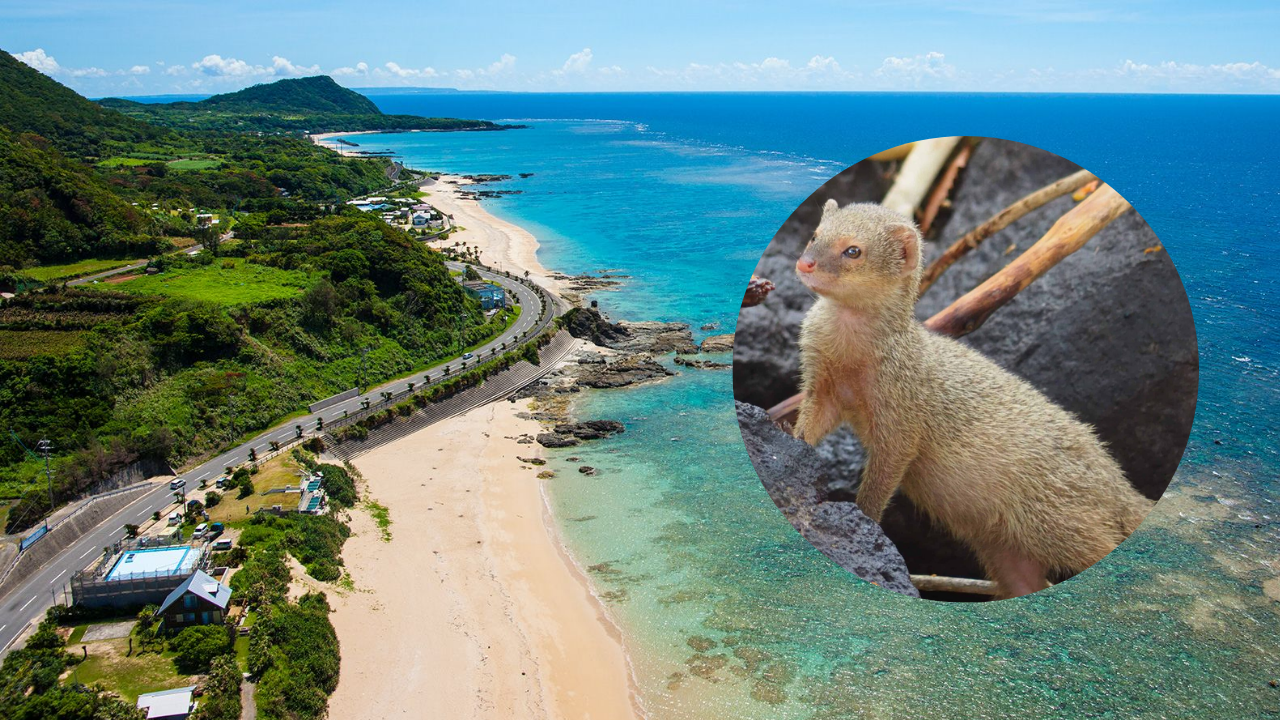
In 1979, roughly thirty small Indian mongooses were dumped into the lush forests of Amami Oshima. The official objective possessed a dangerous simplicity. Eradicate the venomous habu snakes threatening local residents and agricultural workers. Bureaucrats looked at a perceived ecological nuisance, found a textbook biological control agent from a catalog of imported predators, and signed off on the shipment.
They failed to account for basic evolutionary dynamics.
Habu snakes are nocturnal, arboreal, and hunt by thermal sensing. Mongooses are diurnal, ground-dwelling hunters that rely entirely on sight. The two species barely crossed paths in the dark understory. Instead of hunting the venomous snakes, the introduced predators found an easier buffet. Endemic species like the Amami rabbit, an ancient lineage found nowhere else on earth, provided effortless calories. Ground-nesting birds and endangered reptiles vanished into the digestive tracts of an animal that should never have set foot on the island.
This is the anatomy of a conservation failure. When human impatience meets complex ecosystems, the resulting damage compounds exponentially over decades.
The Mechanics of an Ecological Miscalculation
Ecological management has a long history of human hubris. Time and again, decision-makers assume that introducing a foreign predator functions like installing a software patch. You identify a bug, you deploy a fix, and the system stabilizes. Nature rejects this mechanical model entirely.
Amami Oshima sits in the Ryukyu archipelago of Japan. It is an isolated ecosystem featuring high endemism. Evolution worked in relative isolation there for millennia, leaving local wildlife without behavioral defenses against fast, aggressive mammalian carnivores.
When the mongooses arrived, they did not face food scarcity. They faced an absolute abundance of naive prey.
- The Amami rabbit population plummeted as ground burrows were raided.
- Native amphibians and insects experienced sudden, unbuffered predation pressure.
- The targeted habu snakes largely ignored the new arrivals, maintaining their population densities in the rocky terrain.
By the time authorities realized the eradication strategy had inverted into an ecological disaster, the population of mongooses had exploded from thirty individuals into thousands. They spread across the rugged terrain, crossing ravines and scaling steep forested ridges with total impunity.
The Anatomy of the Cleanup
Fixing a biological blunder costs exponentially more than creating one. Decades later, environmental agencies had to mount a massive, systematic counter-offensive just to undo the damage of that single 1979 shipment.
The strategy required patience, funding, and cold-blooded pragmatism. In the early 2000s, conservationists formed specialized removal teams. They deployed thousands of traps across the island. They utilized trained detector dogs capable of sniffing out a solitary mongoose hiding beneath dense root systems.
The operation transformed into a war of attrition.
Every single animal removed represented a massive investment of labor and capital. Traps had to be monitored daily. Bait had to be refreshed against the rotting humidity of the subtropical climate. Funding fluctuated with political attention spans, while the animal populations adapted to avoidance behaviors.
Progress crawled at a glacial pace. Years passed before researchers detected measurable recovery in the local fauna. Amami rabbits slowly began reclaiming territory they had abandoned decades prior. The silence in the forests began to lift as birds returned to areas previously scoured clean by the predators.
The Permanent Cost of Shortcuts
The Amami Oshima mongoose project serves as a stark warning for modern environmental management. Ecosystems do not negotiate with human deadlines. When communities face pressure from dangerous wildlife or agricultural pests, the temptation to deploy silver-bullet biological agents remains remarkably high.
History shows that convenience is an expensive illusion. Every introduced species carries a hidden ledger of unintended consequences. Once a foreign organism establishes a foothold in a receptive environment, the timeline for correction stretches across generations.
The traps on Amami Oshima eventually turned the tide, but the island's ecological baseline changed forever. Some extinct local variants are gone permanently, casualties of a bureaucratic afternoon in 1979 when thirty animals were let loose in the dark.