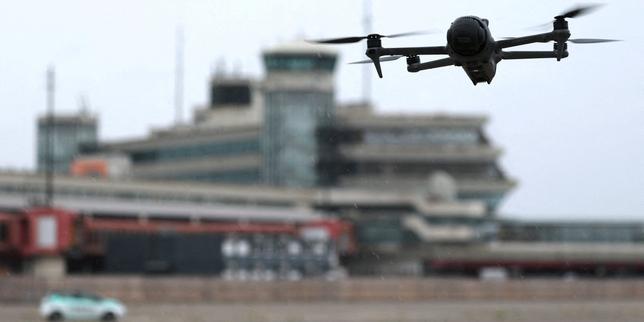
A two-hour operational halt at Genoa Cristoforo Colombo Airport on a Thursday evening demonstrates a severe asymmetry in modern aviation security. Consumer-grade unmanned aerial vehicles (UAVs) costing under a thousand euros can force the immediate suspension of multimillion-euro commercial flight infrastructure. To understand why a visual sighting of drones near a runway triggers total paralysis rather than a localized surgical response, analysts must examine the intersection of kinetic collision physics, regulatory liability frameworks, and the structural limitations of primary surveillance radar.
When air traffic control (ATC) receives a credible report of unauthorized drones within an Aerodrome Traffic Zone (ATZ), the decision to close the airspace is binary. Aviation safety protocols operate on zero-tolerance risk thresholds during critical phases of flight, specifically takeoff and final approach. Unlike commercial airliners, which broadcast their position via transponders (ADS-B) and present large radar cross-sections (RCS), small commercial or custom-built quadcopters lack cooperative identification systems and possess minimal metallic surface area. Once a sighting occurs, controllers lose situational awareness of the intrusion vector. Because the drone’s trajectory, altitude ceiling, and operator intent remain unknown variables, keeping the runway open exposes every departing and arriving hull to an unquantified collision hazard. In related developments, we also covered: What Most People Get Wrong About the New UK and EU Trade and Youth Mobility Deals.
The Physics and Economics of Small UAV Incursions
Standard journalistic coverage of airport closures typically frames the event around passenger inconvenience and flight delays. That framing misses the underlying engineering and economic mechanisms dictating the shutdown.
Kinetic Impact Mechanics
The primary driver of an immediate ground stop is the catastrophic vulnerability of high-bypass turbofan engines to foreign object debris (FOD). While aircraft windshields and airframes undergo rigorous bird-strike certification—tested against soft-tissue projectiles of specific mass—drones present a fundamentally different structural threat. A consumer UAV contains dense, non-deformable components: lithium-polymer battery packs, brushless electric motors, and rigid carbon-fiber or polycarbonate frames. The Washington Post has analyzed this critical issue in great detail.
If a 1.5-kilogram drone is ingested into a turbine engine spinning at several thousand revolutions per minute, the dense battery core can shear compressor blades, causing an uncontained engine failure. During the takeoff roll or initial climb—when engines operate at maximum thrust and the aircraft has minimal altitude to recover—an engine failure compromises aerodynamic stability. The two-hour closure at Genoa reflects the time required to guarantee that the airspace volume is clear of these high-density projectiles.
The Cost Function of Airspace Paralysis
The economic asymmetry of a drone incursion is extreme. The operational cost of deploying an unauthorized drone is near zero, while the financial damage inflicted on the aviation ecosystem scales exponentially with every minute of closure. A two-hour suspension at a regional international hub like Genoa triggers a cascading sequence of financial losses across three distinct layers:
- Direct Airline Operating Costs: Aircraft caught in holding patterns burn excess fuel reserves, increasing direct variable expenses. If holding fuel approaches minimum diversion thresholds, flights must divert to alternate airports such as Milan Malpensa, Turin, or Pisa. A single diversion incurs landing fees, ground handling charges, crew overtime, and the logistical cost of repositioning the aircraft and passengers.
- Network Schedule Propagation: Modern commercial aviation relies on tight aircraft turnaround schedules. A two-hour delay on a Thursday evening disrupts the final rotation of the day, often causing flight crews to exceed legally mandated duty-time limits. When a crew times out, the airline must cancel the flight entirely, displacing passengers overnight and cascading delays into the Friday morning departure bank.
- Airport Infrastructure Revenue: Airport operators lose aeronautical fees tied to aircraft movements and passenger throughput, while simultaneously incurring unbudgeted overtime expenses for security personnel, ground handlers, and terminal operations staff managing stranded travelers.
Detection Bottlenecks and Why Mitigation Fails in Real Time
A persistent misconception among the public is that major airports possess military-grade defenses capable of instantly detecting and neutralizing rogue drones. In reality, civilian airports operate under strict electromagnetic and kinetic constraints that severely limit real-time counter-UAS (C-UAS) capabilities.
The Sensor Gap in Civilian Airspace
Traditional airport surveillance relies on Primary Surveillance Radar (PSR) and Secondary Surveillance Radar (SSR). SSR interrogates aircraft transponders; a rogue drone has none. PSR bounces radio waves off physical objects, but civilian PSR systems are calibrated with clutter filters designed to eliminate false positives from flocks of birds, weather phenomena, and ground vehicles. Because a small quadcopter exhibits a radar cross-section comparable to a large gull and flies at low altitudes, standard airport radar filters it out as environmental noise.
Consequently, detection at many European regional airports still depends heavily on human visual observation—pilots on final approach, tower controllers using binoculars, or ground security patrols. Visual detection is inherently flawed:
- Illumination Constraints: A Thursday evening incursion occurs during dusk or darkness, rendering visual tracking of dark-colored airframes nearly impossible once navigation LEDs are turned off or obscured.
- Depth Perception Errors: Observers on the ground or in a moving cockpit struggle to accurately judge the distance and altitude of a small object lacking standard reference dimensions. A drone flying legally outside the perimeter may appear to be encroaching on the glide path, or vice versa.
- Persistence Deficit: Once an observer loses sight of the UAV, ATC cannot verify whether the device has landed, flown away, or is hovering stationary in an active flight corridor. This uncertainty forces controllers to impose a conservative time buffer—often 30 to 60 minutes after the last confirmed sighting—before resuming operations, which explains why a brief sighting stretches into a two-hour shutdown.
Legal and Technical Constraints on Interdiction
Even when an airport deploys dedicated C-UAS sensors—such as radio-frequency (RF) analyzers that detect controller-to-drone telemetry links, or electro-optical/infrared (EO/IR) cameras—neutralizing the threat remains legally and technically perilous.
Kinetic interdiction, such as shooting down the drone or deploying net-capture interceptor drones, introduces falling debris over active runways or populated urban areas adjacent to the airport. Genoa Airport is built on an artificial peninsula jutting into the Ligurian Sea, bordered immediately by dense industrial infrastructure, highways, and residential districts. An uncontrolled descent of a disabled drone poses a direct hazard to ground personnel, fuel farms, and civilian property.
Electronic warfare measures, specifically RF jamming and GPS spoofing, carry equally severe risks within an airport environment. Broadcasting high-power jamming signals across the 2.4 GHz, 5.8 GHz, or GNSS frequency bands can interfere with critical airport navigation aids, Instrument Landing Systems (ILS), ground-to-air voice communications, and aircraft avionics. Under Italian and European aviation regulations (ENAC and EASA frameworks), airport operators do not hold unilateral authority to jam electromagnetic spectrum; that authority rests strictly with state law enforcement or military entities, introducing a bureaucratic response lag between detection and authorized interdiction.
Structural Mechanics of the Genoa Incident
Analyzing the specific operational profile of Genoa Cristoforo Colombo Airport clarifies why this specific incursion produced a prolonged disruption.
First, Genoa operates with a single runway (Runway 10/28). Multi-runway hubs like Frankfurt or Amsterdam can sometimes isolate an incursion to one sector while maintaining reduced operations on a parallel runway separated by several kilometers. At a single-runway facility, any incursion within the approach or departure funnel compromises 100 percent of airfield capacity immediately. There is no spatial redundancy.
Second, the geographic topography surrounding Genoa forces specific approach profiles. Bounded by the Apennine mountains to the north and the Ligurian Sea to the south, aircraft executing approaches to Genoa follow constrained corridors, particularly during instrument meteorological conditions or night operations. An unauthorized drone operating near the coastal perimeter or the port infrastructure sits directly beneath or adjacent to the final approach fix, leaving pilots zero lateral margin to maneuver around the hazard.
Third, the timing of the event—Thursday evening—coincides with the peak business travel return window and late-evening domestic feeder flights. Airspace capacity during this window is tightly scheduled, meaning the disruption hit maximum passenger load factors while leaving minimal recovery time before the airport's night operational curfews and airline crew duty limits took effect.
Differentiating Known Facts from Operational Hypotheses
Rigorous analysis requires separating verified operational outcomes from unconfirmed variables regarding the perpetrator and hardware involved.
Verified Operational Facts:
- Multiple visual sightings of unmanned aircraft occurred in the vicinity of Genoa Airport on Thursday evening.
- Air traffic control executed an immediate suspension of all arrival and departure operations to preserve flight safety.
- The airspace closure lasted approximately two hours, resulting in flight delays and diversions to regional alternate airports.
- Italian aviation authorities (ENAC) and law enforcement initiated an investigation to locate the operator.
Unverified Variables and Analytical Hypotheses:
- Operator Intent: Without apprehending the pilot or recovering the hardware, it is impossible to classify the incursion definitively as negligent recreational flying versus deliberate malicious disruption. However, historical data from similar European airport closures—including Gatwick (2018), Frankfurt (2019), and Madrid (2020)—indicates that over 85 percent of perimeter incursions stem from negligent hobbyists ignoring geofencing warnings or flying custom builds without awareness of controlled airspace boundaries, rather than coordinated state or activist sabotage.
- Hardware Capabilities: It remains unknown whether the sighted UAVs were off-the-shelf commercial models utilizing standard RF protocols or custom-built First-Person View (FPV) drones operating on non-standard frequencies without factory-installed geofencing. If the drones bypassed standard geofencing, it points toward either deliberate firmware modification or the use of open-source flight controllers (such as Betaflight or ArduPilot), which lack commercial no-fly-zone databases entirely.
- Number of Aircraft: Eyewitness reports during nighttime incidents frequently misinterpret a single maneuvering drone—or even misidentified manned aircraft, stars, or atmospheric phenomena—as multiple distinct targets. Unless correlated by RF telemetry logs, the exact count of distinct UAVs in the Genoa airspace remains an open investigative question.
Strategic Imperatives for European Regional Aviation
The Genoa shutdown proves that relying on passive airspace rules, mandatory drone registration, and manufacturer-installed geofencing fails to secure critical infrastructure against non-compliant actors. geofencing relies entirely on the cooperation of the hardware firmware; it is bypassed by any custom-built drone or modified commercial unit.
Airport operators and national aviation authorities must transition from reactive visual protocols to integrated, persistent airspace awareness architectures. Implementing a defensive posture requires executing three concrete operational shifts:
- Deploy Passive RF and Acoustic Sensor Grids: Single-runway regional airports must install networked arrays of passive RF direction-finders combined with acoustic sensors around the perimeter and along the extended runway centerlines. Passive RF detection does not emit energy, eliminates interference risks with aircraft avionics, and triangulates the physical location of the ground control station—allowing law enforcement to intercept the human operator directly rather than attempting to chase the drone in mid-air.
- Establish Pre-Authorized Interdiction Protocols: Aviation regulators (ENAC/EASA) and interior ministries must eliminate the command-and-control lag between airport operations and state police. Airport control towers require pre-approved, localized rules of engagement that authorize designated on-site law enforcement units to deploy directional RF mitigation or protocol-manipulation takeovers within strict spatial corridors without waiting for multi-agency escalation.
- Mandate Broadcast Remote ID Enforcement Infrastructure: While European Union regulations require new drones to broadcast Remote ID signals, the mandate is operationally useless unless airports deploy ground-based receivers integrated directly into ATC radar displays. Displaying cooperative Remote ID traffic alongside ADS-B data allows controllers to instantly distinguish authorized municipal or commercial drone flights from rogue intrusions, preventing unnecessary total closures caused by false alarms.
Until regional airports pair passive telemetry triangulation with rapid ground-level operator interdiction, a single non-compliant hobbyist will retain the unilateral capability to shut down international air transit corridors at will.