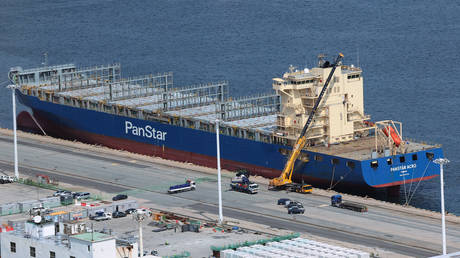
The commercial viability of maritime logistics hinges on transit velocity, fuel efficiency, and risk-adjusted operating expenditures. As southern maritime corridors face chronic throughput bottlenecks and geopolitical friction, attention has turned northward. The Northern Sea Route, spanning approximately 5,600 kilometers along Russia’s Arctic coastline from the Kara Strait to the Bering Strait, presents a physical shortcut between East Asian manufacturing hubs and Northern European consumer markets.
Evaluating this corridor requires stripping away speculative projections to examine the hard economic and operational variables governing trans-arctic trade.
The Cost Function of Polar Transit
The primary driver behind testing the Northern Sea Route is distance compression. A standard maritime voyage from Busan to Rotterdam via the traditional Suez Canal route covers roughly 20,000 kilometers. Routing the same vessel along the Arctic corridor reduces the total transit distance to approximately 13,000 kilometers. This 35 percent reduction in nautical mileage theoretically translates into lower fuel consumption and compressed delivery timelines, trimming up to ten days off a standard voyage.
However, distance savings do not translate linearly into net margin expansion. The total cost function of polar shipping incorporates variables absent from traditional deep-water lanes:
- Icebreaker Tariffs: Navigation through waters under Russian jurisdiction requires compulsory icebreaker escort fees paid to state operators like Rosatom, which neutralize a significant portion of fuel-cost savings.
- Hull Scantling Specifications: Commercial container vessels require reinforced hulls, or Polar Class certifications, to safely navigate marginal ice zones, restricting the deployment of standard global fleet tonnage.
- Insurance Premiums: Underwriters price hull and machinery risk aggressively due to limited salvage infrastructure, search-and-rescue response latency, and harsh environmental conditions along the Siberian coast.
The second limitation involves draft and beam restrictions. The shallow straits punctuating the Siberian shelf constrain vessel sizing, preventing the deployment of ultra-large container vessels that achieve economies of scale on traditional trade lanes. Consequently, cargo capacity per sailing is structurally capped, altering the revenue per voyage equation.
The Temporal Window and Schedule Reliability
Liner shipping operates on strict schedule integrity. Just-in-time manufacturing and automated supply chain nodes demand high schedule reliability, which the Arctic environment currently fails to provide.
Navigability along the Siberian coast is seasonally constrained. While climate dynamics have expanded the open-water window, safe commercial transit without continuous heavy icebreaker support remains largely restricted to the summer and early autumn months, peaking around September when ice concentration reaches its annual minimum. For the remaining two-thirds of the year, transit requires specialized nuclear-powered convoy systems, introducing scheduling dependencies that disrupt predictable supply chain cadences.
This introduces a core operational friction:
Predictability supersedes distance in modern logistics architecture. Shippers tolerate longer transit times via the Cape of Good Hope or the Suez Canal if arrival dates remain deterministic. An Arctic voyage subject to sudden ice formation, mandatory convoy staging, or localized weather delays introduces inventory holding costs that can rapidly outweigh fuel savings.
Regulatory and Geopolitical Friction Variables
Operationalizing the Northern Sea Route requires deep regulatory compliance with Moscow's maritime administration. All commercial transits mandate advance permitting, compulsory pilotage, and adherence to strict environmental monitoring frameworks enforced by Russian authorities.
This administrative dependency creates severe compliance exposure for non-Russian operators. Exporters domiciled in allied nations face complex diplomatic pushback and secondary risk vectors. If a commercial vessel experiences a mechanical failure or grounds within Russian Arctic waters, seeking emergency towage, mechanical assistance, or port refuge exposes operators to operational gridlock and potential insurance invalidation under international sanctions regimes.
Furthermore, sovereign claims over internal waters and straits along the route remain contested under the United Nations Convention on the Law of the Sea, adding a layer of legal uncertainty for international shipping lines seeking to institutionalize regular scheduled services by 2030.
Strategic Deployment Blueprint
To transition the Northern Sea Route from an experimental contingency lane into a functional commercial asset, logistics strategists must execute a phased operational framework:
- Dedicated Niche Deployment: Limit deployment exclusively to point-to-point, non-perishable bulk or containerized freight where inventory velocity is secondary to landed cost, avoiding complex multi-port hub networks.
- Dynamic Risk Hedging: Establish dual-fuel and reinforced fleet allocations specifically engineered for marginal ice environments only when southern route disruptions create catastrophic rate spikes in the spot market.
- Regulatory Contingency Planning: Pre-clear legal and compliance pathways with maritime legal counsel to address potential salvage or emergency scenarios occurring within Russian jurisdictional waters without violating international trade restrictions.
The structural viability of the Northern Sea Route rests on balancing the immediate arithmetic of distance reduction against the compounding costs of environmental risk, regulatory compliance, and unreliable scheduling windows.