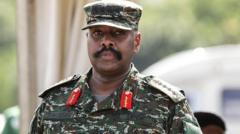
The unilateral closure of Uganda’s premier independent media channels by the military command exposes the underlying mechanics of an accelerating dynastic succession. When General Muhoozi Kainerugaba—the Chief of Defence Forces (CDF) of the Uganda People’s Defence Forces (UPDF) and eldest son of President Yoweri Museveni—enforced a physical and digital blockade on Nation Media Group (NMG) subsidiaries on June 28, 2026, the action moved beyond standard state censorship. It represents an operational test of raw military authority designed to consolidate domestic power structures ahead of an impending transition.
Standard journalistic analysis treats this shutdown as an isolated violation of press freedom. A rigorous, structural analysis reveals it as a deliberate effort to eliminate institutional informational friction. By halting the distribution of the Daily Monitor, NTV Uganda, KFM, Dembe FM, Spark TV, and The East African, the security apparatus has effectively altered the state's political cost function. The move lowers the immediate political penalties for regime consolidation while shifting information flow management toward state-directed channels.
The Three Pillars of Dynastic Consolidation
The execution of a media shutdown during a sensitive political transition relies on three distinct operational layers.
1. Total Information Monopolization
The primary goal is the systematic reduction of alternative narratives within the domestic information ecosystem. Nation Media Group operates as a cross-border entity listed on the Nairobi Securities Exchange. Its financial independence historically allowed its outlets to operate outside the financial leverage of Ugandan state advertising budgets. By placing NMG’s physical infrastructure in Kampala under military guard and forcing broadcasts off the air, the military eliminates independent corroboration of domestic events, political arrests, and policy changes.
2. Validation of Successor Authority
President Yoweri Museveni, 81, recently began his seventh consecutive presidential term following the January elections. However, the operational administration of domestic security has increasingly shifted to General Kainerugaba. By declaring that he possesses the explicit authority to close any media house—a power he claims was delegated by his father—the CDF is signaling his command over the state's security apparatus directly to the ruling National Resistance Movement (NRM) elites and the political opposition.
3. Structural Transition Orientation
As stated by the military command, state media management must change from observing passive neutrality to actively employing "cadres of the revolution." This framework shifts the press from a monitor of state function to an extension of the regime's political communication structure. This structural transition is critical during periods of dynastic succession, where the threat of elite fracturing or popular mobilization requires centralized narrative controls.
The Informational Friction Matrix
Autocratic regimes balance a continuous trade-off between the costs of enforcing direct physical censorship and the risks of allowing independent public discourse. This dynamic can be mapped across three distinct structural phases based on historical precedents in East African governance.
Phase 1: Institutional Toleration (Low Executive Risk)
Independent media operates within loosely defined statutory boundaries. The state relies on selective tax audits, regulatory delays by bodies like the Uganda Communications Commission (UCC), and defamation suits to impose financial costs on critical journalism without triggering international diplomatic backlash.Phase 2: Target Selection (Escalating Transition Contradictions)
As executive transition timelines shorten, independent reporting on internal military restructuring, succession rivalries, or opposition suppression threatens regime cohesion. The state identifies specific media entities that possess the distribution capacity to alter public perception. The 13-day shutdown of the Daily Monitor in 2013 following reports on the "Muhoozi Project"—an alleged plan to orchestrate his rise to the presidency—serves as a clear historical benchmark for this phase.Phase 3: Direct Military Liquidation (High Executive Preemption)
The regime moves past civilian regulatory frameworks entirely. The military command deploys armed personnel to seize printing presses and broadcast studios. Digital distribution channels are disrupted, forcing service providers to display "video unavailable" errors. The security apparatus accepts international reputational damage and regional capital flight to ensure immediate domestic control.
Strategic Bottlenecks for Independent Platforms
The vulnerability of independent journalism in centralized regimes stems from severe structural bottlenecks within their operational models.
[Independent Media Group] ──(Physical Infrastructure Hub)──> [Military Seizure Risk]
           │
           ▼
[Digital Access Point] ────(Telco Gateway Monopolies)───> [State Kill-Switch Risk]
           │
           ▼
[Cross-Border Capital] ───(Public Market Listing)──────> [Regulatory Free-Fall Risk]
The first structural vulnerability is the Physical Distribution Centralization. Despite the growth of digital media platforms, major broadcasters and print operations still rely heavily on physical production facilities and regional transmission towers. A single infantry deployment at an urban headquarters can stop an entire multimedia network's output.
The second vulnerability lies in Telecommunications Intermediation. Independent broadcasting requires access to national telecommunications networks and spectrum infrastructure, which are highly vulnerable to state intervention. When a military command issues a directive, internet service providers and telecommunications monopolies face immediate license revocation if they do not comply with transmission cuts.
The final vulnerability involves Cross-Border Capital Constraints. While international ownership structures provide initial protection against domestic nationalization, they introduce financial vulnerabilities when a shutdown occurs. Sustained military interference reduces advertisement revenue, stops local operations, and harms shareholder value on foreign stock exchanges. This pressure tests the long-term commitment of international parent companies to maintaining operations within high-risk markets.
Regional Operational Implications
The operational suspension of Uganda's primary independent media group will likely alter regional political dynamics across several key areas:
The regional diplomatic balance will face pressure as East African Community (EAC) integration relies on stable cross-border corporate investments and predictable operating environments. The sudden shutdown of an asset owned by a major Kenyan media conglomerate highlights the regulatory and political risks facing foreign capital in neighboring markets.
The domestic political opposition will encounter significantly higher coordination hurdles. The removal of mass-market independent television and radio networks disrupts the primary mechanisms used to broadcast opposition viewpoints, report on political detentions, and mobilize civil society outside of state-monitored internet platforms.
The enforcement of total information control alters how regional security risks are managed. Without independent local reporting, tracking regional border security issues, internal military friction, or cross-border rebel movements will depend almost entirely on state-vetted intelligence releases and satellite verification.
The security command’s current strategy suggests that the military blockade will remain in place until the domestic political transition is secure. The civilian regulatory agencies have been marginalized by direct military intervention. Independent media organizations must now decide whether to restructure their operations for underground digital distribution or accept a compromised position as state-guided information platforms.