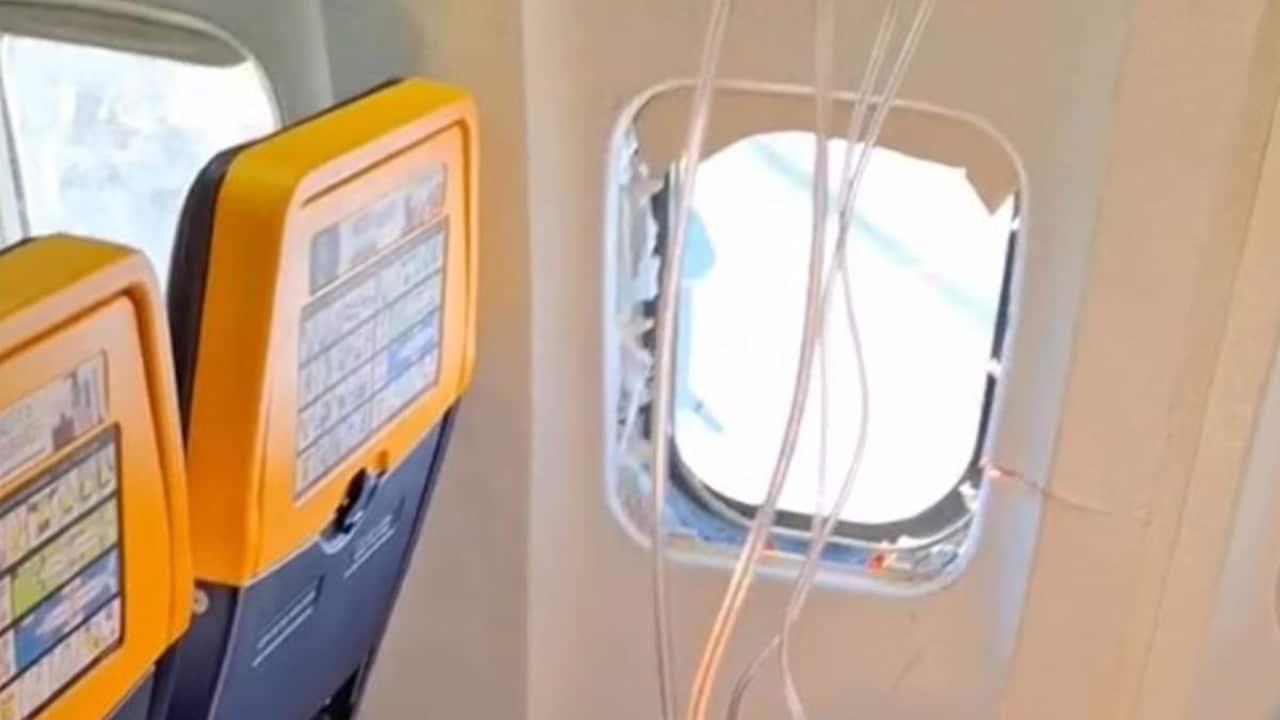
Commercial aviation operates within a strict envelope of atmospheric pressure differentials. When a fuselage boundary fails, the resulting equalization of pressure is not merely an aerodynamic anomaly; it is a violent physical event governed by fluid dynamics and structural engineering limits. The recent structural breach on Ryanair Flight 1879, where a passenger window assembly failed mid-flight over North Macedonia, highlights the critical vulnerabilities that emerge at the intersection of uncontained propulsion failures and cabin pressurization architecture.
Understanding this event requires moving past sensationalized media accounts to evaluate the precise mechanical forces, structural dependencies, and operational variables that determine survival when an aircraft envelope is compromised.
The Physics of Rapid Decompression
Atmospheric pressure drops exponentially with altitude. At a standard cruising altitude or initial climb phase, the internal cabin pressure is maintained at an equivalent of 6,000 to 8,000 feet above sea level to ensure human consciousness. This creates a stark pressure differential ($\Delta P$) between the interior cabin environment and the external atmosphere.
When a structural element like a cabin window fails, this pressure differential acts as a potential energy reservoir that converts instantly into kinetic energy. The air inside the cabin rushes toward the breach to achieve equilibrium, acting as a high-velocity fluid stream.
The velocity of the escaping air mass is governed by the size of the orifice and the magnitude of $\Delta P$. The localized pressure drop at the immediate site of the breach creates a venturi effect, rapidly accelerating air particles and pulling nearby loose masses—including human occupants—toward the opening.
In this instance, the pressure differential was sufficient to force the upper torso of an adult passenger through the window opening. The structural limit that prevented total ejection was not the localized aerodynamic drag, but the mechanical restraint of the lap seatbelt, which anchored the lower pelvic mass to the airframe structure.
Structural Puncture Mechanics and Uncontained Engine Debris
Early operational reports point to a sequence initiating not within the window assembly itself, but within the propulsion system. An uncontained engine failure occurs when rotating components suffer structural breakdown, penetrating the protective containment housing of the engine nacelle. These high-velocity ballistic fragments possess immense kinetic energy.
The vulnerability of a fuselage to external debris impacts involves three distinct mechanical variables:
- Impact Kinetic Energy: The mass and velocity vectors of the detached engine component dictate the force applied to the aluminum or composite skin.
- Material Shear Strength: The structural boundaries of a commercial airliner window are designed to withstand predictable uniform pressure cycles, not localized, high-velocity point impacts.
- Stress Concentration Factors: Once an object punctures the outer acrylic pane, the structural integrity of the entire window forge is compromised, causing instantaneous failure under the existing internal cabin pressure.
The failure path suggests that engine debris directly struck the fuselage skin or window pane during the initial ascent phase. Once the structural integrity of the multi-layered window assembly was breached by the impact, the internal pressure blew out the remaining structural fragments. This sequence underscores why propulsion reliability directly dictates fuselage structural integrity.
The Human Tolerances of Rapid Pressure Equalization
The physiological consequences of a rapid decompression event manifest within seconds. The immediate drop in ambient pressure triggers a rapid expansion of gases within the human body, particularly within the lungs, sinuses, and middle ear. This expansion can cause barotrauma if the gas cannot escape freely through natural pathways.
Simultaneously, the sudden drop in the partial pressure of oxygen reduces the pressure gradient between the alveoli in the lungs and the pulmonary capillaries. This induces hypoxia, significantly reducing the Time of Useful Consciousness (TUC). At standard cruising altitudes, TUC can range from several minutes to less than thirty seconds, depending on the absolute altitude reached.
+-------------------------------------------------------------+
|               Uncontained Engine Failure                    |
|                            |                                |
|                            v                                |
|               High-Velocity Debris Impact                  |
|                            |                                |
|                            v                                |
|            Localized Structural Boundary Breach             |
|                            |                                |
|                            v                                |
|                 Rapid Decompression                         |
|             (Venturi Effect & Airflow Exit)                 |
+-------------------------------------------------------------+
The friction burns sustained by the passenger involved in this event indicate the severe aerodynamic forces and mechanical friction present at the boundary wall. As air rushes out at high velocity, it interacts with the edges of the fractured structure, creating a highly turbulent boundary layer capable of causing severe thermal and mechanical trauma to exposed skin surfaces.
Redundancy Systems and Structural Safeguards
Aviation safety engineering relies on defensive layers to mitigate localized component failures. The primary defense against total occupant ejection during a decompression event remains the passenger restraint system. Modern aircraft seatbelts are anchored directly to the seat tracks, which are tied into the primary floor beams of the fuselage structure. This ensures that the mechanical load of an occupant subjected to aerodynamic or pressure forces is transferred directly into the primary load-bearing structure of the aircraft.
The secondary defense system is the automatic deployment of the supplemental oxygen system. This system operates via an independent barometric sensor network that triggers the drop of passenger masks when the cabin pressure altitude exceeds a predefined threshold, typically 14,000 feet. The strong odor reported by passengers during these events is generally attributed to the activation of chemical oxygen generators, which produce a brief thermal signature and distinct smell as the chemical core reacts to produce breathable oxygen.
The final operational defense is the human intervention of surrounding crew and passengers. The physical act of manually securing an individual who has been partially compromised by a breach provides the vital secondary anchoring mechanism required while the flight crew initiates a high-rate emergency descent to a safe breathing altitude, typically 10,000 feet or the minimum safe altitude dictated by terrain.
Maintenance Architectures and Fleet Utilization Pressures
The operational economics of low-cost carriers rely on high aircraft utilization rates, minimized turnaround times, and tightly scheduled maintenance intervals. While regulatory frameworks enforce rigid inspection protocols, the continuous cycling of propulsion systems and pressurization boundaries introduces the risk of structural fatigue over time.
A critical vulnerability in maintaining high-utilization fleets is the identification of micro-fissures or structural degradation within rotating engine components before they escalate into an uncontained failure. This requires advanced non-destructive testing techniques, such as eddy current testing, ultrasonic inspections, and radiography during scheduled depot-level maintenance.
When an uncontained failure occurs, it exposes an engineering or inspection bottleneck. The investigation must isolate whether the root cause was a localized material defect, a failure in the predictive maintenance algorithms, or an inadequate inspection cycle that failed to account for accelerated thermal or mechanical stress patterns. Operators face a complex balancing act: they must maximize flight hours per hull while ensuring that structural boundaries and propulsion components do not approach their absolute fatigue limits between inspection intervals.
The definitive response to this class of structural emergency requires fleet-wide inspection audits of engine containment systems and adjacent fuselage sections. Regulatory authorities will focus on the specific containment specifications of the engine model involved to determine why ballistic debris bypassed the safety shields. Operators must adjust their predictive maintenance baselines to account for the specific stress profiles observed in high-utilization environments, prioritizing structural boundary integrity over raw asset utilization.
This historical case analysis provides an in-depth breakdown of a previous uncontained engine failure that triggered a similar cabin decompression event, illustrating the precise physics of structural breaches and passenger restraint dynamics during mid-flight emergencies.