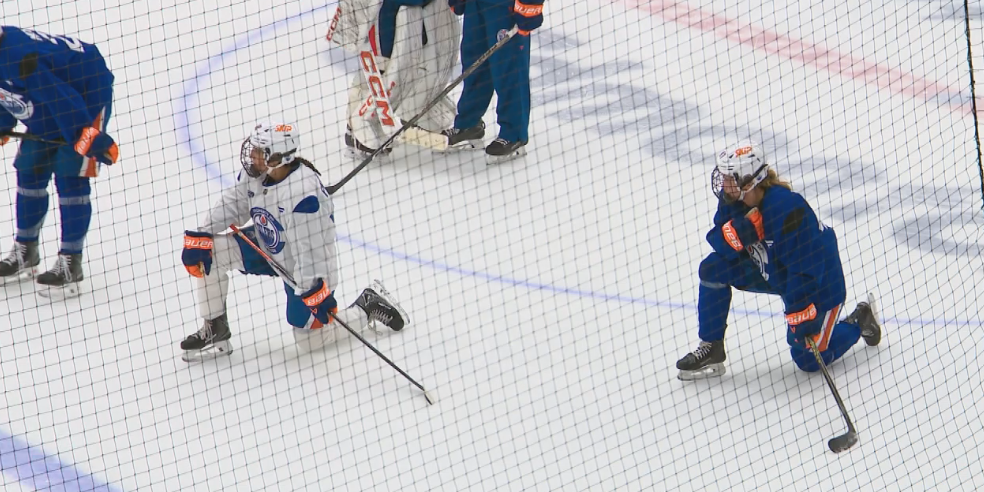
The separation between elite men's and women's hockey has historically been treated as an immutable structural boundary, governed by different resource allocations, distinct physical parameters, and completely segregated developmental pipelines. The Edmonton Oilers inclusion of Abbey Murphy, Chloe Primerano, and Caitlin Kraemer in their 2026 development camp shatters this convention. This is not a standard sports marketing initiative, nor is it a traditional talent-scouting exercise, given that Murphy is already tied to the Professional Women's Hockey League (PWHL) after being selected second overall by the Seattle Torrent. Instead, this cross-league integration operates as an efficiency optimization mechanism for high-performance athletic systems.
By analyzing this integration through the lens of institutional resource allocation and athletic development economics, we can deconstruct how both the NHL franchise and these elite athletes extract mutual, asymmetric value.
The Asymmetric Value Exchange Framework
To understand why an NHL franchise would allocate limited development camp slots to athletes outside its draft system, the event must be broken down into its core economic and performance variables. The relationship is governed by an exchange where both parties trade non-competing resources to optimize their respective operational outputs.
The Franchise Perspective: Marginal Utility and Cultural Benchmark
For an NHL front office, a summer development camp operates under a fixed capacity constraint—typically limited to roughly 24 to 30 players due to coaching ratios, ice availability, and physical evaluation logistics. Allocating three of these slots to non-organizational assets requires an immediate return on investment that outweighs the marginal value of evaluating a lower-tier, undrafted male invitee.
The mechanism at play here is the introduction of elite performance benchmarks into a young prospect ecosystem. The 2026 Oilers development roster includes all five of the club's recent 2026 NHL Draft selections, alongside various American Hockey League (AHL) and collegiate prospects. Introducing an athlete of Abbey Murphy's caliber—an Olympic gold medalist at the 2026 Milan Winter Games who registered 66 points in 31 games for the University of Minnesota—alters the competitive standard of the ice sessions.
Prospect camps often suffer from a performance variance bottleneck, where late-round draft picks or regional invites lower the median execution speed of tactical drills. Injecting highly decorated, elite-velocity players raises the structural floor of the camp. The male prospects are forced to compete against world-class hockey IQ and elite edge-work, exposing technical deficiencies in their defensive tracking and puck-distribution speeds.
The Athlete Perspective: Institutional Knowledge Transfer
For Murphy, Primerano, and Kraemer, the camp represents immediate access to capital-intensive infrastructure that cannot be replicated at the collegiate or early-stage professional level. While the PWHL has fundamentally stabilized the financial viability of women’s professional hockey, its infrastructure is still scaling. The institutional knowledge possessed by an NHL franchise—specifically regarding sports science, contextual data tracking, and specialized mechanical coaching—is decades ahead in maturity.
The athletes enter a high-density learning environment where the primary yield is not a contract, but rather an accelerated understanding of professional operational standards. This includes:
- Advanced Biomechanical Assessment: Utilization of high-frequency force plates, three-dimensional motion capture, and gate analysis tools to identify efficiency leaks in stride mechanics.
- Micro-Nutritional Optimization: Access to institutional dietitians capable of mapping caloric expenditure against high-intensity outputs, creating personalized metabolic profiles.
- Tactical Micro-Coaching: On-ice instruction from specialized NHL developmental coaches, focusing on highly granular mechanics such as the angle of defensive stick-checks and tactical body positioning along the wall.
The Statistical Reality: Deconstructing the Roster Profiles
The selection of these three specific athletes was not random; it was dictated by precise production metrics that align with modern NHL tactical profiles. An examination of their statistical footprints reveals why their inclusion carries legitimate athletic merit.
Abbey Murphy: Elite Finishing and Executive PACE
Murphy’s profile is defined by an extraordinary scoring efficiency. Her 40 goals in 31 games during her graduate year at the University of Minnesota represent an elite shooting percentage and a high-frequency shot generation model.
$$\text{Production Density} = \frac{\text{66 Points}}{\text{31 Games}} \approx 2.13\text{ Points Per Game}$$
This level of offensive density demonstrates that her processing speed operates at a premium level. In a 3-on-3 camp tournament setting—which favors open-ice transition and rapid spatial recognition—Murphy's ability to manipulate defensive gaps provides an immediate tactical challenge for the Oilers defensive prospects.
Chloe Primerano: Spatial Manipulation from the Blue Line
As a 19-year-old left-handed defender entering her junior year at the University of Minnesota, Primerano’s value lies in her transition metrics. Recording 30 points in 34 games as a sophomore indicates an elite capability in executing zone exits and managing the blue line during sustained offensive possession.
Modern NHL defensive structures heavily prioritize puck-moving defensemen who can transition the play without relying on low-probability glass-and-out plays. Evaluating how Primerano navigates the forechecking pressure of larger NHL-drafted forwards provides a highly valuable data point on how elite lateral mobility can neutralize physical size differentials.
Caitlin Kraemer: Historical Scoring Trajectory
Kraemer, a 20-year-old forward out of the University of Minnesota Duluth, brings a historical pedigree as the all-time leading scorer for the Canada National Women’s U18 Team, with 53 points in 32 international matches. Her sophomore collegiate campaign yielded 30 points in 36 games, proving her ability to maintain a baseline of offensive output against older, physically developed collegiate defenses. Kraemer's game is built on leverage and net-front positioning, presenting a unique physical and tactical puzzle for prospects trying to clear the crease.
The Structural Bottlenecks of Cross-League Standardization
While the operational advantages of this integration are clear, a rigorous strategy analysis requires outlining the systemic limitations and structural bottlenecks that prevent this from becoming a permanent talent-acquisition pipeline.
+------------------------------------------------------------+
|             STRUCTURAL LIMITATIONS FRAMEWORK               |
+------------------------------------------------------------+
| 1. Systemic Pipeline Divergence                            |
|    - Divergent career paths limit long-term continuity     |
|    - Roster spots are borrowed, not structurally integrated|
+------------------------------------------------------------+
| 2. Regulatory and Risk Management Barriers                |
|    - Lack of formal CBA frameworks for cross-league injury |
|    - Liability boundaries for non-contracted assets        |
+------------------------------------------------------------+
| 3. Physical Metric Asymmetries                             |
|    - Variations in average body mass alter checking physics|
|    - Restricts full-contact operational evaluation         |
+------------------------------------------------------------+
Systemic Pipeline Divergence
The primary limitation of this exercise is the absence of a shared competitive destination. A traditional NHL development camp is designed to cultivate assets that will eventually populate the franchise’s organizational depth chart across the ECHL, AHL, and NHL. Because Murphy is committed to the Seattle Torrent and both Primerano and Kraemer are bound to their NCAA programs and the future PWHL draft ecosystem, the Oilers cannot realize any long-term asset appreciation. The value generated is strictly transactional and confined to the four-day duration of the camp.
Regulatory and Risk Management Barriers
Cross-league participation introduces complex liability and insurance issues. NHL prospects are covered under standard player contracts or specific league-sanctioned insurance pools that protect against catastrophic injury during team-sanctioned events. Bringing in non-league, external athletes requires bespoke liability waivers and introduces a risk-management challenge: if an elite professional asset like Murphy were to suffer a structural joint injury during an NHL team's scrimmage, the financial and competitive ramifications for her PWHL franchise would be severe. This lack of a formal, standardized collective bargaining agreement framework between the NHL and PWHL regarding player sharing limits this practice to non-contact summer windows.
Physical Metric Asymmetries and Tactical Adjustments
The physical profiles of elite women’s hockey players differ fundamentally from those of modern NHL prospects, particularly regarding average body mass and the physics of body checking. While women's international hockey and the PWHL feature intense physical battles along the boards, explicit open-ice checking is restricted by rule.
In an integrated development camp, this creates a tactical asymmetry. The camp must either alter its intensity parameters—effectively reducing the physical contact element of defensive drills—or force the female athletes to absorb contact from prospects weighing upwards of 200 pounds who are fighting for professional contracts. The Oilers solve this by positioning the camp primarily as a technical and tactical showcase, culminating in a 3-on-3 tournament where speed and puck-handling are prioritized over structural physical grinding.
The Strategic Play
Front offices across the NHL should view the Edmonton Oilers 2026 development camp roster configuration not as a novelty, but as a blueprint for expanding the boundaries of high-performance athletic environments. To maximize the utility of these cross-league integrations moving forward, organizations must advance past basic invitations and implement a structured, repeatable strategy.
The optimal play requires establishing formal, institutionalized training partnerships between regional NHL and PWHL franchises. Rather than relying on individual relationships—such as the pre-existing connection between Oilers General Manager Stan Bowman and Abbey Murphy dating back to her youth hockey days in Chicago—franchises must build formalized development exchanges.
An NHL club should exchange its surplus sports science data capabilities, video analysis infrastructure, and specialized skating coaches for the opportunity to embed world-class international players into their prospect environments. This creates an ongoing, controlled ecosystem where young NHL prospects are routinely exposed to the superior tactical discipline, hockey intelligence, and spatial awareness of elite women's international players, while simultaneously elevating the operational baseline of the women's professional game. Franchises that construct these high-performance loops first will secure a distinct analytical and developmental advantage over organizations that remain siloed in traditional talent pipelines.