Two weeks before Quebec’s October 5, 2026 provincial election, the campaign entered a structural inflection point on Day 26 where minority-government probabilities forced every party leader into a public game-theory dilemma over post-election alliances. Standard campaign reporting treats Day 26 as a disconnected log of daily photo opportunities, press conferences, and isolated policy announcements across Montreal and the regions. That surface-level framing misses the underlying operational mechanics driving the final fourteen days of a five-way race.
At Day 26—September 21, 2026—polling aggregates pointed toward a Parti Québécois (PQ) lead within minority-government territory across the newly expanded 127-seat National Assembly. When a multi-party race enters its final fortnight without a clear majority frontrunner, campaign strategy shifts from broad persuasion to two distinct operational imperatives: locking down vote efficiency in contested ridings and managing coalition expectations without alienating core ideological voters.
The Structural Shift at the Two-Week Mark
A provincial general election campaign operates in three distinct phases: brand positioning in the opening ten days, debate and policy differentiation in the middle phase, and turnout mobilization alongside strategic-voting consolidation in the final fourteen days. Entering Day 26 meant campaigns were operating inside the closing window before advance polling opened on September 27 and 28, leaving less than a week to shape the narrative going into early voting and the final French-language leaders' debate.
Three structural variables defined the operating environment on Day 26:
- Seat Redistribution Friction: For the 2026 general election, Élections Québec expanded the National Assembly from 125 to 127 seats, creating two new electoral divisions (Bellefeuille and Marie-Lacoste-Gérin-Lajoie) and altering boundaries across 39 existing districts. Historical riding baselines from 2022 lost predictive precision in redistributed districts, forcing campaign war rooms to allocate leader travel based on live internal tracking rather than legacy safe-seat assumptions.
- Geographic Concentration on the Island of Montreal: Multiple party leaders converged on Montreal to open the week. While regional ridings decide majority thresholds in Quebec, Montreal serves two functions in the final two weeks: it provides concentrated media infrastructure ahead of televised debates, and it contains dense clusters of federalist, progressive, and swing-urban ridings where vote-splitting between the Quebec Liberal Party (QLP), Québec solidaire (QS), and Coalition Avenir Québec (CAQ) determines narrow pluralities.
- The Minority-Government Overhang: With polls indicating a PQ lead short of an outright majority, the central strategic question shifted from what each party would do with 64-plus seats to how any party could pass confidence votes in a hung legislature.
The Alliance Rejection Paradox
On Day 26, journalists pressed party leaders on whether they would form post-election alliances or governing coalitions if voters delivered a minority National Assembly. Every major leader publicly rejected formal alliances, yet their tactical incentives for doing so differed sharply.
In first-past-the-post systems with five viable parties—the PQ, CAQ, QLP, QS, and the Conservative Party of Quebec (PCQ)—publicly entertaining a coalition before election day carries an immediate vote-transfer penalty. If a voter knows Party A will prop up Party B after the election, strategic voters bypass the junior partner and consolidate directly behind the perceived frontrunner or the primary opposition vehicle.
- Parti Québécois (Paul St-Pierre Plamondon): Leading in public opinion surveys heading into the final stretch, the PQ faced coordinated attacks from opponents while rejecting alliance talk. For a frontrunner polling near the minority-majority threshold, discussing post-election cooperation signals that a majority is out of reach. Refusing alliance scenarios forces soft nationalists and anti-incumbent voters to treat a direct PQ vote as the only mechanism to replace the government.
- Coalition Avenir Québec (Christine Fréchette): Having assumed the premiership and party leadership in April 2026 following caucus turbulence during the 43rd legislature, Fréchette entered Day 26 defending an incumbent coalition that had bled seats through resignations and caucus departures. Rejecting alliances allowed the CAQ to frame the election as a binary choice between incumbent stability and PQ sovereignty risk, avoiding the perception that the CAQ was bargaining for survival as a junior partner.
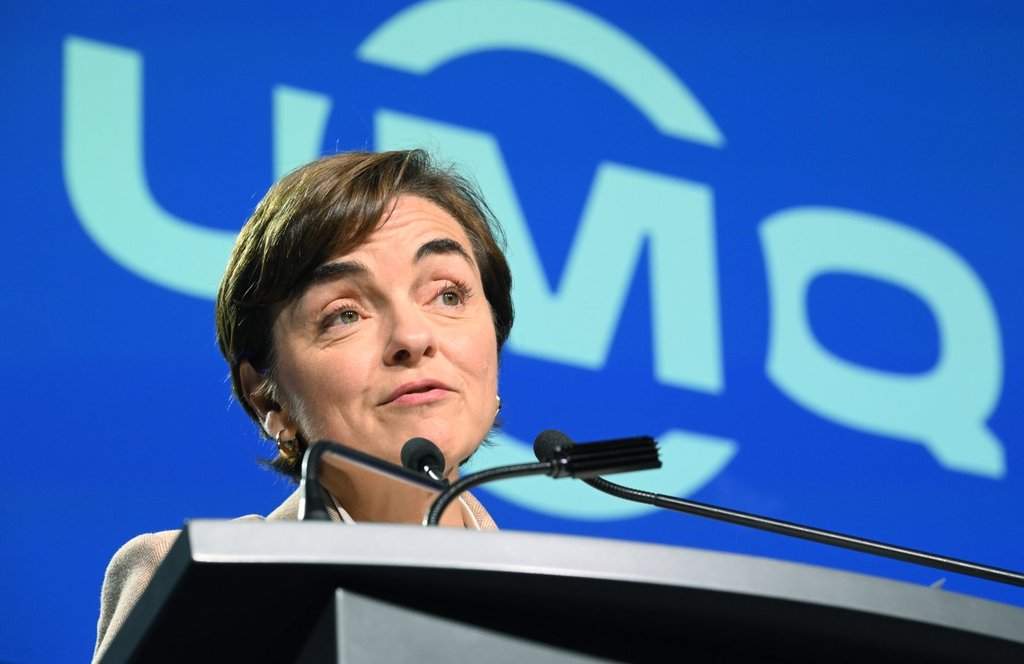
- Québec solidaire (Ruba Ghazal): Operating in her first general election campaign as co-spokesperson and premier candidate, Ghazal noted ideological compatibility on certain fronts while navigating the existential threat posed by a surging PQ. When the PQ rises, progressive sovereigntists face pressure to abandon QS to prevent a center-right split. Maintaining distinct programmatic boundaries prevents total absorption while leaving legislative issue-by-issue cooperation open after October 5.
- Quebec Liberal Party (Charles Milliard) and Conservative Party of Quebec (Éric Duhaime): Milliard focused on party renewal to rebuild a federalist base that had fallen to 14.37 percent of the popular vote in 2022, while Duhaime sought to convert popular vote share into actual seats. Both leaders stood to lose leverage if voters viewed their parties as mere coalition appendages rather than independent parliamentary blocs.
The operational reality beneath these categorical denials is straightforward: pre-election alliance rejections are non-binding signaling tools. In a Westminster parliamentary system, minority governments rarely require formal pre-election coalition pacts; they survive through confidence-and-supply arrangements or case-by-case legislative votes once the seat math is locked in after polling day.
Deconstructing the Day 26 Policy Matrix
Routine campaign summaries list Day 26 policy announcements as isolated news items—shipping, forestry, birthrate incentives, and housing rules. Viewed through an electoral targeting framework, these pledges represent precision micro-targeting aimed at specific demographic and geographic bottlenecks.
Economic and Resource Sector Anchors
The CAQ and Liberal platforms deployed targeted economic pledges around shipping and forestry. In Quebec’s electoral geography, maritime logistics and forestry are not abstract macroeconomic variables; they are the primary employment engines in resource-dependent regions such as Côte-Nord, Bas-Saint-Laurent, Saguenay–Lac-Saint-Jean, and Abitibi. By announcing sector-specific support in the final two weeks, both parties aimed to insulate regional industrial ridings against nationalist swings without alienating urban fiscal conservatives.
Demographic and Cultural Signaling
The PQ’s proposal to boost Quebec’s birthrate—a pro-natalist policy direction also raised by Conservative leader Éric Duhaime—functions on two levels. On the policy level, it addresses long-term demographic decline and labor-force contraction. On the political level, breaking perceived taboos around demographic policy reinforces the PQ’s core narrative around cultural continuity and linguistic preservation, directly differentiating its platform from federalist parties focused on immigration-driven population growth.
Urban Housing Market Intervention
Québec solidaire’s pledge to end blind bidding in real estate transactions targets a high-salience friction point for younger urban renters and first-time homebuyers concentrated in Montreal, Quebec City, and Gatineau. Unlike broad public-housing construction timelines that take years to materialize, banning blind bidding offers an immediate regulatory rule change with zero direct treasury outlay, making it resilient against fiscal-credibility attacks during televised debates.
Operational Bottlenecks in the Final Fourteen Days
Strategic execution between Day 26 and Election Day on October 5 faced three measurable constraints that determine whether polling leads translate into seats:
- Vote Efficiency vs. Raw Popular Vote: Quebec’s electoral map historically produces wide divergences between raw popular vote percentages and actual seat counts. In 2022, the CAQ captured 90 of 125 seats with 40.98 percent of the vote, while the Liberals won 21 seats on 14.37 percent due to heavy geographic concentration in Montreal. In 2026, a party leading in provincial toplines by single digits can still fall short of the 64-seat majority threshold if its vote surplus is piled up in safe francophone ridings while three-way splits decide suburban belts around Montreal and Quebec City.
- Debate Asymmetry: With the third and final French-language leaders' debate scheduled mid-week following Day 26, the frontrunner faced asymmetric downside risk. In multi-leader debates, trailing candidates coordinate attacks against the polling leader to force unscripted errors on high-risk topics like sovereignty timelines, language enforcement, and U.S. tariff exposure.
- Turnout Mechanics Across Advance and Regular Polls: In the 2022 provincial election, total turnout stood at 66.15 percent, with more than 1.5 million electors—24.44 percent of registered voters—casting ballots during advance polling days. With 2026 advance polls scheduled for September 27 and 28, campaigns had less than one week from Day 26 to identify supporter lists and execute ground-game mobilization before roughly a quarter of the electorate locked in their votes.
Strategic Limitations of Late-Campaign Signaling
Campaign strategies built on late-stage policy announcements and alliance denials carry structural vulnerabilities:
- Credibility Discounting: Voters apply a steep discount rate to niche sector pledges introduced in the final two weeks of a 39-day campaign, viewing them as transactional vote-buying rather than vetted legislative priorities.
- Uncontrolled External Shocks: Micro-targeted messaging on shipping, forestry, or housing rules can be instantly displaced by exogenous news cycles—such as local public-safety incidents, social crises, or judicial rulings on election administration—that dominate media bandwidth and reset voter salience overnight.
- Post-Election Rigidity: Hardline refusals to consider inter-party cooperation restrict a leader’s room to maneuver if October 5 produces a narrow minority parliament, creating immediate friction between campaign rhetoric and legislative governance.
Final Strategic Play for the Closing Stretch
In a fragmented five-party race entering its final two weeks with a minority-government polling profile, winning campaigns stop chasing broad provincial vote share and execute a disciplined riding-level triage.
Campaign war rooms must immediately reallocate leader travel, digital ad spend, and ground-game field organizers out of safe seats and into the roughly 25 to 30 redistributed suburban and regional swing ridings where margin spreads sit inside five percentage points. Simultaneously, campaign messaging ahead of the final debate and the September 27–28 advance poll window must pivot exclusively toward binary ballot-question framing—convincing undecided and soft-aligned voters that splitting their vote among trailing parties guarantees an unstable minority legislature rather than decisive governance.
For a closer look at how demographic proposals shaped the campaign conversation at this stage, watch Pro-natalist promises enter the campaign | Quebec Elections 2026, which examines the pro-natalist policies introduced by the Parti Québécois and the Quebec Conservative Party during the 2026 race.