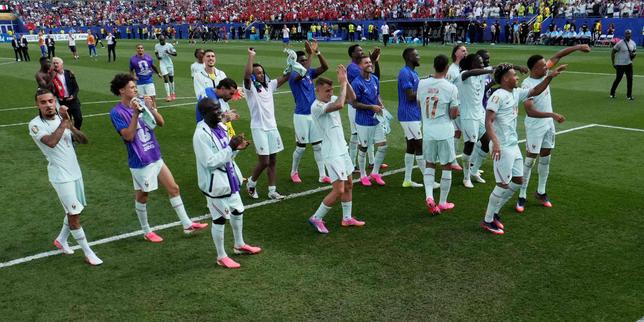
The outcome of elite international football matches is rarely determined by random variance; instead, it is dictated by the precise manipulation of space, the efficiency of transitional structures, and the exploitation of defensive asymmetries. The 2-0 victory of France over Morocco serves as a definitive case study in how structural efficiency outclasses prolonged possession. While superficial accounts focus on individual brilliance, an objective tactical deconstruction reveals that the match was decided by two core variables: the failure of Morocco’s initial low-block mechanics due to early spatial disruption, and France's superior execution of rest defense during phases of sustained opposition pressure.
Understanding this match requires isolating the tactical ecosystems implemented by both managers. Morocco’s tournament strategy relied on a highly compact 4-1-4-1 mid-to-low block designed to deny central progression and force opponents into low-probability crossing zones. France, conversely, operated in a fluid 4-2-3-1 that transitioned into a 4-4-2 out of possession, prioritizing rapid verticality over territorial dominance. The interaction between these two distinct systems created specific tactical bottlenecks that defined the game's trajectory.
The Mechanics of Early Low-Block Disruption
A low-block defensive system is fundamentally reliant on game state. When operating at 0-0, the defensive side can maintain passive horizontal and vertical compactness, forcing the attacking team to circulate the ball laterally without penetrating the lines. The structural integrity of Morocco's defensive shape was compromised in the fifth minute due to a specific failure in spatial coverage during an asymmetric French rotation.
The breakdown occurred not from a counter-attack, but through a structured positional attack. France utilized a deliberate overload on the right flank, drawing Morocco’s central defensive lines toward the ball. This created a mechanical imbalance on the weak side. When Varane executed a vertical pass into the half-space, it bypassed Morocco’s first line of pressure.
Three specific defensive errors cascaded from this action:
- Misjudged Aggression: The Moroccan center-back stepped out of the defensive line to challenge Antoine Griezmann, failing to win the ball or delay the progression.
- Loss of Vertical Compactness: This aggressive step created a structural void directly behind the midfield line.
- Weak-Side Collapse: As Kylian Mbappé’s deflected shot shifted the point of attack to the back post, Theo Hernandez exploited the blind-side space left vacant by the shifting Moroccan fullback.
The early goal fundamentally altered the strategic landscape. A low-block team trailing early is forced to alter its defensive lines, moving from a passive containment strategy to an active, high-pressing system. This shift inherently introduces structural risk by expanding the playing field and creating the exact vertical channels that France’s profile of players was optimized to exploit.
The Economics of Transition and High-Possession Inefficiency
Following the opening goal, the match shifted into a phase where Morocco controlled over 60% of territorial possession. Standard analysis frequently correlates high possession with offensive dominance. A data-driven assessment reveals this possession was largely inefficient, deliberately funneled into low-value zones by France’s defensive structure.
France conceded the flanks intentionally, forming a compact central block that restricted access to the zone 14 area directly outside the penalty box. This forced Morocco to circulate the ball to the wide areas. While Morocco demonstrated technical proficiency in generating overloads on the right flank through Hakimi and Ziyech, their progression suffered from a severe bottleneck in the final third.
The inefficiency of Morocco's possession can be quantified through the concept of crossing economics. Delivering high balls into a penalty box defended by structurally sound, physically superior center-backs yields a low expected goals (xG) return per sequence. France systematically nullified these wide entries by positioning their center-backs to cover the near-post and central zones, while the deep-lying midfielders tracked late runners into the box. Morocco's lack of a central focal point capable of winning first contacts in crowded spaces meant that their high volume of final-third entries generated minimal clear-cut scoring opportunities.
Morocco’s offensive structure also suffered from a mechanical limitation: the absence of a dynamic underlapping threat from the left fullback position to balance the creative output on the right. This predictability allowed France to shift their defensive block horizontally with high precision, minimizing the physical exertion required to maintain their shape.
Rest Defense and the Spatial Contraction Framework
The second half highlighted the concept of rest defense—the positioning of defensive players while their team is still in possession of the ball. France’s strategy in the second period transitioned almost exclusively into a low-block containment and counter-striking model.
To prevent Morocco from converting their territorial dominance into high-quality chances, France utilized a strict spatial contraction framework. By dropping their defensive line closer to their own goalkeeper, France eliminated the space behind them, neutralizing the threat of vertical through-balls. This forced Morocco to play entirely in front of the French defensive structure.
The bottleneck for Morocco then became the speed of ball circulation. To break down a deeply set, compact 4-4-2 block, the attacking team must move the ball with high velocity to force the defensive lines to shift faster than their physical capabilities allow. Morocco’s passing sequences, while technically precise, lacked the necessary change of tempo to create structural gaps.
France's second goal illustrated the punishing nature of transition economics against an exhausted defensive unit. As Morocco pushed higher up the pitch to find an equalizer, their rest defense became compromised. The distance between their midfield line and their recovering defensive line widened. When France intercepted the ball in the mid-block, they immediately exploited this expanded space. Mbappé’s ability to manipulate multiple defenders in a tight space drew the remaining Moroccan coverage toward him, leaving Kolo Muani completely unmarked at the back post to convert a high-probability opportunity.
Strategic Allocation of Physical and Tactical Capital
A major variable in tournament football is the management of physical degradation. Morocco reached this stage of the competition having endured significant physical stress, including extra time in previous rounds and a high volume of defensive running metrics. Operating in a high-intensity defensive block for consecutive matches introduces a compounding rate of muscle fatigue and cognitive decline.
The structural failures in the latter stages of the match were the direct result of this physical depletion. High-pressing and rapid lateral shifting require peak athletic output. As the match progressed past the 70th minute, Morocco’s counter-pressing efficiency dropped significantly. The time required to close down French ball-carriers increased, allowing France to escape pressure and transition into wide areas with fewer touches.
France’s squad architecture allowed them to manage these physical demands more effectively. By defending passively in a medium-to-low block for large portions of the match, France conserved physical capital, reserving their high-intensity sprints for offensive transitions. This asymmetric distribution of physical exertion ensured that France maintained the structural discipline required to close out the match without suffering the late-game defensive collapses that frequently plague fatigued teams.
The definitive play of the match was not an individual act of flair, but the systematic execution of space denial. Teams attempting to replicate Morocco’s historical progression must account for the reality that a low-block strategy possesses zero structural margin for error; conceding early invalidates the entire tactical blueprint and forces an optimization shift that most defensive-first squads are ill-equipped to handle.