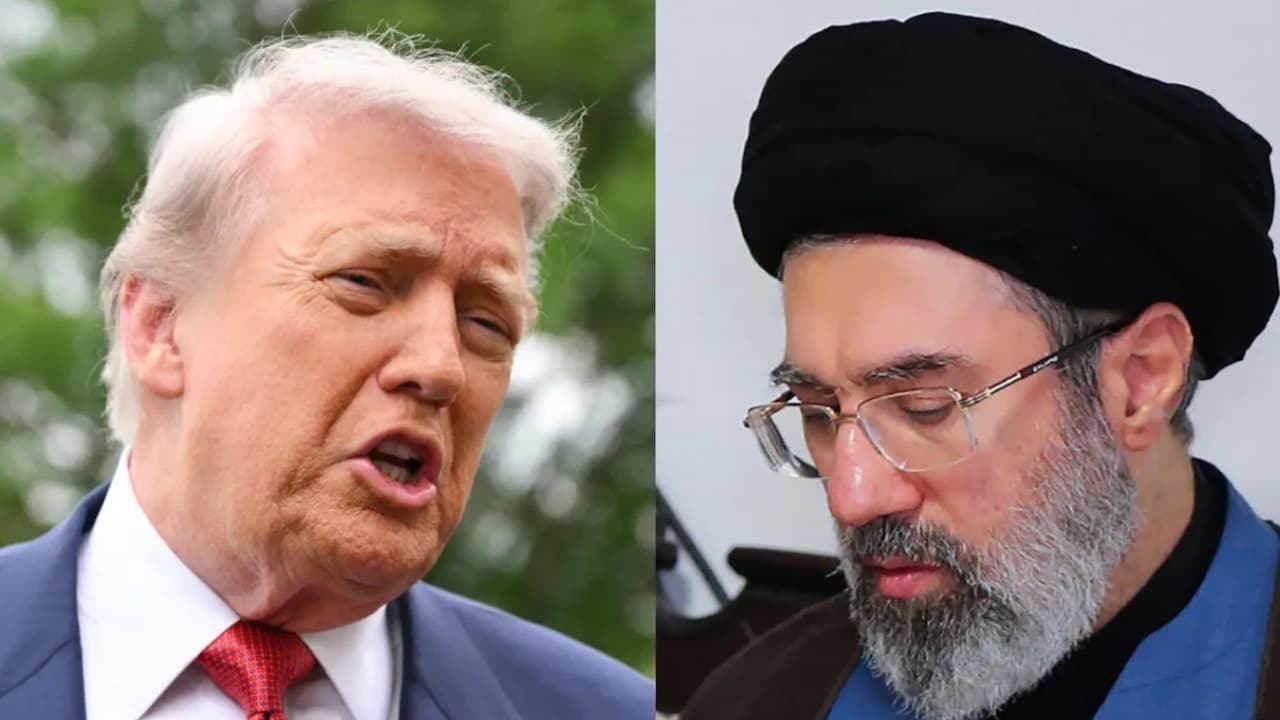
The escalation of kinetic operations in the Persian Gulf highlights a fundamental friction in modern warfare: the disconnect between the physical destruction of conventional state military infrastructure and the persistent survival of asymmetric state-sponsored networks. While executive statements from Washington declare that Iran’s command apparatus and conventional defensive platforms have been thoroughly neutralized—epitomized by the assertion that Supreme Leader Mojtaba Khamenei is "90 percent gone"—a rigorous strategic assessment suggests a more complex operational reality.
To evaluate the geopolitical trajectory of this conflict, we must move beyond rhetorical declarations and analyze the structural integrity of Iran's dual-track military model, the transition mechanics of its clerical leadership, and the economic friction points of enforcing a unilateral maritime blockade in the world’s most critical energy transit corridor. Expanding on this topic, you can also read: Why Chirag Veer Singh Sarao Breaking Barriers at the US Air Force Academy Matters.
Deconstructing the Succession Crisis: The Mechanics of Leadership Attrition
The targeted strike campaign launched by joint U.S. and Israeli forces in late February, which resulted in the death of Ayatollah Ali Khamenei, represented a massive shock to Iran’s highly centralized decision-making vertical. The subsequent appointment of his son, Mojtaba Khamenei, as the third Supreme Leader in March was designed to project institutional continuity. However, hereditary transitions in ideological regimes inherently introduce systemic vulnerabilities.
Three structural variables govern the stability of this new leadership paradigm: Analysts at Reuters have also weighed in on this trend.
- The Theological Legitimacy Deficit: Unlike his predecessor, Mojtaba Khamenei lacks the established religious credentials historically required to command absolute authority over the Shiite clerical establishment. He holds a mid-ranking clerical status, making his elevation a pragmatic political maneuver rather than a natural theological succession. This deficit weakens the traditional religious cohesion that underpins the regime's domestic authority.
- The IRGC Financial-Security Integration: The Islamic Revolutionary Guard Corps (IRGC) is not merely a parallel military organization; it is the dominant economic actor within Iran, controlling vast conglomerates across construction, telecommunications, and energy. Mojtaba's survival depends entirely on his alignment with the IRGC leadership. Yet, this creates a classic principal-agent dilemma. The IRGC requires a functioning economic apparatus to fund its domestic and regional networks, while the Supreme Leader requires ideological purity to maintain systemic legitimacy.
- Physical Incapacitation and Communication Bottlenecks: Reports indicating that Mojtaba Khamenei was severely wounded in an airstrike and remains physically incapacitated—evidenced by his absence from his father’s high-profile state funerals—create an acute operational bottleneck. When a centralized authority is physically isolated, decision-making cycles lengthen. The reliance on remote communication channels, such as official Telegram statements pledging retribution, signals a leadership structure operating under extreme duress, vulnerable to signal interception and internal fragmentation.
The claim that Mojtaba is "90 percent gone" may reflect physical wounding, but from a systems-analysis perspective, the remaining 10 percent represents the institutional inertia of the office itself. The supreme leadership is not a singular human node; it is a sprawling administrative bureaucracy—the Beit-e Rahbari—which continues to issue directives, manage assets, and coordinate regional proxies even when the executive head is incapacitated.
Conventional Air and Sea Attrition: Assessing the Claims of Total Degradation
The assertion that Iran possesses "no navy" and "no air force" requires a precise differentiation between conventional military capacity and asymmetric denial capabilities. From a conventional standpoint, the assessment is largely accurate. The Islamic Republic of Iran Air Force (IRIAF) relied on antiquated, pre-1979 airframes and reverse-engineered platforms that were systematically outmatched by fifth-generation stealth fighters and advanced electronic warfare suites during the U.S.-Israeli campaign. Similarly, Iran's blue-water conventional navy (the IRIN) lacked modern air-defense capabilities, making its surface vessels highly vulnerable to standoff maritime strike munitions.
However, treating the destruction of conventional platforms as the absolute neutralization of Iran’s military utility is a critical analytical error. The regime's defense doctrine has long prioritized asymmetric sea-denial and swarm tactics over conventional force-on-force engagement.
The Asymmetric Sea-Denial Matrix
Iran's naval strategy is bifurcated. While the conventional Navy has been degraded, the IRGC Navy (NEDSJA) operates on a highly decentralized, survivable model designed to function in GPS-denied and highly contested environments.
                                  [ IRGC Navy (NEDSJA) ]
                                            |
         +----------------------------------+----------------------------------+
         |                                  |                                  |
[ Swarm Boats ]                    [ Anti-Ship Missiles ]              [ Smart Sea Mines ]
- Low Radar Cross-Section          - Mobile, Camouflaged Launchers     - Bottom-Dwelling Acoustic Mines
- High-Speed Guided Torpedoes      - Standoff Ranges (100–300 km)      - Extremely Difficult to Sweep
- Saturated Target Engagement      - High Terminal Velocity            - Disrupted Transit Corridors
The destruction of centralized naval bases does not eliminate these decentralized capabilities. Mobile anti-ship cruise missile launchers can be concealed within the rugged terrain of the Zagros Mountains, which run parallel to the Persian Gulf coast. These launchers can be deployed, fired, and concealed within minutes, making pre-emptive destruction exceptionally difficult.
Furthermore, the threat of smart sea mines remains entirely independent of conventional naval survival. Bottom-dwelling, acoustic, and magnetic-influence mines can be deployed from non-military vessels, such as commercial dhows or civilian cargo ships. Once seeded in the shallow, narrow channels of the Strait of Hormuz, these mines require slow, methodical mine-countermeasure (MCM) operations to clear—effectively halting commercial shipping regardless of whether the U.S. Navy maintains total air superiority.
The Geoeconomics of Maritime Interdiction: The 20 Percent Tariff Model
The proposal to establish a U.S.-enforced "Iranian blockade" while simultaneously levying a 20 percent reimbursement fee on all cargo transiting the Strait of Hormuz introduces unprecedented complexity into global maritime law and international trade economics.
[U.S. Guardship / Blockade] ───> Forces Transit Fee (20% Surcharge)
                                     │
                 ┌───────────────────┴───────────────────┐
                 ▼                                       ▼
    [Global Supply Chain Shock]             [Legal & Geopolitical Friction]
    - $120+/BBL Brent Crude                 - Violates UNCLOS Article 37 (Transit Passage)
    - Double-Digit Shipping Surcharges      - Alienates Allied Importing Nations
    - Insurance Premium Spike (War Risks)   - Prompts Direct Iranian Retaliation
To understand why a 20 percent transit tariff is highly disruptive, we must model its impact on global supply chain mechanics.
The Cost-Function of Shifting Maritime Risks
The Strait of Hormuz is the world's most critical maritime choke point, historically handling approximately 20 percent of global petroleum liquids and liquefied natural gas (LNG) consumption. Under normal operating conditions, shipping companies optimize for transit speed and fuel efficiency. The imposition of a 20 percent cargo-value tariff by a unilateral actor completely alters the economics of global shipping.
First, a 20 percent levy on the value of raw crude or LNG cargo represents an astronomical cost increase. For a Very Large Crude Carrier (VLCC) carrying 2 million barrels of crude oil valued at $80 per barrel, a 20 percent tariff equates to a $32 million surcharge per single transit. This cost cannot be absorbed by shipping lines; it must be passed directly to the refining companies and, ultimately, to end-consumers.
Second, this policy creates a powerful economic incentive for shipping companies to bypass the Gulf entirely, where possible, or to seek alternative routes. However, the pipeline capacity capable of bypassing the Strait of Hormuz—primarily through Saudi Arabia and the United Arab Emirates—is structurally limited to less than half of the typical daily flow of the strait. The remaining volume must either pay the tariff or find alternative energy sources, triggering a sharp inflationary spike in global energy markets.
Legal and Diplomatic Friction Points
The proposed fee violates established international maritime law, specifically the United Nations Convention on the Law of the Sea (UNCLOS). Although the United States is not a state party to UNCLOS, it has historically recognized its provisions concerning navigation rights as customary international law.
Article 37 of UNCLOS defines the regime of transit passage through straits used for international navigation. Under this framework:
- All ships and aircraft enjoy the right of transit passage, which shall not be impeded or suspended.
- Strait-bordering states (in this case, Oman and Iran) cannot levy taxes or transit fees simply for passage through international straits.
- The unilateral imposition of a fee by a non-bordering state—even under the guise of security provisioning—sets a dangerous legal precedent that other nations could use to justify similar tariffs in other strategic choke points, such as the Malacca Strait or the Bab-el-Mandeb.
Iranian Foreign Minister Abbas Araghchi’s immediate counter-claim—that Iran remains the historic guardian of the strait and will negotiate its own "fair" terms—is a calculated move to exploit this legal vulnerability. By positioning Iran as the defender of traditional maritime norms against unilateral U.S. financial demands, Tehran seeks to drive a diplomatic wedge between Washington and its European and Asian allies who rely heavily on Persian Gulf energy imports.
Strategic Friction Points of the Proposed Blockade
Implementing a physical blockade targeting only "Iran's ships or customers" while attempting to allow "fair and open use" for all other nations is operationally problematic in a high-intensity conflict zone. A blockade, by definition under international law, is an act of war that must be applied impartially to all vessels to be legally recognized.
In practice, a selective blockade requires a highly intrusive Visit, Board, Search, and Seizure (VBSS) regime. Every commercial vessel transiting the narrow shipping lanes of the Strait of Hormuz—which are only two miles wide in each direction—would need to be intercepted, verified, and cleared by U.S. naval forces.
This creates three immediate operational bottlenecks:
- Transit Velocity Degradation: The physical process of stopping, boarding, and inspecting a modern container ship or supertanker takes hours, if not days. This delay disrupts the delicate just-in-time logistics models of global shipping, leading to massive port congestion globally.
- Target Saturated Environments: The concentrated presence of U.S. warships conducting boarding operations in a restricted waterway provides highly lucrative, static targets for remaining Iranian mobile missile batteries and drone swarms.
- Insurance Capital Flight: Marine insurance syndicates (such as the Lloyd's Joint War Committee) will inevitably designate the entire Persian Gulf as a high-risk zone. The combination of active kinetic exchanges, boarding operations, and the threat of sea mines will cause Hull War Risk insurance premiums to surge to prohibitive levels, effectively halting commercial traffic through private sector risk-aversion, regardless of whether the physical waterway is technically "open".
The Path Forward: Tactical and Strategic Realities
The conflict has reached a critical juncture where conventional military dominance has failed to translate into absolute strategic control. To stabilize the region and secure the global energy supply chain, policy-makers and maritime operators must base their planning on three foundational realities.
First, the physical degradation of Iran’s command structure has not dismantled its decentralized proxy network. The regional networks—stretching from the Houthis in Yemen to various militias in Iraq—operate on a highly autonomous basis, requiring minimal direct oversight from Tehran to continue targeting commercial shipping and regional infrastructure.
Second, the unilateral imposition of transit fees in international straits is a structurally non-viable policy that threatens the cohesion of the international maritime coalition. Rather than generating revenue to offset security costs, it alienates key allies, inflates global energy prices, and provides Iran with diplomatic leverage to contest the legitimacy of Western naval presence in the region.
Finally, the resolution of this crisis will not be achieved through aerial bombardment or targeted leadership strikes alone. A durable containment strategy must focus on enhancing localized mine-clearing capabilities, standardizing international convoy operations, and reinforcing alternative pipeline routes to systematically reduce the strategic leverage that any state bordering the Strait of Hormuz can exert over the global economy.
For a closer look at the immediate impact of these naval operations, this analysis of recent CENTCOM strikes on Iranian bases breaks down how sea drones are changing the tactical balance of power in the Gulf.