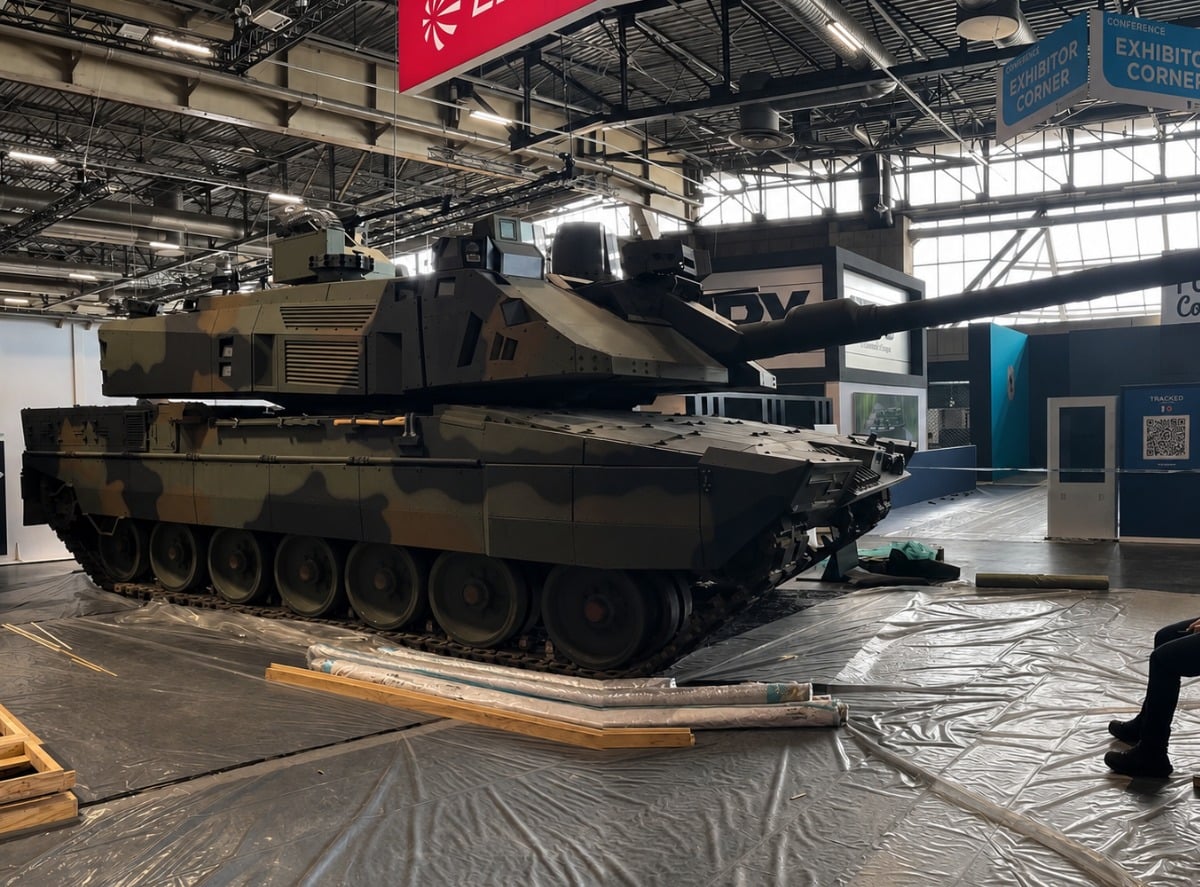
The fragmentation of European defense procurement is no longer just an economic inefficiency; it is a structural vulnerability. While political rhetoric frequently champions unified pan-European defense initiatives, the operational reality is defined by industrial protectionism and misaligned national requirements. The collapse of the negotiations between Italy’s Leonardo and the Franco-German holding company KNDS in mid-2024 underscored this systemic friction. Rather than absorbing a standardized, German-specified Leopard 2A8 platform, Italy pivoted, establishing a 50-50 joint venture with Rheinmetall: Leonardo Rheinmetall Military Vehicles (LRMV).
At Eurosatory, the physical manifestations of this strategic realignment demonstrate that the future of European heavy armor will not be dictated by a singular consensus, but by competing industrial blocks. The deployment of the LRMV initiative—spanning the New Main Battle Tank (NMBT) based on the Panther KF51 architecture and the Army Armored Combat System (A2CS) based on the Lynx KF41—presents a highly calculated framework designed to maximize domestic industrial yield while addressing critical capabilities gaps.
The Tri-Pillar Friction of Joint Procurement
Industrial partnerships in continental defense must balance three conflicting vectors: sovereign technological control, rapid military procurement, and cross-border standardization. When Italy initially sought entry into the Main Ground Combat System (MGCS) framework via a proposed alliance with KNDS, the negotiation broke down fundamentally on the configuration matrix. KNDS required adherence to a standardized Leopard 2A8 baseline to preserve a single European user standard across 18 nations. Leonardo demanded deep systemic integration, specifically the installation of Italian-manufactured electronics, command-and-control (C5I) suites, and domestic weapon systems.
This friction creates a predictable bottleneck in multinational defense programs, visible in the multi-decade timelines of projects like MGCS or the Future Combat Air System (FCAS). By abandoning the KNDS talks and partnering directly with Rheinmetall, Italy altered its posture from a subordinate purchaser to an equal architectural co-developer.
The LRMV joint venture functions under a strict division of labor designed to optimize the core competencies of both corporate entities:
- Rheinmetall Deliverables: Provision of core vehicular platforms, including the basic tracked chassis, automotive drive modules, and underlying heavy ballistics (such as the 130mm smoothbore gun tech for the Panther baseline).
- Leonardo Deliverables: Complete development and production of the mission systems, digital electronic backbones, C5I architectures, and specific domestic turrets (such as the Hitfist 30mm variant).
- Integration and Assembly: Execution of localized hull modifications, system integration, and final assembly at Leonardo’s facilities in La Spezia and through its acquired vehicular footprints like Iveco Defence Vehicles.
This structural distribution ensures that 50% of the workshare remains entirely within the Italian domestic economy, satisfying national sovereign mandates while bypassing the rigid governance structures of trilateral state agreements.
The Cost Function and Market Dynamics of the NMBT and A2CS
The scale of the LRMV program represents one of the largest single land-defense capital allocations in modern European history. The Italian Army’s initial modernization blueprint outlines a gross value exceeding 23 billion euros over the lifecycle of the contract, with broader export projections estimated up to 50 billion euros over the next fifteen years.
Total Program Allocation: €23 Billion Baseline
├── Army Armored Combat System (A2CS): ~1,050 Units
│   └── Multi-role configurations (IFV, Command, C-UAS, Mortar)
└── New Main Battle Tank (NMBT): 272 Units
    └── Panther KF51 derivative architecture
The underlying economic mechanism driving this investment is platform modularity. Rather than engineering custom, single-purpose vehicles for distinct battlefield tasks, the A2CS utilizes a common drive module framework. The first batch of four Lynx KF41 vehicles delivered to the Montelibretti test range featured Rheinmetall-supplied turrets, but successive serial units integrate Leonardo’s Hitfist 30mm turret.
By utilizing a single technological backbone for 1,050 planned A2CS units across 16 different variants—including armored reconnaissance, command posts, medical evacuation, and mortar carriers—the operational maintenance cost function shifts downward dramatically. Logistics commonality reduces the supply-chain footprint in theater, optimizing the mean time to repair (MTTR) and standardizing the spare parts pipeline.
The 272 planned NMBT units introduce a parallel calculation. While the Panther KF51 was initially developed by Rheinmetall as a private venture to disrupt the legacy Leopard 2 market, its formal adoption by Italy establishes a state-backed production pipeline. This creates an immediate counterweight to KNDS’s market dominance with the Leopard 2A8 and prospective 2A9 variants.
Systemic Vulnerabilities and Integration Risks
The operational viability of the LRMV strategy is bounded by significant technical and execution risks. Multi-domestic system integration introduces a predictable layer of architectural complexity. Merging a German-engineered chassis governed by specific weight, power, and cooling (SWaP) thresholds with an entirely separate Italian electronic and turret ecosystem can introduce systemic instability if not strictly managed.
The first technical bottleneck centers on turret mass and center-of-gravity calculations. Replacing a native turret with a Leonardo Hitfist or custom-configured alternative alters the physical dynamics of the chassis. During high-velocity off-road maneuvers or sustained main-gun firing sequences, the harmonic stabilization of the optics and fire-control radar must be recalibrated from scratch.
The second limitation is temporal. The delivery of the first four introductory Lynx vehicles represents low-rate initial testing tokens. The actual delivery of fully integrated Italian-spec prototypes for advanced variants is scheduled between 2027 and 2028, with serial production lagging further behind. For the NMBT Panther derivatives, the first prototypes are deferred until late 2029 or early 2030. This creates an operational gap where the Italian land forces must continue to maintain legacy platforms, like the Ariete C1 and interim C2 upgrades, driving up short-term maintenance expenditures.
Furthermore, the relies-on-export thesis carries geopolitical assumptions. For LRMV to realize its projected 50 billion euro export valuation, it must secure major procurement wins against established global baselines, including KNDS's Leopard portfolio, Hanwha Aerospace's K2 Black Panther, and General Dynamics' M1 Abrams variants.
The Strategic Blueprint for Allied Procurement Officers
The validation of the Leonardo-Rheinmetall vehicle family for the European Union’s SAFE plan alters the financing dynamics of continental rearmament. Nations seeking defense modernization loans from the EU can now legally allocate those funds directly to the Lynx and Panther platforms, creating a formalized financial corridor that bypasses standard lengthy budgetary appropriations.
For procurement officers evaluating this realignment, the optimal play requires decoupling from traditional monolithic single-source contracts. The LRMV framework proves that medium-tier military powers can leverage private-venture architectures (like the Lynx/Panther baseline) to force local economic concessions and technology transfers, rather than accepting off-the-shelf foreign configurations.
Organizations must map their long-term fleet requirements against this new duopoly in European armor. The continent is no longer moving toward a single, unified MGCS future. Instead, a bifurcated landscape has emerged: the Franco-German KNDS axis defending the legacy Leopard/Leclerc successor market, and the agile, commercially driven Rheinmetall-Leonardo bloc capturing rapid-deployment capital. Procurement strategies must actively play these two blocks against each other to optimize industrial workshare, minimize acquisition costs, and prevent long-term sovereign lock-in to a single corporate provider.