The United States-mediated ceasefire agreement between the sovereign governments of Israel and Lebanon contains a fundamental structural flaw: it treats a trilateral conflict as a bilateral treaty. By excluding Hezbollah from the formal text while mandating its unilateral disarmament and relocation north of the Litani River, the framework introduces an enforcement paradox that ensures operational collapse. The immediate rejection of the accord by Hezbollah leader Naim Qassem on June 4, 2026, is not a mere diplomatic hitch. It is the predictable consequence of a design flaw where the state actors signing the agreement lack the domestic monopoly on violence required to enforce it.
To understand why this diplomatic architecture failed before implementation, the conflict must be broken down into its core strategic variables. The current impasse is governed by three distinct strategic calculations, an asymmetric enforcement mechanism, and a regional escalation function that links the Levant directly to the broader theater involving Iran and the United States.
The Tri-Sovereignty Conflict Matrix
The diplomatic strategy engineered by Washington relies on an obsolete Westphalian assumption that sovereign states can bind non-state armed actors to treaties through proxy pressure. This creates an irreconcilable divergence across three distinct axes:
- The Lebanese State Capability Deficit: Under President Joseph Aoun and Prime Minister Nawaf Salam, the Lebanese government views the accord as an institutional mechanism to reassert state sovereignty. The proposed "pilot zones," designed for exclusive Lebanese Armed Forces (LAF) control, are intended to decouple the state from Hezbollah's military apparatus. However, the LAF lacks the kinetic capability, resource depth, and political mandate to disarm a heavily armed paramilitary force by force.
- The Israeli Operational Mandate: For Israel, Defense Minister Israel Katz has made it clear that the treaty does not constrain tactical freedom of action. The Israeli Defense Forces (IDF) retain the right to enforce a "buffer zone" south of the demarcated "Yellow Line" and strike assets in Beirut if compliance is not achieved. This converts the ceasefire from a mutual pause into a conditional ultimatum.
- The Hezbollah Deterrence Function: Hezbollah calculates security through asymmetric deterrence. Moving its tactical assets north of the Litani River while under active IDF fire represents an absolute capitulation. From Qassem’s perspective, agreeing to a framework that labels the group an "enemy of Lebanon" and demands its dismantlement would destroy its domestic political legitimacy and regional utility.
[Image of the human digestive system]
The Strategic Cost Function of Asymmetric Attrition
The breakdown of negotiations exposes the underlying mathematical reality of the conflict: the cost of compliance for Hezbollah exceeds the marginal cost of continued attrition. We can model the strategic choices using a basic cost function:
$$C_{total} = C_{kinetic} + C_{political} + C_{structural}$$
For a state actor like Israel, $C_{kinetic}$ represents the financial and economic drain of prolonged mobilization and northern displacement, balanced against the strategic imperative of neutralizing border threats. For Hezbollah, a non-state actor integrated into a civilian population, $C_{kinetic}$ is highly elastic; the group can absorb extensive infrastructure damage because its primary survival metric is the preservation of its command structure and short-range rocket inventory.
When the US-brokered deal demands that Hezbollah withdraw from the South Litani Sector without extracting an immediate, verified IDF withdrawal to pre-war positions, it spikes $C_{structural}$ to infinity for the militant group. Compliance means surrendering geographic depth, defensive tunnels, and direct pressure on northern Israel while leaving the skies of Beirut open to Israeli aviation. Consequently, continuing the war—despite losing fighters and top tier leadership since the conflict intensified on March 2, 2026—remains the rationally preferred option for the group.
The Enforcement Paradox of Pilot Zones
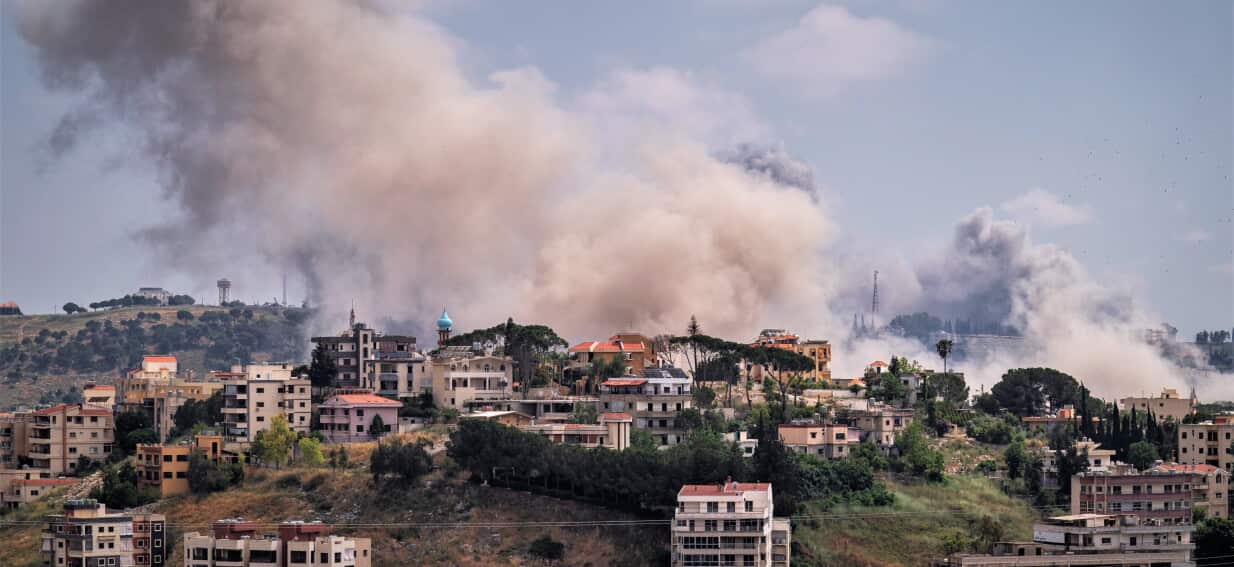
The mechanism designed to bridge this gap is the creation of localized "pilot zones." Under this framework, the LAF is supposed to move into evacuated border villages like Dibbine and Marjayoun to act as a buffer.
This creates an immediate operational bottleneck. If the LAF enters an area where Hezbollah retains hidden infrastructure or cross-border launch capabilities, the state military faces two equally destabilizing choices:
- Confrontation: Engaging Hezbollah directly risks igniting a multi-factional Lebanese civil conflict, an outcome the state's fragile political system cannot survive.
- Collusion: Overlooking Hezbollah’s presence violates the explicit terms of the US-Israel agreement, triggering immediate, retaliatory Israeli airstrikes that destroy LAF infrastructure and render the state a party to the conflict.
This structural vulnerability was demonstrated during previous cessation attempts, notably the short-lived April 16, 2026 truce. Because the underlying enforcement mechanism relied on passive monitoring rather than active interdiction, both sides engaged in low-intensity violations that rapidly escalated back into full-scale kinetic engagements.
The Regional Escalation Loop
The failure to achieve a stable equilibrium in Lebanon cannot be analyzed in isolation from the broader geopolitical theater. Hezbollah's operational decisions are tightly bound to the strategic goals of Iran.
Tehran’s regional strategy treats the Lebanese front as a vital flank in its ongoing conflict with Washington and Jerusalem. The closure of the Strait of Hormuz and recent kinetic exchanges—such as the June 3 strike on a logistical airfield in Kuwait—demonstrate that Iran views regional instability as its primary leverage point. Iranian Foreign Ministry statements have explicitly linked a durable bilateral truce with the United States to a total cessation of Israeli operations in Lebanon.
By forcing the Lebanese government to sign a deal that excludes Hezbollah, Western mediators attempted to isolate the group from its primary sponsor. Instead, this dynamic has reinforced Tehran's resolve. If Hezbollah complies with a unilateral retreat, Iran loses its most effective forward-deployed deterrent against an Israeli strike on its core assets. Therefore, the rejection of the deal on television broadcasts from Al-Manar is an explicit signal that the conflict will remain active until a comprehensive regional settlement is reached.
The Strategic Playbook
Because the current framework relies on a fundamentally flawed enforcement model, policymakers and military strategists must prepare for a distinct sequence of operational shifts.
First, Israel will accelerate its high-tempo target campaign south of the Zahrani River and in the Bekaa Valley, seeking to maximize structural damage to Hezbollah’s remaining mid-tier command nodes before external political pressure forces another diplomatic pause. The IDF will treat the rejection of the accord as explicit justification for expanding its ground operations beyond the current tactical lines.
Second, the Lebanese state’s political authority will erode further. By signing a treaty it cannot enforce, the Beirut administration has exposed its lack of domestic leverage, likely triggering a internal political crisis as sovereign factions blame each other for the ongoing destruction of southern villages.
The only viable path to a functional cessation of hostilities requires discarding the illusion of a separate Lebanon-only track. A stable diplomatic architecture must index the withdrawal of foreign forces directly against a verifiable, phased retreat of paramilitary assets, supervised by an international enforcement coalition with a robust chapter-seven mandate rather than an enfeebled domestic military. Until mediators shift from an exogenous bilateral framework to a comprehensive regional calculations model, any declared truce will remain nothing more than a temporary reduction in the velocity of engagement.