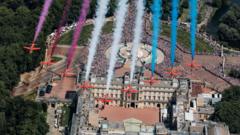
The United Kingdom Ministry of Defence's announcement of a £360 million allocation within the Defence Investment Plan to fully recapitalize its Jet Training System marks the beginning of an inevitable, high-stakes industrial transition. While public attention centers on the survival of the Royal Air Force Aerobatic Team, the Red Arrows, this capital injection addresses a structural failure in the UK's advanced pilot pipeline. The decision to retire both the BAE Systems Hawk T1 and the newer Hawk T2 fleets simultaneously reveals severe operational bottlenecks, escalating asset degradation, and the collapse of a sovereign aerospace manufacturing strategy.
The strategic challenge requires balancing three competing priorities: maintaining a national soft-power asset, stabilizing an unserviceable fast-jet pilot training pipeline, and preserving domestic aerospace manufacturing capacity.
The Economics of Structural Fleet Attrition
The operational crisis facing the Red Arrows is fundamentally an engineering and supply-chain bottleneck. The team remains the world’s sole remaining operator of the Hawk T1, an airframe that entered Royal Air Force (RAF) service in 1979 and was largely withdrawn from broader military operations in 2022.
Operating an isolated, legacy fleet introduces a severe cost-and-maintenance curve governed by two variables:
- Sovereign Component Obsolescence: Because the global supply chain for Hawk T1 parts has contracted, the cost of sourcing, certifying, and manufacturing structural spares and Adour engines scales exponentially.
- Airframe Fatigue Accumulation: Decades of high-G aerobatic maneuvers accelerate microscopic structural fatigue, requiring frequent, invasive non-destructive testing that removes hulls from the operational pool.
This maintenance bottleneck caused the Red Arrows to reduce their standard display formation from nine aircraft to seven. This change was not cosmetic; it was a resource-preservation strategy designed to ration a finite pool of safe flying hours and dwindling engine components ahead of the fleet’s mandatory 2030 Out-of-Service Date (OSD).
[Isolated Legacy Fleet] ➔ [Supply Chain Contraction] ➔ [Exponential Component Cost]
                                                                ↓
[Reduced Display Formation] 🔀 [Accelerated Hull Fatigue] 🔀 [Frequent Technical Downtime]
The Advanced Training Pipeline Bottleneck
The deeper systemic vulnerability lies within the UK Military Flying Training System (UKMFTS) at RAF Valley. The more advanced Hawk T2 fleet, which entered service in 2012 to prepare pilots for frontline Eurofighter Typhoon and F-35 Lightning II platforms, has been plagued by engine reliability issues. These technical failures have reduced daily aircraft availability below the minimum threshold required to graduate fast-jet pilots on schedule.
The Strategic Defence Review's mandate to replace both marks of the Hawk with a single airframe acknowledges that the current training system is broken. Advanced pilot training requires a high-tempo, predictable flight schedule. When engine reliability drops, student pilots experience extended delays between instructional flights. This delay extends the training timeline, increases training costs per pilot, and delays the arrival of fresh personnel to operational frontline squadrons.
By merging the replacement of the Red Arrows' T1 fleet with the UKMFTS T2 fleet, the Ministry of Defence is leveraging procurement scale to drive down unit acquisition costs. However, this strategy links a public-facing display team to the demanding technical requirements of modern combat readiness.
The Industrial Procurement Dilemma
The collapse of Aeralis into administration eliminated the UK's only domestic, clean-sheet modular jet design. This development leaves the Ministry of Defence dependent on foreign aerospace architectures. The upcoming procurement competition must balance three distinct aircraft options against stringent requirements for domestic workshare and technical compatibility.
| Aircraft Contender | Primary Industrial Backers | Core Technical Advantages | Critical Program Risks |
|---|---|---|---|
| T-7A Red Hawk | Boeing, Saab, BAE Systems | High supersonic performance; large-scale US Air Force backing. | Severe cost inflation and software/ejection seat delays in the US program; high complexity via afterburning turbofan. |
| M-346 Master | Leonardo | Proven twin-engine reliability; active operational integration in Italy's International Flight Training School. | High lifetime operating costs due to twin-engine configuration; limited industrial assembly layout in the UK. |
| T-50 Golden Eagle | Korea Aerospace Industries, Lockheed Martin | Highly mature platform (production since 2005); active use by the Black Eagles aerobatic team. | Complex global supply chain integration; potential political friction regarding the scale of UK manufacturing workshare. |
The £360 million funding package represents an initial investment to launch this competition rather than a complete purchase fund for a new fleet. This budget limitation suggests the Ministry of Defence may pursue an alternative financing model. Instead of buying a fleet outright, the government might select a Contractor-Owned, Contractor-Operated (COCO) framework or a deeply structured service-provision lease under UKMFTS. This approach transfers initial asset depreciation risks to private industry but limits the RAF's direct operational control over its airframes.
Strategic Action Plan
The Ministry of Defence must execute a three-part strategy to navigate this transition without halting the pilot training pipeline or grounding the Red Arrows:
- Enforce Strict Flight-Hour Rationing: The RAF must maintain the seven-jet formation limit for the Red Arrows through 2030. It must restrict nine-ship formations strictly to high-value national flypasts to maximize the remaining structural life of the Hawk T1 fleet.
- Uncouple the Avionics Requirements: The procurement specifications must clearly separate the advanced synthetic training environment needed for frontline fighter preparation from the visual display needs of the aerobatic team. Forcing the Red Arrows to adopt complex, combat-simulating avionics suites adds unnecessary unit expense and maintenance overhead.
- Tie Procurement to Local Industrial Infrastructure: The selection panel must penalize bids that do not include final assembly lines, component manufacturing, and long-term depot maintenance within the United Kingdom. This condition is necessary to mitigate future supply-chain risks and retain core aerospace engineering skills domestically.
This video analysis details the operational capabilities and historical context of the outgoing Hawk platform within the Royal Air Force.