Large-scale glacial detachment events do not happen by random chance; they follow a strict sequence of mechanical failure governed by stress accumulation, thermal propagation, and structural fatigue. When an enormous mass of ice shears away from a parent glacier or rock wall, it represents the terminal phase of a destabilization process that has often been unfolding for decades. Understanding this phenomenon requires moving past superficial descriptions of melting ice and examining the specific physical forces that transform a stable cryospheric slope into an active kinetic hazard.
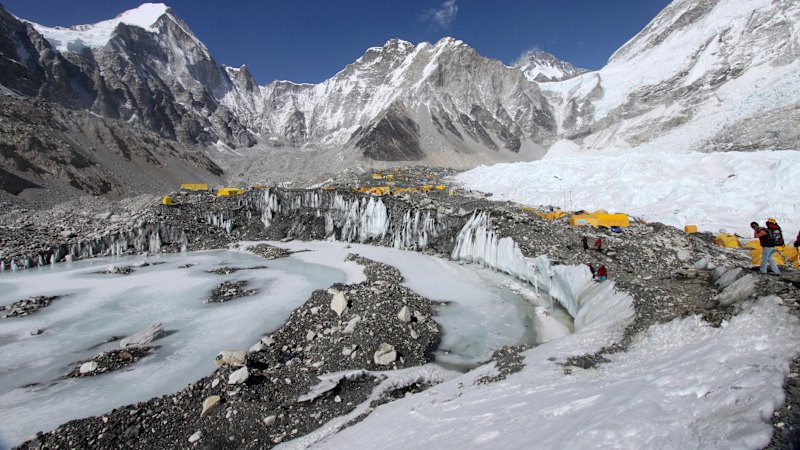
The primary mechanism driving these catastrophic collapses is the progressive degradation of internal shear strength matched with the external pressures of meltwater infiltration. Glaciers and hanging ice masses rest on sloping bedrock or adhere to adjacent ice fields through friction and internal cohesion. Under normal operating conditions, these forces maintain a state of static equilibrium. However, when ambient temperatures rise and volumetric melt increases, water enters micro-fractures and crevasse networks. This introduces two distinct mechanical vectors: hydrostatic pressure that forces fractures open from within, and thermal lubrication that reduces the baseline friction coefficient at the bed interface.
To systematically evaluate the precursor conditions of such failures, analysts must examine three core structural variables: basal hydrology, thermal profile shifts, and geometric overloading.
The first variable, basal hydrology, dictates how effectively meltwater can drain from the interior of the ice mass. If drainage channels are narrow or choked by debris, internal water pressure spikes. This converts static weight into an active hydraulic wedge, accelerating the propagation of tensile cracks perpendicular to the primary stress axis.
The second variable involves thermal profile shifts. As latent heat penetrates deeper into the firn and ice layers, the internal temperature approaches the pressure-melting point. Cold ice behaves with high brittle strength; warm, temperate ice deforms through ductile creep. The transition zone between these thermal regimes creates high localized shear stress concentrations, forming a natural slip plane where mechanical failure can initiate with minimal warning.
The third variable is geometric overloading. Glaciers lose mass at their termini while accumulating or maintaining mass in accumulation zones, creating unnatural strain gradients. If the toe of an ice mass thins out, it can no longer provide the structural buttressing required to hold back the upper sections. This structural starvation leads directly to catastrophic gravitational slumping.
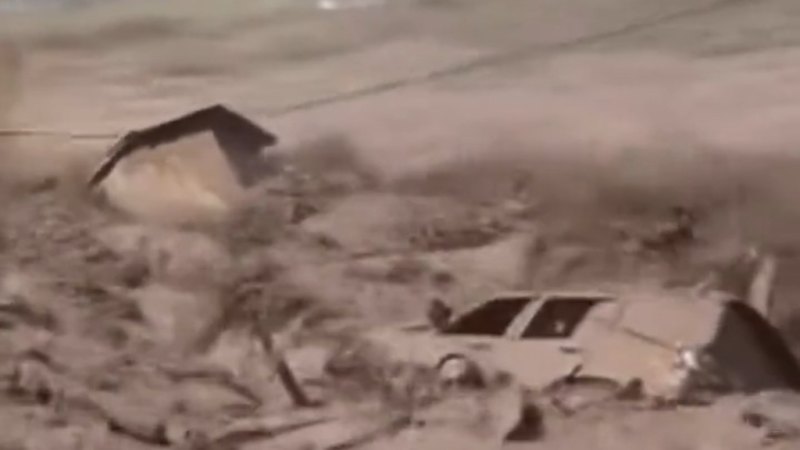
When assessing the kinetic energy released during a major detachment event, standard observational metrics often prove inadequate. Eyewitness accounts describing scenarios where it sounded like a bomb exploded point to the sudden release of stored elastic strain energy combined with sonic shockwaves generated by supersonic block fracturing. As millions of cubic meters of ice break loose, the material undergoes rapid fragmentation. This transforms a solid block into a chaotic flow of ice, rock, and fluidized debris that behaves similarly to a high-density avalanche.
The downstream impact of this material depends entirely on the canyon morphology and the presence of pre-existing proglacial lakes. If the detachment zone feeds directly into a steep, narrow gorge, the kinetic energy is channeled linearly, amplifying destructive velocity. Conversely, if the mass impacts a body of water, it displaces massive volumes instantly, generating displacement waves that can overtop containment dams or scour valley walls miles below the source zone.
Predicting these events demands continuous monitoring frameworks that track surface velocity vectors rather than simple area retreat metrics. Interferometric synthetic aperture radar and high-resolution GPS arrays can detect subtle surface acceleration phases weeks or months before final structural rupture occurs. When a glacier transitions from steady-state creep to exponential surface acceleration, the underlying mechanical framework has breached its yield strength threshold.
Mitigating risk in vulnerable regions requires abandoning reactive disaster response in favor of predictive threshold modeling. Infrastructure planning downstream of hanging glaciers must account for worst-case kinetic discharge volumes, treating the ice mass not as a static landscape feature, but as a loaded mechanical system operating near its structural limit. Real-time seismic monitoring of micro-fracturing activity remains the most reliable diagnostic tool for identifying the transition from stable deformation to terminal failure.