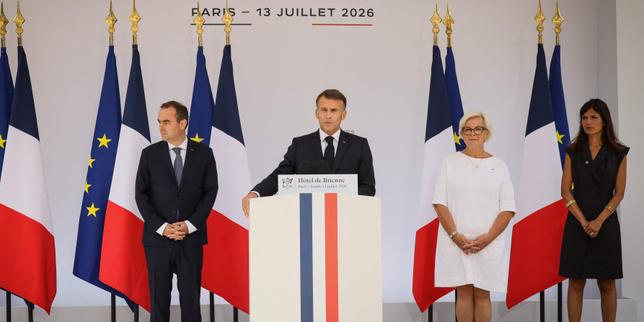
The strategic architecture of Western defense is shifting from a consumption-based security model to an asset-heavy, production-driven paradigm. In his final traditional address to the armed forces at the Hôtel de Brienne, President Emmanuel Macron outlined a ten-year balance sheet that seeks to codify this transition. However, evaluating this posture requires looking past political rhetoric and examining the cold mechanics of military capitalization, fiscal constraints, and industrial throughput.
The core challenge of modern defense policy is not merely the accumulation of financial capital, but its conversion into high-readiness operational units. The European security landscape no longer yields what economists call the "peace dividend"—the systemic reallocation of defense budgets into social infrastructure. Instead, the modern strategic landscape imposes an escalating cost function on sovereignty, driven by state-level non-linear threats, industrial bottlenecks, and the return of conventional, high-intensity attrition warfare.
The Capital Conversion Function: Doubling Budgets vs. Real Capacity
The headline metric of the current French defense strategy is a nominal doubling of the annual military budget, projected to reach €64 billion by 2027, compared to a baseline of €32 billion in 2017. This trajectory represents an aggregate allocation equivalent to approximately 2.5% of gross domestic product (GDP).
While a 100% nominal increase suggests a profound expansion of hard power, input metrics (euros spent) do not automatically equate to output metrics (combat-ready battalions, advanced munitions stocks, and deployment velocity). The efficacy of this capital infusion is governed by a strict conversion function, which is currently limited by three specific structural bottlenecks.
+------------------+     (Structural Bottlenecks)     +--------------------+
|  Input Capital   | ---> [Industrial Capacity]  ---> | Operational Output |
| (€64B by 2027)  |      [Labor & Raw Materials]      | (Combat Readiness) |
+------------------+      [Monetary Inflation]        +--------------------+
The Industrial Lead-Time Constraint
Military supply chains cannot scale production symmetrically with budget increases. The transition to what has been termed a "war economy" requires defense contractors to shift from artisanal, low-volume manufacturing to high-rate serialized production. For complex systems like the Rafale fighter or Caesar self-propelled howitzers, production acceleration is throttled by specialized tool-and-die manufacturing, advanced microelectronics sourcing, and the procurement of high-grade metallurgical inputs. Consequently, capital deployed in 2026 may not yield physical assets on the tarmac or the front line until 2029 or later.
The Labor and Resource Cost Curve
The defense sector is competing for highly technical labor—such as systems engineers, cybersecurity specialists, and precision machinists—against a highly competitive commercial technology sector. As the state injects billions into defense procurement, the immediate effect is a steepening cost curve for labor and raw materials. A significant portion of the budget increase is absorbed by internal cost inflation rather than expanding the net inventory of hardware.
The Maintenance and Sustainability Debt
A significant portion of the €64 billion allocation is structurally earmarked for legacy asset maintenance and the stabilization of personnel retention rates. Over the previous two decades, sub-baseline funding resulted in a deep maintenance deficit, meaning that current capital must first serve to repair and sustain existing frameworks before it can finance net-new capabilities.
The Three Pillars of Contemporary Strategic Autonomy
The execution of France’s updated Military Programming Law (Loi de Programmation Militaire) rests upon three interdependent strategic pillars designed to address the erosion of international legal frameworks and the rise of hybrid warfare. Each pillar carries clear operational mandates and structural vulnerabilities.
       +-------------------------------------------------------+
       |     PILLARS OF CONTEMPORARY STRATEGIC AUTONOMY        |
       +-------------------+-------------------+---------------+
                           |                   |
                           v                   v
+----------------------------+  +----------------------------+  +----------------------------+
| Pillar 1: Mass & Attrition |  | Pillar 2: Deep Sovereignty |  | Pillar 3: Nuclear Security |
| - Munitions & Reserves     |  | - Space & Cyber Domains    |  | - Advanced Deterrence      |
| - Operational Readiness    |  | - Electro-Optical Assets   |  | - Strategic Backstop       |
+----------------------------+  +----------------------------+  +----------------------------+
1. Mass and Attrition Capacity
Decades of asymmetric counter-insurgency operations in the Sahel led Western militaries to optimize for expeditionary efficiency rather than conventional mass. Current doctrine explicitly pivots back toward high-intensity preparedness.
The primary objective here is an immediate, aggressive expansion of munitions reserves. High-intensity conflicts consume artillery shells, air-defense interceptors, and precision-guided missiles at rates that dwarf peacetime industrial capacity. The current strategy mandates a €36 billion supplementary effort between 2026 and 2030 to build structural depth, ensuring the armed forces can sustain a prolonged conventional engagement without exhausting their inventory in the opening weeks of conflict.
2. Multi-Domain Deep Sovereignty
Modern warfare has eliminated the distinction between the rear guard and the front line. The strategic framework focuses on expanding capabilities across non-traditional domains, specifically space, cyber, and deep-strike vectors.
- Space Domain: Capital is flowing toward low-Earth-orbit surveillance constellations and anti-satellite resilience. Control over orbital infrastructure dictates tactical performance on the ground.
- Cyber-Information Domain: The state is investing heavily in offensive and defensive cyber units to counter asymmetric, gray-zone operations designed to destabilize civil infrastructure and manipulate public perception.
- Deep Strike: Enhanced funding for deep-strike assets—such as long-range cruise missiles and loitering munitions—is meant to establish a credible anti-access/area-denial (A2/AD) envelope.
3. The Nuclear Deterrence Backstop
France remains the sole native nuclear-armed power within the European Union. The strategy re-emphasizes the modernization of both components of the French nuclear deterrent: the sea-based ballistic missile submarines (SSBNs) and the airborne cruise-missile vectors. In a degraded geopolitical environment where nuclear signaling has re-emerged as an active tool of coercive statecraft, the conventional build-up is viewed not as a replacement for deterrence, but as an essential ladder of escalation that prevents early reliance on nuclear alternatives.
The Macroeconomic Imperative: Non-Debt Financed Rearmament
A defining characteristic of this defense posture is the explicit refusal to fund the €64 billion target through sovereign debt expansion. The underlying economic thesis states that military independence cannot exist in tandem with fiscal vulnerability.
To achieve a balanced equation, the state relies on a self-funding economic model:
$$ \Delta D_x = \Delta Y \cdot t + \Delta P_m $$
Where:
- $\Delta D_x$ represents the increase in defense expenditure.
- $\Delta Y \cdot t$ represents the incremental tax revenues generated by expanding aggregate domestic economic activity ($Y$) at the prevailing tax rate ($t$).
- $\Delta P_m$ represents domestic military production gains that replace imports and stimulate industrial exports.
This model treats defense expenditures as an economic multiplier rather than a sunk cost. By localizing supply chains for advanced platforms, state spending directly fuels high-value industrial manufacturing, technology spin-offs, and regional employment.
However, this fiscal approach carries a distinct risk: it relies entirely on sustained domestic economic growth and industrial productivity. If GDP growth stalls or structural industrial bottlenecks prevent the expansion of production lines, the state will face a difficult trade-off: either accept a widening fiscal deficit or scale back the planned military procurement targets.
The Strategic Path Forward
To translate increased defense spending into verifiable, scalable combat readiness, defense planners must shift their focus from high-level budget allocations to execution-level metrics.
First, procurement models must abandon highly customized, low-volume designs in favor of industrial standardization across European partners. Reducing component complexity is the only reliable way to compress production timelines from years down to months.
Second, the state must establish long-term, multi-year purchasing guarantees for core defense suppliers. Private defense firms cannot justify investing capital into expanding factories or securing raw material stockpiles without multi-decade demand visibility.
Ultimately, the true test of this capital-to-combat transition will not be measured by the size of the financial commitments made in Paris, but by the physical volume of ammunition, heavy equipment, and integrated systems delivered directly to operational units.