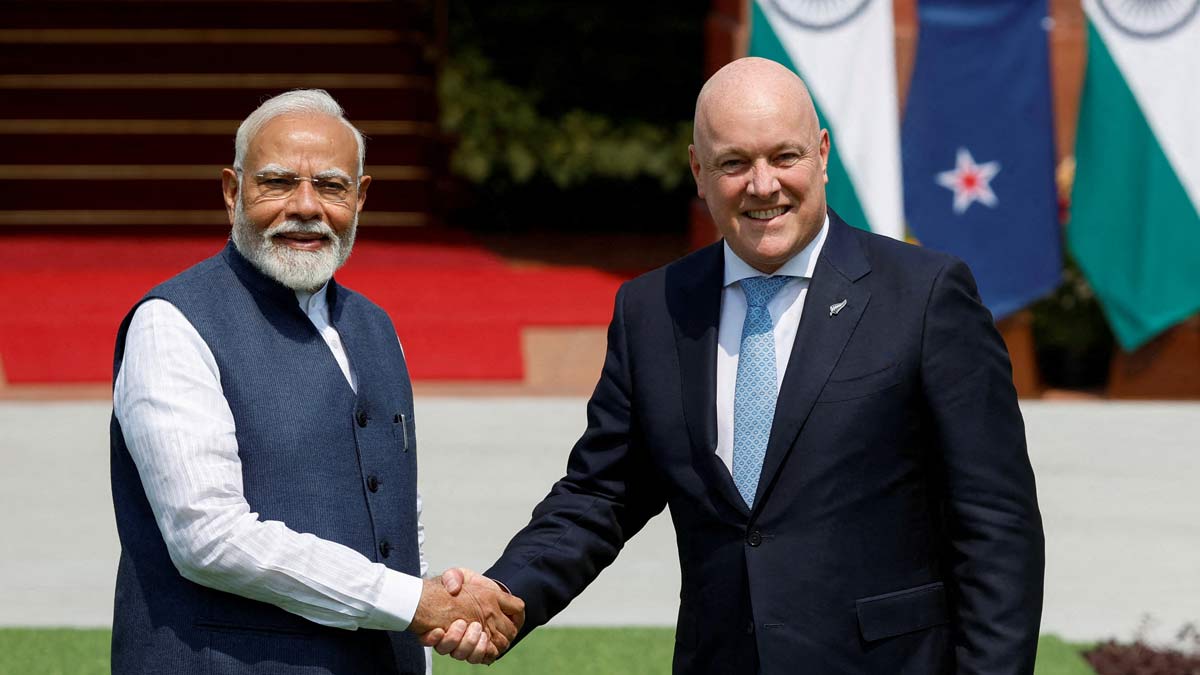
The realization of the India-New Zealand Free Trade Agreement (FTA) and the subsequent elevation of bilateral ties to a Strategic Partnership mark a structural shift in regional trade mechanics rather than a simple diplomatic milestone. Prime Minister Narendra Modi’s visit to Auckland—the first by an Indian head of government in four decades—codifies a trade architecture designed to systematically re-engineer bilateral economic flow. The core commercial objective is explicitly defined: scale two-way trade from its current baseline to NZ$7 billion (approximately ₹35,000 crore) by 2030. Achieving this target requires unpacking the underlying economic variables, operational mechanisms, and structural asymmetries that govern this framework.
The Structural Mechanics of Tariff Elimination and Market Access
The bilateral trade baseline prior to the agreement exhibited a modest trajectory, with merchandise trade hovering at $1.16 billion in FY2026. While representing an 8% compound annual growth rate (CAGR) from FY2022, the volume remained severely constrained by historical tariff walls and regulatory bottlenecks.
The primary mechanism for immediate volume acceleration is the day-one tariff liberalization strategy implemented by Wellington. New Zealand has eliminated tariffs on more than 50% of its import lines from India immediately, transitioning toward total duty-free access across key product categories.
The trade logic functions as a complementary economic matrix, pairing New Zealand's resource-heavy, high-yield primary sectors with India’s manufacturing and demographic scale.
- Indian Export Optimization: Indian manufacturers gain immediate cost advantages in engineering goods, organic chemicals, machinery, electronics, and textiles. By stripping away border taxes, Indian industrial products shift down the price-elasticity curve in the New Zealand consumer and industrial markets, undercutting competitors locked into standard Most-Favored-Nation (MFN) tariff rates.
- New Zealand Primary Sector Integration: New Zealand’s export strategy targets India’s expanding consumer class by deploying its advanced capabilities in dairy science, horticulture, and forestry. Rather than directly competing with sensitive domestic Indian agricultural segments, the framework emphasizes the development of global food value chains, integrating New Zealand’s agricultural yield into India's mega food parks and agri-tech infrastructure.
Service Sector Liberalization and the De Facto Barrier Problem
The scope of this agreement extends deep into services and labor economics, addressing structural bottlenecks that have historically suppressed bilateral services trade. New Zealand has opened its services market across 118 distinct sectors and granted MFN treatment across 139 sectors. This represents Wellington's most permissive services commitment in a contemporary trade pact.
A critical friction point in international services trade is the deployment of non-tariff barriers, specifically the administrative delays associated with technical talent mobility. Long processing times and restrictive visa frameworks function as de facto non-tariff barriers that impede corporate agility. The FTA addresses this cost function through concrete, legally binding mobility mechanisms:
- Skilled Mobility Channels: The agreement formalizes streamlined pathways for Indian professionals and high-skilled workers, directly targeting the high-tech, engineering, and digital services sectors.
- Educational Capital and Post-Study Visa Architectures: Indian students in New Zealand are granted working rights of up to 20 hours per week during academic terms. More critically, the agreement introduces extended post-study work visas of up to four years depending on qualification levels. This mechanism establishes a predictable talent pipeline, allowing New Zealand firms to absorb Indian human capital while mitigating domestic labor shortages in high-skill sectors.
Capital Allocation and the Fifteen-Year Investment Horizon
Trade agreements yield minimal long-term utility without corresponding capital mobility. To anchor the commercial architecture, New Zealand has committed to an institutional investment target of $20 billion in India over the next 15 years. This capital allocation strategy bypasses volatile equity markets, focusing instead on long-term fixed capital formation and infrastructure development.
The deployment of this capital is structurally aligned with India’s domestic economic modernization goals, specifically targeting sectors characterized by high capital expenditure requirements and technological intensity. New Zealand institutional investors and corporate entities are positioning capital across several core operational fields:
- Logistics and Civil Aviation: Modernizing supply chain corridors, cold-storage networks for agricultural distribution, and supporting India’s rapid commercial aviation expansion.
- Urban Infrastructure and Resource Management: Deploying specialized technologies in water management, industrial waste processing, and urban mobility frameworks across tier-1 and tier-2 Indian metropolitan areas.
- The Digital and Financial Ecosystem: Directing venture and growth capital into India's fintech networks, decentralized infrastructure, and emerging technology startups to leverage local engineering scale.
Maritime Geopolitics and the Indo-Pacific Security Core
The transition from a purely transactional trade relationship to a formal Strategic Partnership is dictated by shared maritime geography and the geopolitics of the Indo-Pacific sea lanes of communication. Both nations operate as democratic, maritime-dependent economies whose supply chain stability relies on an open, rules-based regional order.
The security architecture underpinning the commercial pact is anchored by the implementation of the bilateral Memorandum of Understanding on Defence Cooperation. This operational framework shifts security ties from occasional diplomatic alignment to structured, recurring military interoperability.
The collaborative blueprint is evidenced by joint operations within the Combined Task Force 150 (CTF-150) framework, where New Zealand has assumed operational command with India serving as Deputy Commander. This operational integration delivers distinct maritime security outcomes:
- Interdiction Operations: Executing synchronized maritime patrols to deter narcotics smuggling, maritime terrorism, and illicit trade networks in the Western Indian Ocean and Middle Eastern maritime corridors.
- Sea Lane Protection: Establishing shared protocols for maritime safety and domain awareness, ensuring that critical trade choke points remain insulated from state and non-state disruption.
- Defence-Industrial Roadmap: Initiating a structured framework for bilateral defence industry collaboration, aiming to co-develop security technologies and streamline port-visit logistics for naval assets.
Framework Counterweights and Structural Friction Points
A rigorous analysis demands outlining the inherent limitations and friction points embedded within the agreement. The execution phase faces non-trivial headwinds.
First, the asymmetric scale of the two economies presents a structural imbalance; India’s massive domestic market can easily absorb New Zealand's total national export output, whereas New Zealand's domestic market of five million consumers imposes a hard ceiling on the absolute volume of Indian manufactured goods it can consume.
Second, while the agricultural provisions focus on value chains and technical cooperation, complete tariff elimination on highly sensitive agricultural commodities remains politically constrained due to India’s domestic farming protection frameworks. Navigating sanitary and phytosanitary (SPS) measures will require continuous regulatory alignment to prevent technical barriers from replacing the dismantled tariffs.
The Strategic Playbook
To capitalize on the newly established trade architecture, market participants must pivot from exploratory market research to active capital and operational deployment.
Indian engineering, textile, and technology firms should immediately recalibrate their export pricing models to account for the day-one tariff exemptions, positioning product lines to capture market share in Oceania before competing regional exporters can adjust.
Concurrently, corporate entities leveraging cross-border talent must establish formalized recruitment pipelines that utilize the four-year post-study work visa framework, treating New Zealand as a strategic regional hub for high-skill operations.
Institutional investors should align their 15-year capital deployment strategies directly with India’s national infrastructure pipelines—specifically targeting cold-chain logistics and urban waste management systems—where New Zealand's technical IP can be scaled across India's high-density urban corridors.