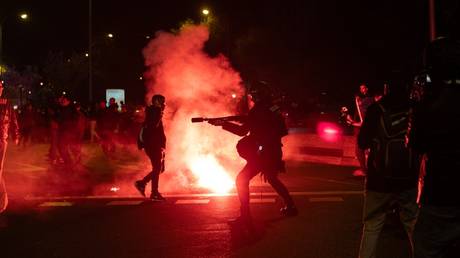
Public demonstrations outside the Spanish Ministry of Transport following a fatal rail disaster are not spontaneous emotional outbursts; they are the predictable equilibrium outcome of asymmetric accountability in state-managed monopolies. When physical infrastructure fails catastrophically, the immediate kinetic response at the administrative headquarters signals a breakdown in the institutional trust contract between commuters, operators, and regulatory oversight bodies. Standard media coverage focuses on the immediate street-level friction—the chants, the police cordons, and the viral video clips—while ignoring the structural mechanics that convert a technical rail failure into an acute political legitimacy crisis.
To evaluate the crisis outside the Ministry of Transport accurately, one must separate the proximate physical failure on the tracks from the systemic governance failures that precede and follow it. The public anger directed at the ministry stems from three distinct operational deficits: principal-agent misalignment in rail maintenance, opacity in post-incident root-cause attribution, and the erosion of perceived regulatory independence. You might also find this connected article useful: What Most People Get Wrong About the Arab Vote and Israeli Election Deadlocks.
The Structural Mechanics of Post-Disaster Public Outrage
In high-reliability transit networks, safety relies on redundant defense-in-depth protocols. When those protocols fail, public reaction follows a rigid behavioral trajectory governed by risk perception theory and institutional economics.
1. The Asymmetric Risk-Reward Equation
Commuters enter an implicit contract with state transit authorities. In exchange for ticket revenue and tax subsidies, the state guarantees baseline physical safety through rigorous capital expenditure (CapEx) and preventive maintenance (OpEx). As highlighted in detailed reports by BBC News, the effects are significant.
The asymmetry occurs because operational efficiency gains—such as deferred track maintenance or aggressive scheduling to meet political punctuality targets—accrue visibly to administrators in the short term. Conversely, the tail risk of catastrophic failure is borne entirely by the ridership. When a disaster materializes, the public immediately recognizes that their safety was traded against administrative metrics. Protests outside the central ministry represent an attempt by the principals (the public) to impose immediate political costs on the agents (ministry officials) who insulated themselves from physical risk.
2. Attribution Bias and Centralized Accountability
Modern European rail networks often operate under unbundled models, separating infrastructure management (such as Spain's ADIF) from train operations (such as Renfe), alongside private competitors introduced via rail liberalization. While technically distinct, this corporate fragmentation dissolves in the public consciousness during a crisis.
Because the Ministry of Transport sets the overarching budgetary constraints, appoints executive leadership, and oversees the safety regulator, demonstrators bypass corporate subsidiaries and target the sovereign ministry directly. This is a rational heuristic. In systems characterized by diffused operational responsibility, accountability inevitably centralizes at the highest node of budgetary and regulatory authority.
The Three Pillars of Institutional Failure in Transit Crises
Analyzing historical rail disasters across OECD nations reveals that street-level unrest escalates proportionally to three specific administrative missteps in the immediate aftermath of an accident.
- Information Asymmetry and Narrative Vacuums: Immediately following a derailment or collision, technical telemetry—data from event recorders, signaling logs, and track geometry sensors—is sequestered by investigators. If the ministry fails to establish a transparent communication cadence during this technical blackout, public discourse fills the vacuum with hypotheses of negligence or cover-ups. Silence is interpreted not as procedural caution, but as institutional self-preservation.
- The Regulatory Capture Perception: When the accident investigation body operates under the structural or financial umbrella of the same ministry responsible for running the trains and maintaining the tracks, the investigation lacks baseline credibility. Protesters demand external accountability precisely because internal audits violate the fundamental governance principle of independent verification.
- Historical Pattern Recognition: Public fury rarely erupts over a truly isolated, black-swan mechanical failure. Mobilization occurs when a disaster aligns with pre-existing commuter grievances—chronic delays, aging rolling stock, documented union warnings regarding staffing shortages, or previous near-miss incidents that went unaddressed. The disaster acts as a catalyst that validates prior, ignored warnings.
Deconstructing the Protest Dynamics at the Ministry
The physical gathering outside the Spanish Transport Ministry functions as both a signaling mechanism and a pressure tactic. Understanding the composition and demands of these demonstrations requires breaking down the participating cohorts and their distinct objectives.
The Operational Cohort: Rail Unions and Technical Staff
Frontline workers—train drivers, signalers, and maintenance crews—often form the organizational backbone of post-disaster demonstrations. Their involvement shifts the protest from pure grief to technical indictment. Unions possess insider knowledge of deferred maintenance schedules, budget cuts to track inspection teams, and staffing ratios. When technical staff publicly protest the ministry, it destroys the administration's ability to frame the disaster as an unforeseeable accident or isolated human error. It reframes the event as a predictable outcome of management policy.
The Commuter Cohort: The Captive Customer Base
Unlike consumer markets where safety failures result in immediate brand switching and revenue collapse, regional and commuter rail networks operate as natural monopolies. Daily commuters cannot easily substitute their transit mode without incurring severe economic penalties. Deprived of market exit mechanisms, commuters rely entirely on political voice. Physical protest at the ministry is the direct application of political voice when market exit is impossible.
The Media Amplification Loop
Modern protest dynamics are heavily conditioned by visual media distribution. Viral footage of confrontations between grieving citizens, workers, and riot police outside a government building creates a secondary crisis for the administration. The visual contrast between state security apparatus and unarmed citizens demanding safety accountability degrades the ministry's moral authority faster than any technical report could.
Operational Limitations of Standard Crisis Responses
Ministries typically respond to post-disaster protests using a standardized public relations playbook. In high-stakes infrastructure failures, these standard interventions routinely fail and frequently exacerbate unrest.
The Fallacy of Immediate Executive Scapegoating
A common political reflex is to demand the immediate resignation of mid-level operational directors or isolated technical operators. While this offers temporary political relief, it fails to address systemic vulnerabilities. If a signaling failure or track defect stemmed from multi-year underfunding of preventive maintenance, replacing an executive does not alter the physical risk profile of the network. Informed protesters and unions recognize scapegoating as an evasion of structural reform, prolonging the mobilization.
The Limits of Financial Compensation Announcements
Announcing rapid compensation funds for victims and families is necessary for humanitarian relief, but ineffective as a crowd-control or legitimacy-restoring measure. Financial restitution addresses past harm; protests outside a transport ministry are fundamentally forward-looking demands for systemic risk reduction. Commuters want assurance that the system they must ride the next morning is structurally sound.
Procedural Deflection Through Long-Term Commissions
Establishing a multi-year parliamentary inquiry or technical commission often triggers further anger when used as a shield against immediate questions. While formal engineering investigations require months of metallurgical testing and data reconstruction, hiding behind ongoing inquiries to avoid releasing basic factual timelines—such as the date of the last track inspection or the status of known safety alerts—erodes public trust.
Tactical Framework for Post-Incident Governance
To stabilize institutional legitimacy and prevent sustained civil disruption following a major transport failure, administrative leadership must abandon defensive public relations in favor of radical operational transparency and structural decoupling.
- Decouple Investigation from Administration Immediately: Transfer full authority over physical evidence, telemetry, and black-box data to an autonomous, third-party engineering body with zero budgetary ties to the Transport Ministry. Publicly verify this chain of custody within 24 hours of the incident to neutralize accusations of institutional interference.
- Publish Raw Maintenance and Inspection Logs: Bypass filtered press releases by releasing unedited historical inspection records, maintenance deferral logs, and union safety filings related to the affected corridor. Transparency regarding known vulnerabilities, even when unflattering to the administration, demonstrates institutional honesty and allows independent experts to validate the scope of the problem.
- Implement Immediate, Visible Risk Mitigation: If a specific mechanical, signaling, or track geometry issue is suspected, impose immediate, conservative operational restrictions across similar assets—such as mandatory speed reductions or heightened manual inspection intervals—prior to the final investigation report. Accepting short-term punctuality losses to guarantee physical safety directly reverses the asymmetric risk-reward perception that fuels public anger.
- Establish Direct Technical Briefings: Replace political spokespeople with lead safety engineers for daily public briefings. Technical personnel should explain the exact physics of the failure, the parameters of the investigation, and the specific engineering criteria required before normal operations resume.
- Ring-Fence Infrastructure Maintenance Budgets: Restructure capital allocation mechanisms so that preventive maintenance funds for critical safety systems are legally protected from executive reallocation or austerity cuts. Publishing a transparent, audited ledger of safety-critical CapEx and OpEx execution shifts the governance model from opaque bureaucratic discretion to verifiable public accountability.
The strategic priority for the Spanish Ministry of Transport is not managing the optics of the demonstrations outside its doors, but dismantling the structural opacity that brought the demonstrators there. Without verifiable separation between regulatory oversight and operational management, combined with immediate transparency regarding maintenance deficits, every subsequent service disruption will reignite the exact same crisis of legitimacy.