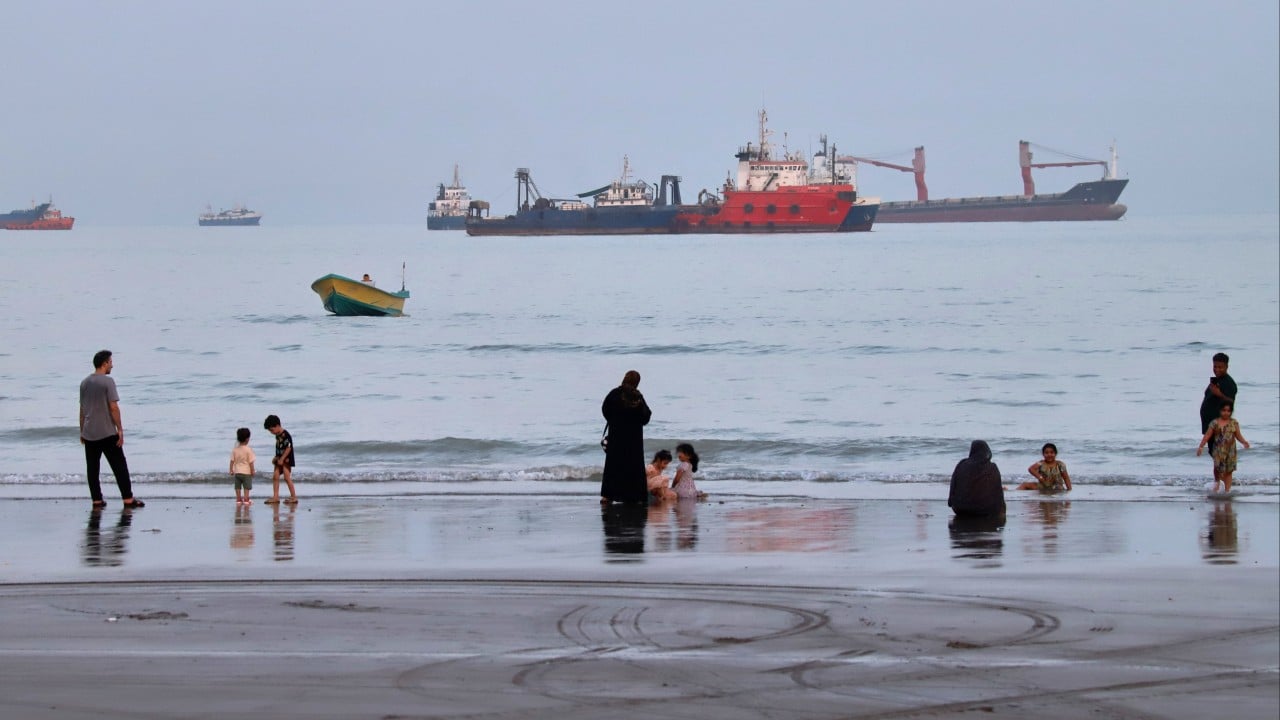
The physical closure of the Strait of Hormuz has transformed from a tactical disruption into a structural restructuring of global energy transit. When the United Arab Emirates reported that a missile launched by Iran struck a state-owned Abu Dhabi National Oil Company tanker, it underscored a persistent operational reality: maritime security in the Persian Gulf has deteriorated past the point of diplomatic posturing. Simultaneously, Tehran announced that bilateral negotiations with Oman regarding the future administration of the waterway are nearing finalization. Evaluating these parallel developments requires stripping away political rhetoric to examine the underlying mechanisms of chokepoint leverage, naval economics, and regional power distribution.
The Economic Mechanics of the Hormuz Blockade
Before the outbreak of hostilities involving US and Israeli strikes against Iranian targets, the Strait of Hormuz accommodated approximately one-fifth of global petroleum and liquefied natural gas consumption. The systematic interruption of this transit corridor is not merely a byproduct of collateral combat damage; it functions as a deliberate economic strategy executed by Tehran to exert pressure on global markets and extract geopolitical concessions.
The mechanism relies on two distinct vectors:
- Physical Interdiction and Asset Attrition: State-backed missile and drone targeting systems have rendered commercial transit unviable for companies unwilling to absorb astronomical war-risk insurance premiums. Abu Dhabi National Oil Company records indicate that 15 of its vessels have sustained direct hits since the commencement of the conflict.
- Regulatory Coercion and Toll Imposition: Iran seeks to establish a formal administrative framework wherein commercial vessels transiting the corridor are subjected to mandatory route alignment, inspection protocols, and potential transit tariffs.
This creates a structural bottleneck. While international maritime law traditionally protects freedom of navigation in international straits, kinetic realities on the water override legal norms. The unilateral imposition of an effective blockade shifts the baseline assumption of transit from an open global commons to a regulated, conditional utility managed under threat of force.
The Diplomatic Divergence Between Oman Talks and Tactical Realities
The ongoing diplomatic track mediated through Oman reveals a fundamental split between high-level diplomatic signaling and operational military objectives. Iranian Foreign Minister Abbas Araghchi stated that talks in Muscat to establish geographical parameters for a new shipping route are approaching their final stages. However, Tehran has explicitly decoupled these administrative negotiations from the immediate resumption of unrestricted maritime traffic.
The Iranian Islamic Revolutionary Guard Corps issued statements clarifying that the physical reopening of the strait operates under an independent military mechanism. Two distinct variables govern this separation:
- Pre-conditions and Restitution: Tehran maintains that any full normalization of traffic depends on formal compensation for perceived violations of prior diplomatic understandings by Washington, alongside the cessation of external interference in regional governance structures.
- Asymmetric Escalation Dominance: By continuing kinetic operations against vessels perceived as circumventing preferred lanes—such as the recent attack on the Abu Dhabi National Oil Company asset—the military apparatus ensures its institutional leverage remains intact regardless of civilian diplomatic concessions.
Consequently, any prospective agreement between Iran and Oman concerning lane coordination represents a framework for regulated passage rather than unconditional demilitarization. It institutionalizes a new baseline of regional sovereignty over a critical global artery.
The Cost Function for Regional Energy Exporters
For energy exporters in the Gulf, the protracted closure of the strait forces an immediate recalculation of logistics, risk management, and market share. Pipeline alternatives designed to bypass the chokepoint—such as the Habshan-Fujairah pipeline in the United Arab Emirates or the East-West pipeline in Saudi Arabia—possess finite volumetric capacity. They cannot fully absorb the throughput previously handled by supertankers navigating the Hormuz corridor.
This structural limitation imposes three immediate operational penalties on producers:
- Throughput Compression: Total export volumes are artificially constrained, forcing producers to accept lower production quotas or accumulate excess inventory onshore.
- Elevated Freight and Insurance Structures: Vessels willing to navigate contested waters must price in catastrophic loss probabilities, inflating per-barrel transportation costs.
- Strategic Vulnerability to Secondary Chokepoints: Exporters attempting to route supplies via alternative maritime exits face secondary risks, exemplified by concurrent disruptions in the Red Sea and the Bab el-Mandeb strait managed by allied regional actors.
These pressures erode the traditional revenue stability enjoyed by Gulf state-owned enterprises, shifting capital expenditure priorities away from expansion toward defense, diplomatic insurance, and logistical redundancy.
Strategic Outlook and Operational Adaptation
The convergence of targeted maritime strikes and advanced administrative negotiations with Oman indicates that the post-war security architecture of the Persian Gulf will not revert to the pre-conflict status quo. The capability to project power into the strait has allowed Tehran to force a structural renegotiation of transit terms, challenging the historical enforcement of open navigation by external naval powers.
Energy market participants and shipping operators must abandon models that treat the Hormuz corridor as a frictionless, low-cost utility. Strategic planning must now incorporate long-term transit volatility, permanent regulatory oversight by littoral states, and the persistent risk of localized kinetic engagement. Resilience in this environment requires diversified supply chains, flexible contractual mechanisms that distribute war-risk exposure, and continuous real-time threat evaluation across all Gulf transit lanes.

/cdn.vox-cdn.com/uploads/chorus_asset/file/22155007/doc_ock.jpg)