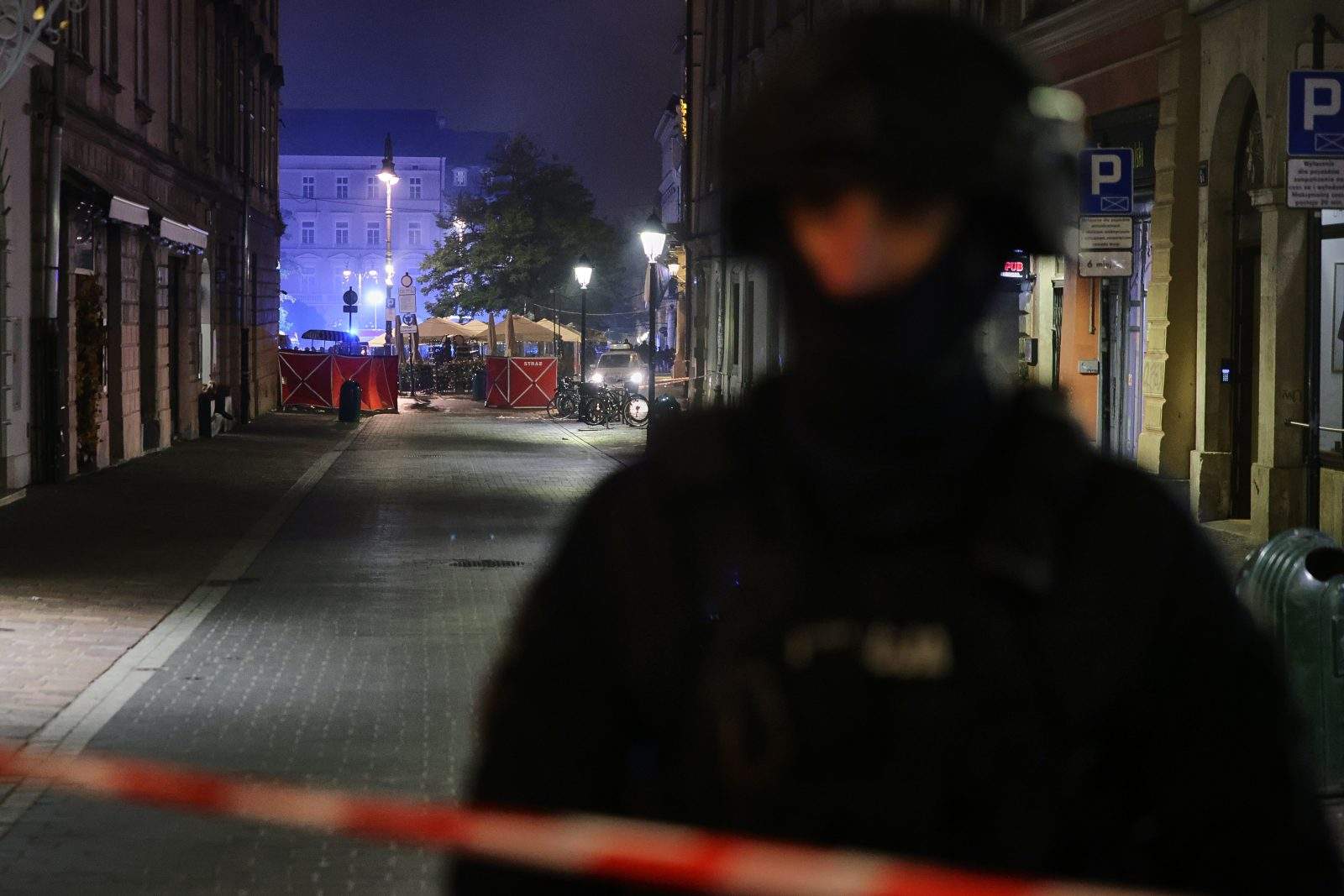
Mass casualty shootings in densely populated European urban centers like Krakow expose a specific operational vulnerability: the collision between high pedestrian throughput and low baseline kinetic security. When an active shooter event results in 6 fatalities and 15 injuries, the outcome is rarely the product of random chance. Instead, it is governed by predictable physical, spatial, and temporal variables. Standard news coverage treats these events as isolated anomalies, focusing on immediate casualty counts while ignoring the underlying mechanics of crowd dynamics, emergency medical triage, and law enforcement neutralization timelines. Analyzing the Krakow incident through a rigorous operational lens requires stripping away emotional narratives to examine the exact failure points in urban threat mitigation and the mathematical realities of active shooter containment.
The Temporal Mechanics of Active Shooter Events
The lethality of an active shooter incident is a direct function of time. Specifically, casualty rates scale linearly—and occasionally exponentially—with the duration of unopposed shooter activity. In security analysis, this is measured as the Neutralization Window: the elapsed time between the first discharged round and the moment the perpetrator is killed, captured, or incapacitated. Meanwhile, you can explore other stories here: What Happened When Paraguay’s Ousted President Fernando Lugo Faced Prosecutors.
Every active shooter event divides into three distinct chronological phases:
- The Initiation Phase (0 to 90 Seconds): The perpetrator transitions from concealed movement to active engagement. During this window, cognitive friction—often termed the normalcy bias—prevents bystanders from immediately recognizing gunfire. Victims frequently misinterpret muzzle blasts as construction noise, vehicle backfires, or pyrotechnics. This delay grants the shooter uncontested control of the immediate environment, accounting for the highest concentration of initial fatalities.
- The Dispatch and Transit Phase (90 Seconds to 4 Minutes): Acoustic detection or emergency calls trigger law enforcement dispatch. In historic European city centers like Krakow, medieval street grids, pedestrian-only zones, and physical anti-vehicle bollards create severe transit bottlenecks for motorized tactical units. Patrol officers must often abandon vehicles at the perimeter and cover the final distance on foot, carrying heavy ballistic gear.
- The Containment and Neutralization Phase (4 Minutes Onward): First-arriving officers establish contact. Modern tactical doctrine mandates immediate engagement by single or paired patrol officers rather than waiting for specialized SWAT equivalents (such as Poland’s Samodzielny Pododdział Kontrterrorystyczny Policji). The objective is to force the shooter to shift focus from soft targets to armed responders, immediately halting civilian casualty accumulation.
In an incident yielding 21 total casualties (6 dead, 15 wounded), the ratio of wounded to killed—2.5 to 1—provides critical diagnostic data. Standard ballistics in civilian mass shootings typically produce a wounded-to-killed ratio between 2:1 and 3:1 when emergency medical services (EMS) achieve rapid extraction. A ratio of 2.5:1 indicates that while the shooter achieved sustained fire during the Initiation Phase, law enforcement intervention and medical stabilization prevented a catastrophic skew toward higher mortality. To understand the bigger picture, we recommend the recent report by The Washington Post.
Spatial Architecture and Crowd Dynamics
Krakow’s urban layout presents unique vulnerabilities regarding crowd compression and egress bottlenecks. Unlike modern North American cities designed around wide arterial grids, historic European urban cores feature narrow cobblestone streets, enclosed courtyards, and high-density commercial zones. These architectural features dictate how human crowds behave under acute ballistic threat.
When gunfire erupts in a confined urban corridor, crowd movement is governed by fluid dynamics principles, specifically the phenomenon of turbulent flow under pressure. As pedestrians attempt to flee simultaneously, narrow exits act as chokes. When the inflow of panicked individuals exceeds the capacity of an exit point, crowd density spikes beyond 4 to 5 persons per square meter. At this threshold, individual movement becomes impossible, creating a stationary target cluster for an active shooter.
Urban architecture in these zones introduces three compounding hazards:
- Acoustic Reverberation: Narrow streets flanked by stone and brick facades reflect sound waves, creating multi-directional echoes. This acoustic distortion prevents targets from accurately locating the origin of gunfire, causing individuals to inadvertently run toward the threat rather than away from it.
- Cover Versus Concealment Deficits: Historic storefronts rely heavily on plate glass and decorative woodwork. While these structures offer visual concealment, they provide zero ballistic protection against intermediate rifle calibers or standard pistol rounds. Pedestrians taking shelter behind cafe furniture or glass partitions remain entirely exposed to kinetic penetration.
- Bollard-Induced Tactical Friction: Security measures designed to prevent vehicle-ramming attacks—such as retractable steel bollards and concrete planters—successfully mitigate vehicular threats but inadvertently impede emergency response. Ambulances and tactical vans cannot breach these perimeters without manual override codes or physical removal, adding critical minutes to patient evacuation times.
The Trauma Care Bottleneck and the Golden Ten Minutes
Surviving a ballistic trauma event depends on a rigid physiological timeline. While trauma medicine traditionally references the "Golden Hour" for surgical intervention, ballistic wounds involving major vascular structures—such as the femoral artery, subclavian vessels, or thoracic cavity—operate on a far more compressed clock. Uncontrolled hemorrhage from a major arterial breach leads to exsanguination and irreversible hypovolemic shock within three to five minutes.
Consequently, the survival of the 15 injured individuals in Krakow hinges entirely on point-of-injury hemorrhage control rather than hospital proximity. Even if a Level 1 trauma center sits two kilometers from the incident site, transport cannot occur until the scene is declared secure—a process that frequently takes 15 to 30 minutes due to secondary threat sweeps (checking for improvised explosive devices or accomplices).
To bridge this gap, modern urban emergency protocols rely on the Tactical Emergency Casualty Care (TECC) framework, which divides the incident zone into three operational perimeters:
- Direct Threat Care (Hot Zone): Active gunfire is ongoing. Medical intervention is strictly limited to suppressing the threat and moving viable victims to ballistic cover. Attempting complex airway management or tourniquet application in the Hot Zone increases responder casualties without improving patient survival.
- Indirect Threat Care (Warm Zone): The immediate gunfire has ceased, though the perimeter is not fully cleared. Responders apply commercial windlass tourniquets, pack junctional wounds with hemostatic gauze, and place patients in recovery positions to maintain airway patency. This is the decisive phase where the 2.5:1 wounded-to-killed ratio is secured.
- Evacuation Care (Cold Zone): Victims are transferred to ambulances at a secure casualty collection point (CCP) outside the ballistic perimeter. Here, paramedics initiate permissive hypotension protocols and rapid transport to surgical facilities.
The limitation of the TECC model in civilian environments is the initial capability gap. Before tactical medics enter the Warm Zone, survival depends on whether police officers or bystanders possess tourniquets and the baseline mechanical knowledge to apply them under extreme sympathetic nervous system arousal.
Regulatory Frameworks Versus Asymmetric Threats
Poland maintains some of the strictest firearm ownership regulations in the European Union. Under the Polish Weapons and Ammunition Act (Ustawa o broni i amunicji), acquiring a firearm license requires a documented, legally recognized justification—such as sport shooting, hunting, or verified personal protection—alongside rigorous medical, psychological, and background evaluations. As a result, Poland exhibits one of the lowest per-capita civilian firearm ownership rates in Europe, estimated at roughly 2.5 firearms per 100 residents.
High-casualty shootings in low-ownership jurisdictions highlight a fundamental asymmetry in security economics: regulatory friction raises the cost of acquisition for compliant actors but cannot achieve absolute zero-risk against determined outliers.
When a shooting occurs in a tightly regulated environment, the perpetrator acquires the weapon through one of four distinct vectors:
- Illicit Cross-Border Trafficking: Exploitation of open borders within the Schengen Area to smuggle legacy military hardware from post-conflict zones in the Balkans or Eastern Europe.
- Reactivation of Deactivated Firearms: Mechanical modification of acoustic or deactivated weapons—a documented vulnerability in European illicit markets where deactivated barrels are drilled out and replaced.
- Theft from Licensed Entities: Diversion of legally held firearms from private residences, shooting clubs, or security personnel.
- Regulatory Bypass by Licensed Holders: An individual who passed initial psychological screening experiences acute mental decompensation or radicalization after obtaining legal access, bypassing ongoing monitoring mechanisms.
Relying solely on supply-side gun control creates a structural blind spot in public safety planning. Because firearms are rare, municipal police forces and urban planners underinvest in active shooter response drills, public trauma kits, and architectural hardening. When a rare tail-risk event materializes, the system experiences severe shock because its baseline operational assumptions did not account for high-velocity ballistic threats.
Limitations of Predictive Threat Modeling
Following any mass casualty event, public discourse inevitably shifts toward intelligence failures and predictive prevention. The prevailing assumption is that threat actors emit clear behavioral signals that security services failed to aggregate. In practice, predictive threat modeling faces severe mathematical constraints, primarily the Base Rate Fallacy.
Active shooters represent an infinitesimally small fraction of the general population. Even if a behavioral screening algorithm achieves 99% accuracy in identifying individuals with violent ideation, applying that model to a metropolitan population of 800,000 people like Krakow generates thousands of false positives. Law enforcement agencies lack the investigative capacity to surveil thousands of flagged individuals continuously without violating civil liberties or exhausting operational budgets.
Furthermore, lone-actor perpetrators frequently operate without formal organizational ties. Unlike structured terrorist cells that require financial transfers, encrypted communications, and logistical coordination—all of which create detectable signals intelligence—a lone actor using a single firearm leaves a minimal digital and physical footprint. Intelligence services cannot intercept communications that do not exist. Therefore, shifting security strategy from pure prevention to resilience and rapid consequence management is not an admission of failure; it is a mathematically necessary adaptation to asymmetric threats.
Strategic Urban Security Optimization
Municipal authorities, law enforcement leadership, and urban planners in high-density cities must abandon reactive post-incident reviews in favor of systemic structural hardening. To reduce lethality in future urban ballistic incidents, security strategy must execute four concrete operational shifts:
- Deploy Decentralized Bleeding Control Infrastructure: Municipal authorities must integrate public-access trauma kits—containing windlass tourniquets, hemostatic dressings, and chest seals—directly into existing automated external defibrillator (AED) cabinets across high-foot-traffic zones. Placing hemorrhage control tools within 60 seconds of any pedestrian corridor neutralizes the transit delay faced by EMS units.
- Re-Engineer Perimeter Bollards for Emergency Override: Urban planners must replace static concrete barriers in pedestrian zones with automated, transponder-activated hydraulic bollards linked directly to police and ambulance dispatch systems. Eliminating physical perimeter friction shaves critical minutes off tactical neutralization and casualty evacuation timelines.
- Mandate Acoustic Gunfire Detection in Historic Cores: Deploying acoustic sensor arrays across dense commercial districts allows dispatch centers to triangulate gunfire within seconds, bypassing the 90-second normalcy bias delay. Automated triangulation feeds exact coordinates directly to patrol units, eliminating the spatial confusion caused by urban street reverberation.
- Standardize Patrol-Level Tactical Medical Training: Every frontline municipal police officer—not merely specialized tactical units—must carry a minimum of two tourniquets and undergo quarterly high-stress drills in Warm Zone extraction. When patrol officers transition seamlessly from threat neutralization to immediate hemorrhage control, survival rates among the wounded increase dramatically.