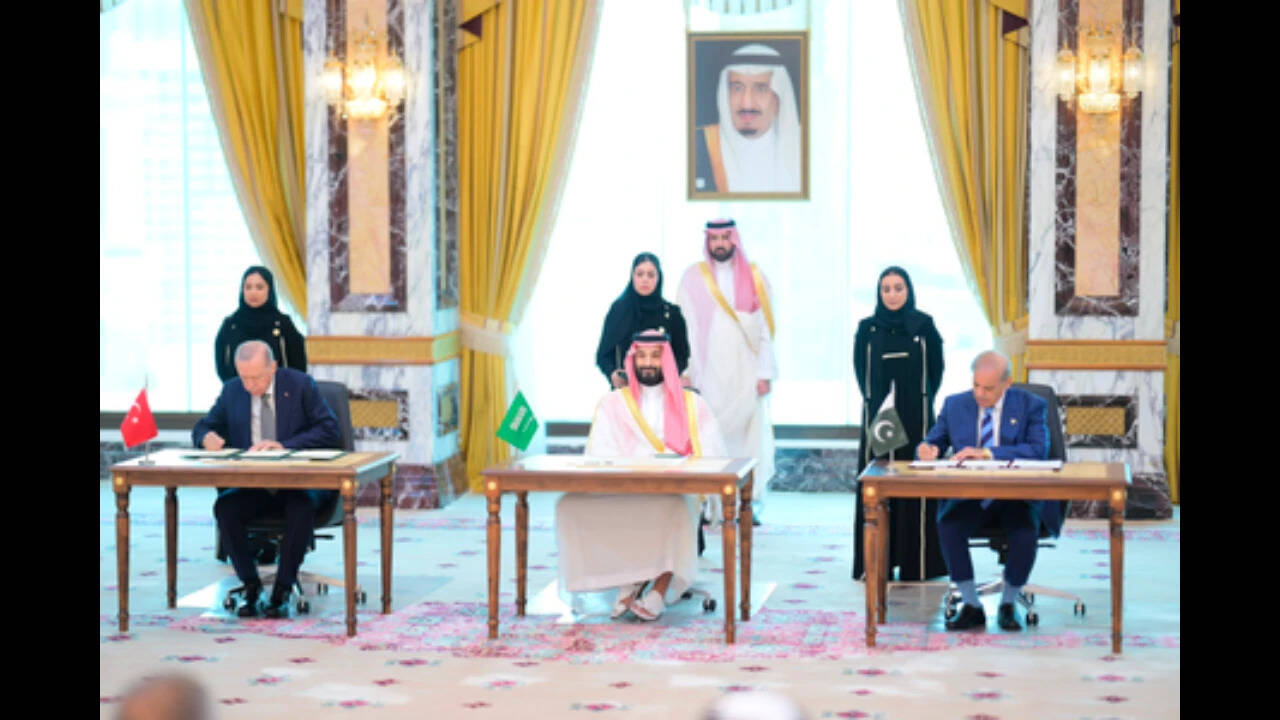
The ratification of the Mecca Joint Defence Agreement by Saudi Arabia, Pakistan, and Turkey establishes a tripartite security architecture designed to counter sustained missile and drone operations by Yemen-based Houthi forces. Rather than a uniform military coalition, the pact operationalizes distinct functional capabilities across asymmetric state actors. Evaluating this trilateral framework requires examining the specific operational mechanisms, resource commitments, and strategic limitations of each participant.
The Tripartite Division of Labor
The architecture of the agreement relies on functional specialization rather than shared force posture. Each signatory contributes distinct military inputs based on domestic industrial capacity, geographic positioning, and constitutional constraints.
- Saudi Arabia as Strategic Financer and Target Node: As the primary security consumer, Riyadh provides the financial underwriting, intelligence infrastructure, and territorial depth for the coalition. The kingdom's military command structure, undergoing continuous reorganization following front-line setbacks along the Red Sea coast, anchors the operational logistics of the southern theater.
- Pakistan as Ground Force and Personnel Provider: Islamabad brings historical force-projection mechanisms to the Arabian Peninsula. Building upon decades of bilateral defense protocols, Pakistan’s contribution centers on specialized ground formations, tactical training, and air-defense personnel designed to reinforce critical infrastructure zones within the Eastern Province and southern border sectors.
- Turkey as Technological and Advisory Exporter: Ankara operates on a non-combatant deployment model. Eschewing large-scale infantry commitments, Turkey's strategic value rests on Unmanned Aerial Vehicle (UAV) systems, electronic warfare expertise, command-and-control software integration, and military technical advising.
The Cost Function of Collective Deterrence
Article provisions mirroring mutual defense pacts—stipulating that an attack on one is an attack on all—impose varying economic and political costs on the signatories.
For Pakistan, the risk profile involves potential strategic overextension. While military deployments to the Gulf generate crucial foreign remittances and defense trade, they simultaneously strain domestic military resources already committed to western and eastern border security. Furthermore, entanglement in a protracted southern Arabian counter-insurgency creates diplomatic friction with regional competitors, particularly Tehran.
For Turkey, the cost function is governed by NATO obligations and regional balancing. Ankara maintains complex diplomatic channels with Iran and operational friction with Western allies. By limiting its formal footprint to advisory and technical roles, Turkey preserves strategic ambiguity, avoiding a direct kinetic confrontation with Houthi asymmetric networks while securing lucrative defense-industrial export contracts within the Gulf market.
Operational Friction and Strategic Limitations
The efficacy of the trilateral agreement faces structural bottlenecks that limit its long-term viability against decentralized threats.
- Command Integration Deficits: Integrating Pakistani ground units, Turkish command systems, and Saudi logistics into a unified coalition force introduces interoperability friction. Standardizing communication protocols, intelligence-sharing frameworks, and tactical doctrines across three distinct military cultures requires extensive lead time.
- Asymmetric Threat Vulnerability: Conventional defense pacts are structured around state-on-state deterrence. The primary adversary—the Houthi movement—operates as a non-state actor utilizing dispersed, low-cost asymmetric platforms (one-way attack drones and ballistic missiles). High-end conventional troop deployments and mutual defense declarations do little to alter the cost-per-strike economic asymmetry of intercepting inexpensive munitions with high-cost interceptor missiles.
- Theater Disconnect: While the strategic pact is anchored in Mecca, the tactical realities unfold across the Bab el-Mandeb strait, Marib, and southern Yemen, where shifting frontlines and the fragmentation of local anti-Houthi proxies create volatile operational conditions independent of central command decrees.
Execute joint intelligence fusion cells between Riyadh, Islamabad, and Ankara to standardize early-warning telemetry for incoming low-altitude vector threats before deploying additional foreign ground personnel into active strike zones.