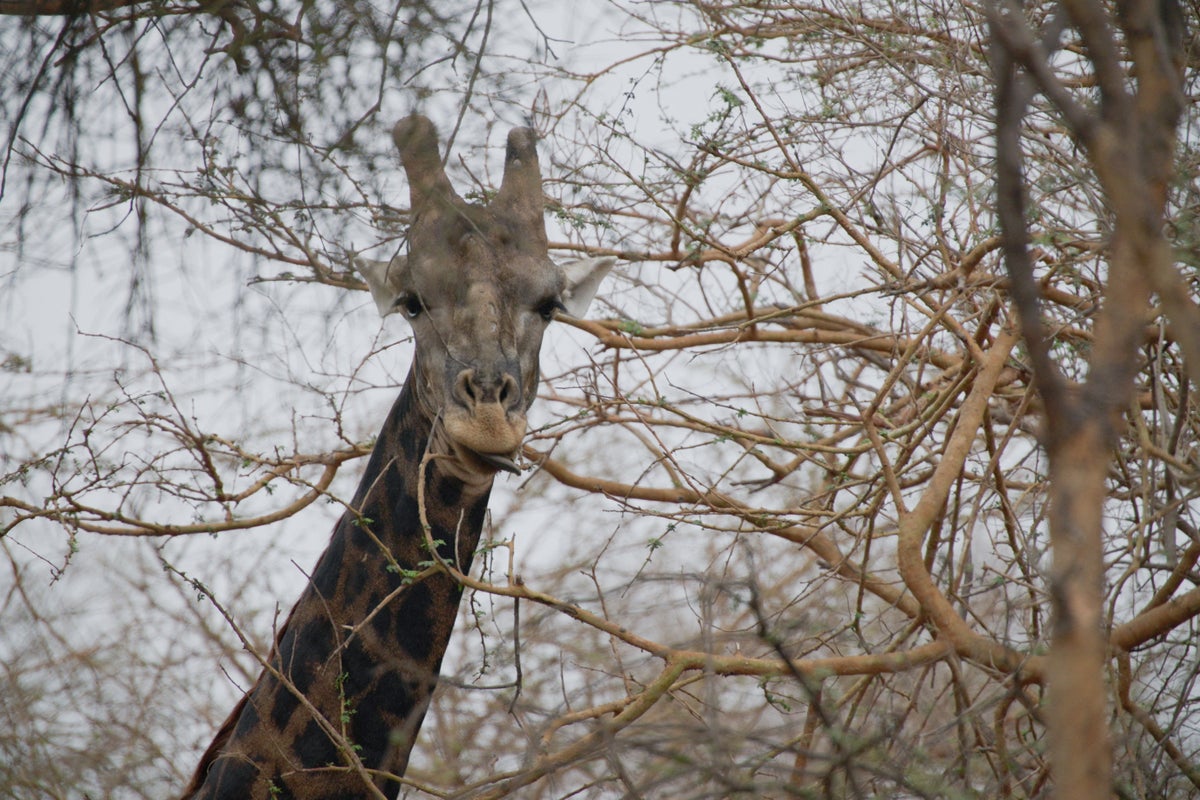
Large-scale exotic wildlife preservation operates on an implicit risk-mitigation paradox: the financial viability of a private game ranch depends on simulating open-range autonomy, yet structural boundaries must remain absolute. When a three-to-four-year-old reticulated giraffe named Gracie breached containment at the 1,000-acre Cedar Hollow Ranch in Real County, Texas, the incident exposed severe vulnerabilities in exotic asset tracking, perimeter architecture, and regional search mechanics. This containment failure provides a data-driven blueprint for analyzing how minor behavioral deviations compound into massive operational deficits.
Evaluating this case requires moving past sensationalized reporting and examining the precise physical, biological, and technical choke points governing both the escape and the ongoing, multi-week recovery operation.
The Micro-Behavioral Catalyst and Perimeter Deficit
Containment infrastructure for exotic megafauna traditionally relies on topographical assumptions and behavioral predictability. At Cedar Hollow Ranch, situated in the rugged Texas Hill Country approximately 100 miles west of San Antonio, the perimeter design was leveraged against a steep valley. Historical tracking data indicated that the resident giraffes consistently avoided high-elevation, rocky ledges due to physical optimization preferences; giraffes are morphologically adapted to flat or gently undulating savannas.
The escape sequence trace indicates a direct failure of this behavioral model:
- Dietary Arbitrage: Driven by specialized foraging opportunities, the subject ascended a steep hillside to access localized canopy vegetation on rocky ledges—a territory previously unutilized by the herd.
- Topographical Breach: The descent path deviated from the ascent trajectory. The subject descended on the exterior side of a high-game fence gate, effectively bypassing the primary containment line without destroying the physical asset.
- The Lag Metric: Because high-game ranches rarely deploy continuous real-time telemetry on every animal, the breach was classified as a latent event. The ranch staff discovered the absence through physical roll-call methods rather than automated alerts, creating an immediate information lag.
This incident highlights a flaw in stationary perimeter planning. When an animal's caloric or behavioral incentive outweights its structural aversion to difficult terrain, unmonitored gates or localized dips in fence height become immediate vectors of escape.
The Information Decay Funnel in Megafauna Recovery
Once an exotic asset enters a rural, low-density jurisdiction like Real County—which contains fewer than 3,000 residents across highly fragmented private properties—the recovery process shifts from a localized containment problem to a complex distributed search operation. The ongoing search for Gracie demonstrates the rapid decay curve of actionable intelligence.
The recovery operation currently encounters an asymmetrical information landscape driven by three distinct bottlenecks:
Spatial-Temporal Asymmetry
The search manager deployed aerial reconnaissance assets, including chartered helicopters and commercial drones, across a primary search zone spanning roughly 7,500 acres. This aerial sweep yields zero live detections due to the dense canopy cover characteristic of the Texas Hill Country, which creates a natural visual shield for an animal standing nearly the height of a mature tree.
Sighting Latency
Information inputs from passive ground sensors (trail cameras and game cameras owned by adjacent private landowners) suffer from a severe processing delay. By the time a landholder retrieves data from a remote game camera card or manually reports an image, the information is 48 to 72 hours old. Given a giraffe’s average walking speed, the radius of probability expands exponentially within a 48-hour window, rendering the past coordinate useless for active tracking vector calculations.
Disinformation and Signal Noise
The introduction of a $5,000 cash bounty structurally compromised the information pipeline. Digital amplification led to a critical failure on June 23 and 24, when global and local media outlets published unverified reports claiming the animal had been secured. This false confirmation caused temporary operational paralysis. Search coordinators must now dedicate limited administrative bandwidth to filtering out "idiots in their pajamas"—as defined by Real County Sheriff Nathan Johnson—and verifying raw data inputs against physical biological traits, such as Gracie’s uniquely rounded ear morphology.
Environmental Stressors and Asset Depreciation Risk
While the Texas Hill Country offers a reasonable climatic and dietary proxy for East African savannahs, prolonged exposure to unmanaged terrain introduces non-linear risk vectors that threaten the asset's survival. The physiological and environmental cost functions must be quantified to project the window of viable recovery.
- Nutritional Suboptimization: While adequate browse exists (primarily via oak and brush species), the lack of specialized mineral supplementation over a multi-week period increases the risk of metabolic imbalances.
- Locomotive Trauma: The structural morphology of Giraffa camelopardalis is optimized for firm, level substrates. The sharp limestone shelves, sinkholes, and karst topography of Real County present a constant threat of catastrophic skeletal failure. A broken distal limb segment in a wild or free-roaming megafauna asset is a terminal medical diagnosis.
- Apex Predator Interaction: Though an adult giraffe is largely immune to localized predation, a juvenile or sub-adult specimen facing nutritional stress is highly vulnerable to ambush predators. Regional mountain lion populations and coordinated coyote packs represent active threats to a solitary, displaced exotic animal.
Systemic Optimization for High-Value Wildlife Operations
The Real County containment failure establishes that traditional physical boundaries and passive search protocols are insufficient to mitigate risk within the billion-dollar exotic wildlife industry. To prevent similar operational failures, commercial game ranches must transition from static containment models to active, closed-loop tracking architectures.
Implementing a permanent mitigation framework requires changing three core operational procedures:
- Sub-Surface Telemetry Deployment: High-value exotic megafauna must be outfitted with low-power, long-range wide-area network (LoRaWAN) or satellite-linked GPS ear tags upon intake. This eliminates reliance on passive game cameras and provides precise, real-time spatial coordinates irrespective of fence integrity.
- Dynamic Perimeter Sensors: High-game fencing must incorporate automated gate-state monitors and laser tripwires at known topographical vulnerabilities—specifically where rocky terrain interfaces with perimeter lines.
- Pre-negotiated Cross-Border Access Agreements: The current search is bottlenecked by the legal friction of entering adjacent private ranches. Operators must establish standing mutual-access frameworks with contiguous landowners prior to any incident, authorizing immediate drone overflights and tracking teams to neutralize the information decay curve during the critical first 24 hours of a breach.