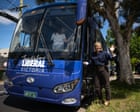
When the Victorian Liberal Party’s primary campaign bus struck a shop awning on its inaugural outing during the state election campaign, standard political reporting framed the incident as a moment of comedic irony or an omen of electoral misfortune. That framing misses the structural reality. A campaign launch failure of this nature is rarely an isolated driving error; it is a visible symptom of systemic friction between communications strategy, logistical execution, and physical risk management. In high-stakes political operations, the campaign bus functions as a mobile command center, a broadcast backdrop, and a physical manifestation of administrative competence. When that asset sustains structural damage within hours of deployment, the resulting media cycle displaces the intended policy message and forces the campaign into an immediate defensive posture.
To understand how an operational mishap overshadows a multi-million-dollar communications rollout, strategists must separate the physical mechanics of the collision from the reputational mechanics of the news cycle. The incident demonstrates a breakdown in route reconnaissance, vendor coordination, and crisis containment—three variables that govern the reliability of field operations.
The Dual Function of the Campaign Asset
In modern Westminster-style elections, particularly within concentrated media markets like Melbourne and regional Victoria, the branded campaign bus serves two distinct operational roles:
- Logistical Transport: Moving the party leader, senior strategists, security personnel, and traveling press corps between tightly scheduled media appearances across metropolitan and regional electorates.
- Visual Framing: Providing a controlled, branded background for television cameras and still photographers, ensuring that every broadcast clip reinforces campaign slogans and party colors regardless of the local streetscape.
Because the vehicle is engineered to maximize visual real estate—often utilizing high-roof coaches wrapped in vinyl graphics—its physical dimensions differ substantially from standard passenger vehicles. Standard urban infrastructure, particularly heritage shopping strips in Melbourne’s suburbs and regional Victorian towns, frequently features cantilevered veranda awnings extending close to the curb line. Cambered road surfaces exacerbate this hazard; when a high-sided vehicle pulls close to the footpath to disembark passengers in front of cameras, the top edge of the coach tilts toward the building line, reducing effective horizontal clearance even when the tires remain within the marked lane.
Anatomy of the Pre-Deployment Breakdown
A collision on day one of an official campaign indicates a failure in standard operating procedures before the vehicle ever left the depot. In mature political logistics, advance teams audit every stop on the leader's itinerary days or weeks in advance. The breakdown occurs across four sequential layers of operational oversight.
1. Incomplete Route and Site Reconnaissance
Advance operations require physical measurement, not digital estimation. Relying on satellite imagery or standard mapping software fails to account for overhanging signage, temporary scaffolding, tree canopies, and road camber at specific curbside drop-off points. When an advance team selects a retail strip for a "street walk"—a staple of Australian campaign optics designed to show the leader interacting with small business owners—the proximity of the drop-off zone to shopfront awnings becomes the primary physical constraint. Without a physical clearance check using the exact vehicle specifications (height, width, turning radius, and suspension tilt), the driver is forced to make real-time spatial judgments under intense schedule pressure.
2. Misaligned Vendor and Campaign Incentives
Campaigns typically lease coaches from commercial charter operators and apply custom external branding shortly before the writ is issued or the campaign officially launches. This creates a split chain of command:
- The Commercial Driver: Prioritizes vehicle safety, traffic compliance, and mechanical integrity, often unfamiliar with the chaotic pace of political media drops.
- The Campaign Advance Lead: Prioritizes camera angles, tight scheduling, and minimizing the walking distance between the bus door and the storefront to prevent unscripted encounters before cameras are rolling.
When the advance lead directs the driver to pull directly alongside a curb to optimize the television shot, the driver's margin for error collapses. If the campaign has not conducted a dry run with the wrapped coach at the actual site, conflicting priorities lead directly to physical contact with fixed street furniture.
3. Compressed Mobilization Timelines
The transition from pre-campaign positioning to the formal campaign period involves a sudden compression of decision-making cycles. Branding installation, security sweeps, and itinerary finalization frequently occur within a 24-to-48-hour window prior to the first media event. Under these conditions, quality assurance protocols—such as test-driving the specific route with spotters—are routinely sacrificed to protect media prep time for the candidate.
4. Absence of Physical Spotters at Drop Zones
In commercial transport and aviation, high-clearance maneuvers near fixed structures mandate external ground spotters. Political advance teams often focus exclusively on crowd control, media placement, and candidate briefing, leaving no staff member assigned to watch the upper corners of the coach during curbside docking.
The Mechanics of Narrative Displacement
Once the physical impact occurs, the crisis shifts from a logistics problem to an attention-economy problem. Political campaigns operate under strict scarcity of earned media. Every day of an election cycle offers a finite number of broadcast bulletins and digital news cycles to establish a core economic or social argument.
The mechanics of narrative displacement operate through three compounding effects:
- Visual Primacy in Broadcast Media: Television news editors and digital publishers prioritize high-contrast, dynamic visuals over policy announcements. Footage of a scraped bus roof, shattered glass, or bent corrugated iron requires zero policy explanation to be understood by a casual viewer. It immediately outcompetes staged press conferences on infrastructure spending or cost-of-living relief.
- Metaphorical Framing by Opponents and Commentators: Political journalists and opposing communications teams rapidly convert physical mishaps into structural metaphors. A collision on the opening day of a campaign is framed as evidence of poor planning, lack of readiness to govern, or internal disarray. Once established in the opening 48 hours of a campaign, this frame acts as a confirmation bias filter: every subsequent minor scheduling delay or policy clarification is interpreted by the press gallery as further proof of operational incompetence.
- Asymmetric Fact-Checking: While the campaign must spend communications bandwidth confirming that no pedestrians, staff, or journalists were injured and coordinating insurance and repair logistics, opposing strategists can amplify the imagery with minimal effort. The defensive party absorbs all the reputational cost while generating zero positive message penetration.
Quantifying the Opportunity Cost of Day-One Friction
While the direct financial cost of repairing a vinyl wrap, replacing damaged coach panels, and compensating a shop owner for awning damage is negligible relative to a multi-million-dollar campaign budget, the strategic opportunity cost is substantial.
Campaign launches are engineered to create momentum—a measurable lift in media share-of-voice, volunteer sign-ups, and voter attention. When the launch asset is sidelined or visibly damaged, the campaign suffers three distinct losses:
- Loss of the Opening Argument: The first 24 hours of a campaign set the baseline debate. If the party intended to prosecute the incumbent government on economic management or infrastructure delivery, an unforced logistical error neutralizes the credibility of that critique for the remainder of the news cycle.
- Asset Downtime and Visual Continuity: Removing a primary branded coach for bodywork or wrap replacement forces the campaign to deploy an unbranded backup vehicle or operate with visible damage. Both options degrade visual discipline on evening news broadcasts.
- Internal Morale and Risk Aversion: Field teams and advance staff become overly cautious following a public embarrassment. Subsequent stops are pushed further away from high-foot-traffic areas to guarantee vehicle safety, which inadvertently reduces the organic street-level energy that retail campaigning is meant to capture.
Limitations of Risk-Mitigation Protocols
Even the most disciplined campaign operations cannot eliminate environmental friction entirely. Over-engineering advance logistics introduces its own operational liabilities:
- Loss of Tactical Agility: Requiring formal engineering clearance and multi-day advance audits for every curbside stop prevents a campaign from pivoting quickly to respond to breaking news or opponent missteps in regional areas.
- Predictability: Extensive advance scouting in local shopping strips alerts local media and political opponents to the leader's itinerary, eroding the element of surprise and enabling organized protests at the drop-off site.
- Resource Drain: Assigning dedicated personnel solely to vehicle clearance and route auditing diverts staffing from voter contact, digital rapid response, and policy research.
The objective of campaign operations is not zero risk, which is incompatible with dynamic retail politics, but rather the elimination of predictable, high-visibility failure modes during marquee media moments.
Strategic Protocol for High-Visibility Mobile Campaigns
To prevent physical logistics from undermining communications strategy, campaign directors and operations leads must enforce a strict separation between broadcast staging and vehicle docking:
- Decouple the Drop Zone from the Camera Zone: Never require a high-sided campaign coach to dock directly in front of a heritage veranda or low-hanging awning for a camera shot. Establish the vehicle drop-off point on a wide arterial road or open parking area at least 50 to 100 meters from the retail strip, and have the leader walk into the camera frame on foot.
- Mandate Physical Clearance Audits for Marquee Days: For the opening 72 hours of a campaign and major policy launch days, require advance leads to verify physical curb height, road camber, and overhead obstructions at every scheduled stop using exact vehicle dimensions, assigning a dedicated ground spotter for every reverse or curbside pull-in maneuver.
- Pre-Stage Redundant Visual Assets: Maintain a secondary, fully wrapped backup vehicle or modular magnetic/vinyl panels on standby during the opening week of the campaign so that any minor cosmetic damage can be remediated within two hours without disrupting broadcast continuity.
- Execute Immediate Narrative Containment: If an operational mishap occurs in front of cameras, issue a single, factual statement confirming safety and property restitution within 15 minutes, then immediately pivot the leader to an unscripted policy Q&A at a separate location to deny the press gallery a prolonged visual vacuum.