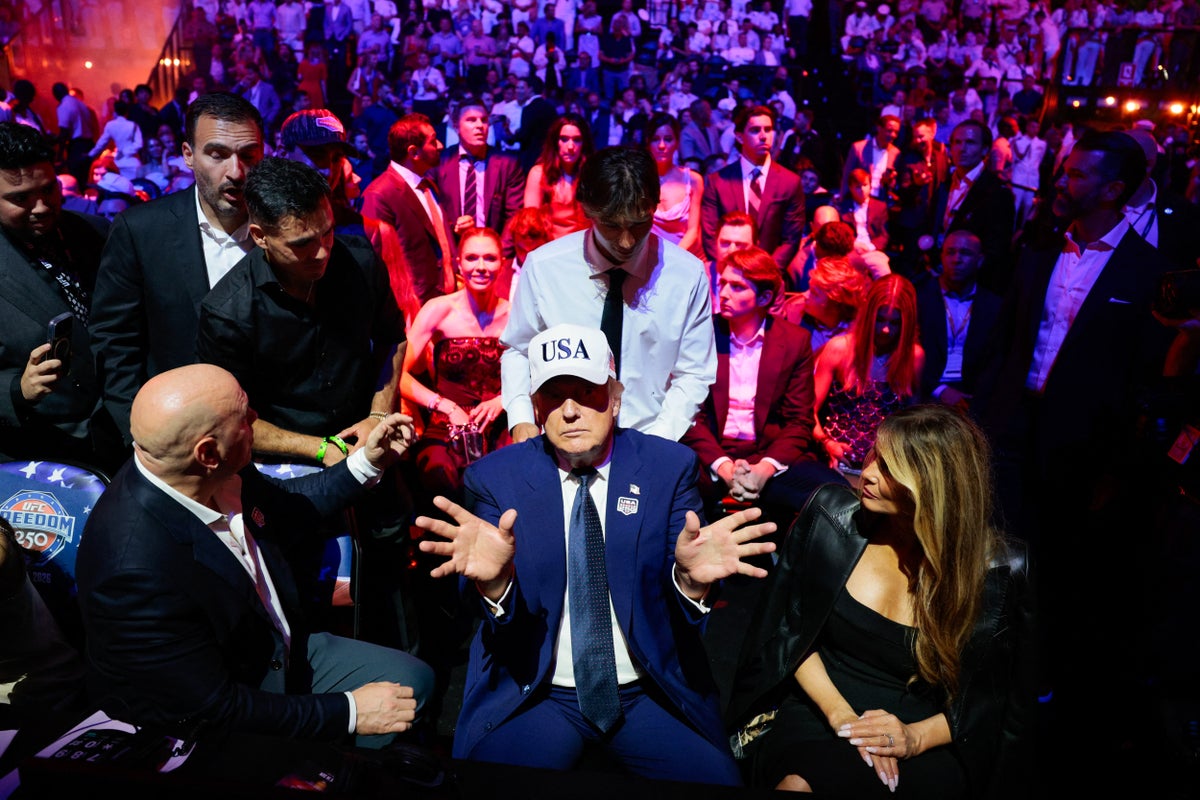
The physical transformation of the White House South Lawn into an outdoor mixed martial arts arena for UFC Freedom 250 represents far more than an unorthodox 80th birthday celebration or a highly irregular commemoration of the American Semiquincentennial. Viewed through a rigorous analytical framework, this event represents a highly calculated, multi-variable deployment of state resources, corporate media consolidation, and attention-space optimization. To understand the operational mechanics of this event requires looking past the rhetoric of cultural division and mapping the precise strategic feedback loops that link modern state power, private capital accumulation, and populist mass entertainment.
The entire enterprise functions as a high-density mechanism designed to solve a specific political optimization problem: how to insulate a political executive from escalating macro-environmental friction—such as the regional conflict in Iran, global energy market volatility, and persistent domestic inflation—by constructing an overwhelming, non-falsifiable cultural commodity. By executing this strategy, the executive branch converts public infrastructure into private equity, trading historical prestige for immediate, high-yield attention capital.
The Three Pillars of Executive Spectacle
The execution of an unprecedented corporate-state event on federal parklands relies on three distinct structural dimensions. These pillars function as an integrated engine where each component reinforces the velocity of the others.
- Pillar 1: Structural Financial Enclosure. The capitalization of federal space for commercial activity. While the executive claims that private entities absorb the direct costs, court filings from the National Park Service reveal that an initial capital expenditure of over $60 million and tens of thousands of federal labor hours were required to prepare the infrastructure. This operates as an implicit public subsidy for a private pay-per-view media asset.
- Pillar 2: Regulatory Asymmetry and Arbitrage. The deliberate bypass of established statutory boundaries. The deployment of "The Claw"—a 600-tonne, 92-foot-tall steel superstructure on the South Lawn—occurred without the standard environmental impact assessments or public notice periods dictated by National Park Service regulations. This asymmetry establishes a precedent where executive preference overrides legislative and administrative guardrails.
- Pillar 3: Absolute Ideological Convergence. The alignment of commercial athletic violence with state-sanctioned patriotism. By orchestrating fighter entrances directly out of the Oval Office, utilizing the U.S. Marine Band as a promotional opening act, and timing the event alongside a military flyover by the Blue Angels and Thunderbirds, the regime executes a complete fusion of state authority and hyper-commercialized physical dominance.
The Cost Function of Attentional Diversion
The timing of UFC Freedom 250 is directly correlated with a surge in negative externalities confronting the administration. In classic diversionary theory, an executive initiates high-impact, non-political spectacles to alter the composition of public information architecture. This relationship can be expressed through a clear cause-and-effect cost function, where the utility of the spectacle increases as traditional policy metrics degrade.
Utility of Spectacle = f(Macroeconomic Friction + Geopolitical Volatility) / Public Auditing Capacity
This structural dynamic resolves explicit vulnerabilities facing the administration. The three-month-old conflict in Iran has introduced severe friction into global energy corridors, specifically choking the Strait of Hormuz and driving domestic fuel costs to multi-year highs. Simultaneously, domestic inflation indicators have spiked to their highest levels since April 2023, depressing real wages and lowering the administration's core public approval ratings.
Under standard political operating conditions, an executive facing these compounding variables is forced to absorb severe media scrutiny. By introducing a $60 million gladiatorial event directly into the seat of government, the administration alters the inputs of the media ecosystem. The primary mechanism here is sensory and narrative overload; the press corps is forced to allocate finite airtime and editorial resources to debating the aesthetic propriety of a steel cage on the White House lawn, effectively crowded out from sustained structural analysis of macroeconomic underperformance.
Corporate Integration and the Capture of Public Space
The economic architecture of the event exposes a tight network of corporate interdependencies that characteristically define modern state capitalism. This is not a detached cultural phenomenon but a precise monetization vector involving major media conglomerates, apparel monopolies, and executive self-dealing.
Public Asset (White House Lawn)
  ──> Regulatory Waiver
  ──> Corporate Infrastructure (TKO Group / UFC)
  ──> Exclusive Distribution Network (Paramount Skydance)
  ──> High-Margin Monetization (Subscriptions / VIP Packages)
The distribution rights for the event highlight a clear transactional architecture. The event streamed exclusively on Paramount+, a platform owned by Paramount Skydance. This media entity secured the broadcast rights as part of a massive $7.7 billion, seven-year exclusive distribution agreement with TKO Group, the parent company of the UFC. The transaction occurred shortly after the executive branch cleared the regulatory hurdles for Paramount's high-profile corporate merger. The loop closes at the level of personal equity: public financial disclosures indicate the executive acquired a equity position valued between $15,000 and $50,000 in TKO Group while actively leveraging the power of the office to promote the underlying commercial asset.
Further monetization of the state apparatus occurred through a direct joint venture with Fanatics, a dominant sports apparel firm. The corporate integration included the manufacturing and retail distribution of "USA 250" apparel, featuring custom branding placed directly onto the physical uniforms of the combatants. The commercialization extended to the live gate, where the promotion marketed ultra-premium VIP access packages priced at $1.5 million per ticket. This pricing model structurally engineered an audience composition restricted exclusively to high-net-worth corporate sponsors, selected political allies, and targeted military personnel who met precise visual specifications for the broadcast view-shed.
The Populist Manosphere and the Dominance Model
Beyond the financial and regulatory engineering, the choice of mixed martial arts as the central medium of executive communication functions as a deliberate cultivation of a specific demographic base. The administration's cultural strategy operates through a psychological mechanism known as vicarious dominance.
The core target demographic—disproportionately comprised of young, economically volatile male cohorts—experiences high levels of structural alienation within an evolving service-and-technology economy. The standard pathways toward economic mobility have become increasingly capital-intensive, leading to feelings of systematic displacement. The administration intercepts this demographic friction not by adjusting economic inputs, but by offering an alternative currency: raw, unmediated physical force.
The rhetoric deployed throughout the event underscores this precise tactical objective. Executive messaging consistently emphasizes a binary worldview defined strictly by dominance or total submission. This framework informs both domestic political maneuvers and international relations, exemplified by explicit executive warnings that a failure to comply with maritime trade terms would result in the absolute destruction of foreign civilizations. The cage match operates as the perfect physical manifestation of this zero-sum logic. When a combatant like Bo Nickal uses his post-fight interview to explicitly praise the executive's physical courage, it validates a hyper-masculine governing philosophy that explicitly associates state power with corporate warrior ethos.
Systemic Bottlenecks and Strategic Risks
Despite the near-perfect tactical execution of the event as an attention-capture device, the strategy contains deep structural limitations that introduce long-term risks to the regime. No media insulation mechanism is completely absolute, and the reliance on hyper-spectacle introduces three distinct systemic bottlenecks.
The first limitation is the erosion of institutional authority. By converting the highly regulated, historically restricted space of the executive mansion into a commercial sporting arena, the administration permanently degrades the symbolic capital of the state. While this yields immediate populist dividends, it permanently diminishes the future capacity of the executive to invoke traditional institutional prestige during moments of severe domestic or constitutional crisis.
The second bottleneck is elite defection and brand resistance. The event experienced a significant structural failure in its attempt to secure broad cultural legitimacy. Despite extensive invitations distributed to premier athletic and cinematic figures—including Tom Brady, Adam Sandler, and Dwayne Johnson—the event suffered near-total non-attendance from mainstream cultural elites. Furthermore, six out of nine scheduled musical acts canceled their performances ahead of the weekend. The resulting audience composition ringside was starkly limited to explicit political insiders and highly transactional tech executives, such as Mark Zuckerberg. This indicates that hyper-aggressive political spectacles incur a steep tax in the form of mainstream corporate and cultural isolation.
The final risk factor is the vulnerability of outdoor physical infrastructure to environmental disruptions. The total reliance on a temporary, outdoor layout exposed a $60 million broadcast asset to acute meteorological volatility. With regional weather alerts warning of high-velocity wind gusts and severe thunderstorms, the administration's defensive apparatus resorted to aggressive, ad-hominem public relations attacks against scientific forecasting agencies. This pattern demonstrates that as the scale of a physical spectacle expands, the administration must expend increasing amounts of political and communicative capital simply to defend the operational viability of the event against objective material realities.
The Strategic Forecast
The institutionalization of corporate combat sports on the grounds of the state signals a permanent shift in the architecture of executive governance. We are moving rapidly past the era of standard media management into a period of total corporate-state synthesis, where the execution of raw physical spectacle is leveraged to validate raw executive power.
Organizations and market analysts evaluating the political risk environment must expect that future executive actions will increasingly bypass traditional regulatory and administrative channels in favor of direct, media-optimized public campaigns. The reliance on standard economic performance metrics to forecast political stability is fundamentally broken; the administration has demonstrated a repeatable capacity to substitute real-world policy success with highly concentrated, corporate-sponsored cultural commodities. The long-term stability of this model depends entirely on whether the public's capacity to absorb compounding economic and geopolitical friction can be indefinitely sustained by the recurring injection of highly commercialized, state-sanctioned violence.