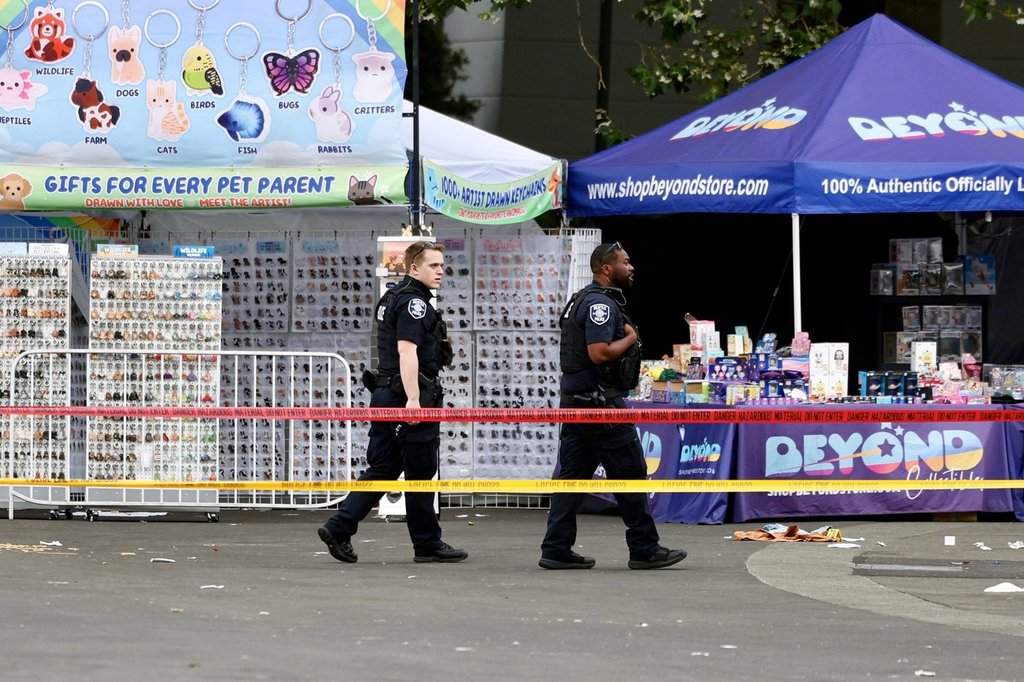
The containment of violence in open public spaces relies on a predictable architecture of surveillance, physical restriction, and rapid tactical intervention. When a shooting occurs at a high-density civic gathering—such as the recent incident resulting in three fatalities at a Seattle food festival involving a teenage suspect—it exposes immediate fractures in the underlying security protocol. Standard news reporting typically reduces these events to isolated criminal acts driven by individual pathology. That approach ignores the systemic vulnerabilities that permit a weapon to enter a heavily populated, low-friction environment.
The Security Friction Deficit
Open-access urban events operate on an economic and social trade-off. To maximize attendance and municipal revenue, organizers intentionally minimize physical barriers and checkpoint friction. This creates an inverse relationship between accessibility and baseline safety.
- Spatial Permeability: Festivals configured with multiple unmonitored entry vectors eliminate the ability to enforce credential or contraband screening.
- Crowd Density Dynamics: High-volume pedestrian traffic degrades the situational awareness of law enforcement, turning dense corridors into blind zones where kinetic threats can materialize without pre-incident detection.
- Response Latency: In open-air layouts, the time elapsed between the discharge of a firearm and the physical consolidation of a tactical response unit is dictated by line-of-sight obstructions and crowd panic vectors.
When the perimeter lacks hard control points, the operational burden shifts entirely to reactive intervention. By the time law enforcement establishes kinetic dominance, the catastrophic phase of the event has already concluded. The presence of a juvenile suspect in a multi-casualty shooting further complicates the baseline threat model, as traditional law enforcement intelligence models are heavily biased toward adult offender typologies and known criminal networks.
The Mechanics of Juvenile Kinetic Escalation
Analyzing youth-involved firearm violence requires looking past motive and examining the structural availability of the weapon and the environmental triggers that accelerate conflict into lethal outcomes. Minors operating in public spaces are subject to distinct behavioral variables that alter standard threat mitigation strategies.
- Access Vectors: Juveniles rarely manufacture or legally acquire firearms used in public homicides. The primary supply chain runs through unsecured domestic storage, straw purchases, or illicit secondary markets. Security analytics must therefore treat community-level firearm leakage as a leading indicator of public venue vulnerability.
- Escalation Velocity: Pre-adolescent and teenage conflict dynamics often lack the de-escalation thresholds common in older demographics. Impulsivity combined with high-capacity concealable firearms compresses the timeline between verbal altercation and lethal deployment to mere seconds.
- Retreat Inhibitors: Dense social settings increase the psychological cost of backing down from a dispute. The presence of peer groups creates a feedback loop that penalizes conflict avoidance, forcing participants into a binary choice of escalation or perceived loss of status.
Municipal authorities frequently attempt to mitigate these vectors through blanket curfews or reactive police deployments after an incident occurs. These measures address symptoms rather than the operational mechanics of venue safety. A permanent reduction in festival-related violence requires a shift from post-incident criminal investigation to pre-emptive spatial fortification.
Redefining Public Safety Architecture
Securing large-scale civic gatherings without destroying their cultural utility demands a complete redesign of the risk management framework. Organizers must abandon the illusion that public events can remain entirely open while guaranteeing absolute protection against targeted kinetic threats.
The implementation of zoned access control represents the primary structural fix. Instead of treating an entire festival footprint as a single zone, planners must segment venues into controlled-access perimeters with designated screening corridors. This concentrates security resources where they maintain maximum leverage, neutralizing the threat of unauthorized firearm entry before weapons reach high-density congregation areas.
Concurrently, municipalities must integrate acoustic gunshot detection systems with automated pan-tilt-zoom camera tracking. Traditional reporting relies on delayed 911 calls from panicked witnesses, introducing critical minutes of latency into the emergency response chain. Automated acoustic triangulation pinpoints the exact origin of a discharge instantly, directing tactical assets to the precise coordinate while the suspect is still attempting exfiltration.
The deployment of these technical measures alters the cost-benefit calculation for potential offenders. When a venue establishes strict perimeter integrity and rapid digital tracking, the probability of immediate apprehension rises sharply. This operational friction is the only proven deterrent against spontaneous or high-impulse acts of violence in public environments.
Deploy municipal resources toward perimeter-hardened zoning for all open-air events exceeding designated crowd thresholds, mandate real-time interoperability between private event security and municipal dispatch, and establish automated acoustic tracking grids in historically high-risk urban entertainment corridors to compress emergency response latency below the threshold of secondary escalation.