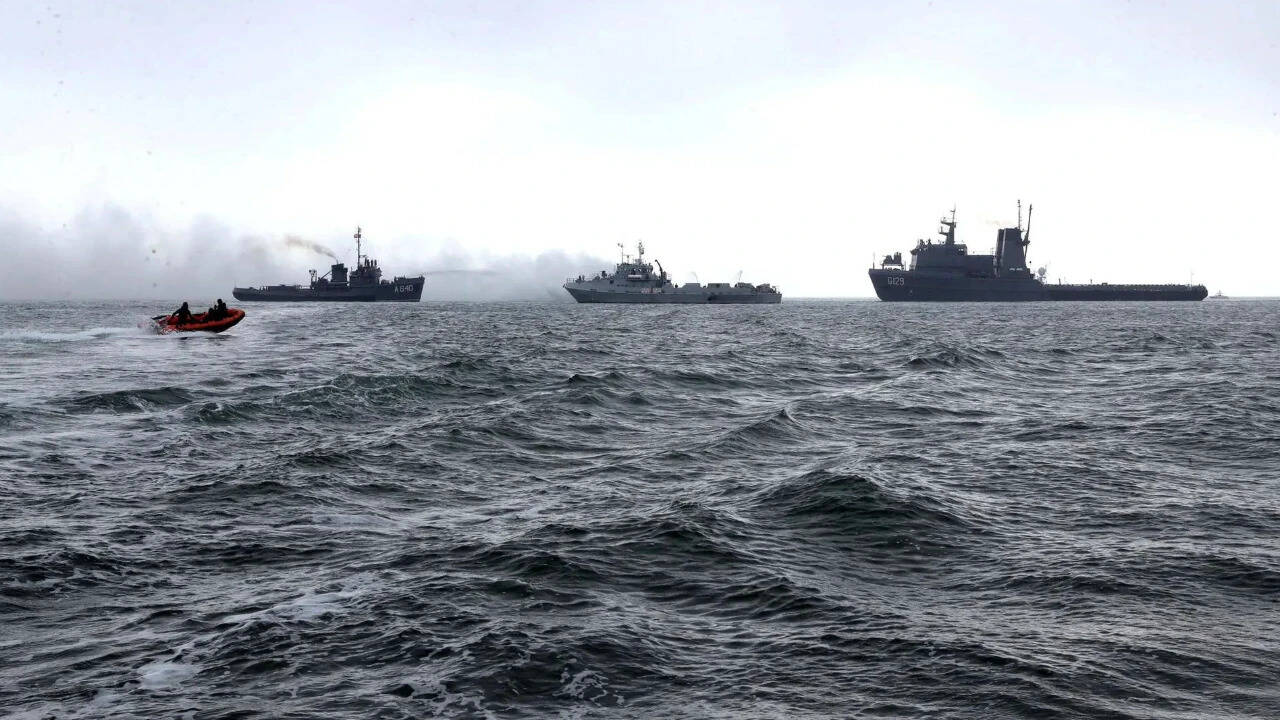
Geographic isolation dictates the survival of modern state-level sanction evasion. When conventional trade lanes face active interdiction, supply chains shift from public commercial vectors to enclosed geographical basins where exterior naval power has zero legal or physical access. Recent intelligence derived from European government documentation indicates that Moscow has initiated direct transfers of tactical explosives, artillery ammunition, and unguided and guided drone components to Iran via the Caspian Sea. This logistical pipeline represents a structural inversion of the early-conflict paradigm, where Tehran acted as the primary hardware exporter to the Russian Federation. Analyzing this maritime corridor requires a breakdown of geographic constraints, transit mechanisms, and the economic utility of closed-basin logistics.
The Geopolitical Mechanics of the Caspian Basin
The primary structural advantage of the Caspian Sea transit vector lies in its physical geography. As an landlocked inland body of water bounded exclusively by five littoral states—Russia, Iran, Kazakhstan, Turkmenistan, and Azerbaijan—it possesses no natural navigable outlet to the world's open oceans. Under international legal frameworks governing closed seas and inland bodies of water, external naval forces maintain no legal right of entry or transit.
This geographical isolation creates an absolute security vacuum for allied maritime operations:
- Absence of Interdiction Assets: The United States Navy and allied maritime forces cannot project surface power into the basin to board, inspect, or seize suspicious cargo vessels.
- Transponder Dark Operations: Commercial vessels operating within the basin frequently disable their Automatic Identification System transponders, exploiting lax monitoring by secondary littoral states to obscure cargo origins and destinations.
- Direct Port-to-Port Linkages: Cargo moves uninterrupted from southern Russian riverine and maritime hubs such as Astrakhan or Port Olya directly to northern Iranian infrastructure including Bandar Anzali and Amirabad.
The cost function of this route heavily favors the sender. Moving military-grade consignments via land transport through the Caucasus introduces multiple customs bottlenecks, high visibility to Western intelligence overhead assets, and potential transit friction from third-party states. Conversely, short-sea shipping across the Caspian bypasses terrestrial checkpoints entirely, maximizing payload capacity while minimizing interception probabilities.
Supply Chain Reversal and Industrial Replenishment
The transition from an export-oriented defense relationship to a reciprocal resupply matrix highlights the operational attrition experienced by Iranian forces following coordinated air campaigns executed by the United States and Israel. Prolonged strike campaigns against domestic Iranian manufacturing complexes left critical deficits in propellant reserves, guidance packages, and structural airframe subcomponents.
To understand the mechanics of this inventory recovery, analysts must examine the component categories crossing the maritime corridor:
- Propellants and Precursors: High-energy explosives such as TNT and solid-propellant components necessary for ballistic missile motor casting. Without domestic self-sufficiency in specific chemical stabilizers, replenishment relies directly on external industrial inputs.
- Avionics and Guidance Subassemblies: Microprocessors, inertial measurement units, and navigation modules required to finish unguided munitions and upgrade loitering munition accuracy.
- Airframe Structures: Pre-fabricated composite bodies and stabilization fins for long-range strike assets, reducing the internal manufacturing burden on depleted Iranian state arsenals during active operational tempos.
This transfer pipeline operates in a feedback loop. Intelligence sharing, satellite telemetry, and targeting data previously supplied to proxy networks are now reinforced by physical munitions delivery, ensuring that inventory depletion rates do not outpace tactical replenishment capabilities during active ceasefires or intermittent hostilities.
The Vulnerability of Regional Chokepoints and Kinetic Limits
Despite the insulation provided by the Caspian basin, the supply chain encounters severe structural friction once shipments transition from maritime nodes to internal distribution networks. Port infrastructure utilized for transshipment remains vulnerable to preemptive kinetic targeting. For instance, prior strikes executed against the Bandar Anzali port complex demonstrated that regional adversaries possess the intelligence capability to identify and disrupt specific offloading zones.
However, kinetic strikes on port facilities yield diminishing strategic returns. Maritime supply chains are inherently resilient; physical damage to a specific pier or crane structure introduces only temporary logistical delays. Shippers quickly divert consignments to alternative secondary ports along the northern Iranian coastline, mitigating single-point-of-failure risks.
Furthermore, efforts by external actors to establish naval blockades in external maritime choke points—such as statements regarding the Strait of Hormuz—fail to alter the calculus inside the landlocked northern basin. A blue-water blockade operating in the Persian Gulf exercises zero physical control over internal merchant traffic moving between Astrakhan and Iranian Caspian ports. This dichotomy exposes the limits of traditional naval containment strategies when applied to contiguous, closed-basin bilateral trade between sanctioned economies.
Strategic Vector Analysis for Defense Planning
Evaluating the long-term viability of the Russia-Iran logistical bridge requires measuring the friction of dual-use item tracking against the velocity of indigenous production recovery.
- Monitor Secondary Transshipment Nodes: Intelligence agencies must pivot from open-ocean interdiction models to granular monitoring of river-sea vessels operating out of the Volga-Don canal system, as these ships represent the primary physical bottleneck before cargo enters the Caspian basin.
- Target Financial and Registry Networks: Because physical boarding is legally constrained, disruption must occur at the corporate level by sanctioning shell companies, maritime insurance providers, and flag registries utilized by vessels making regular runs between Astrakhan and Iranian ports.
- Assess Chemical Precursor Controls: Curtailing the flow of finished explosives requires upstream supply chain restriction on commercial chemical precursors manufactured outside Russia and Iran that find their way into industrial mixing facilities via third-party intermediaries.
The persistence of the Caspian military corridor demonstrates that traditional maritime interdiction models break down entirely when sovereign states utilize enclosed geographic spaces to bypass global trade surveillance. Effective containment requires an operational shift toward financial strangulation of the vessel operators and strict oversight of the riverine entry points feeding the inland sea.