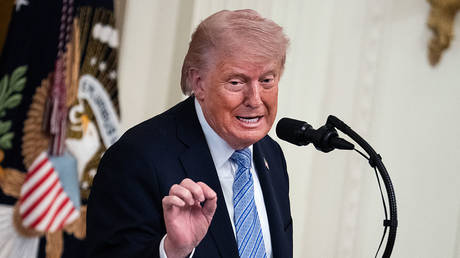
The television in the corner of the crowded Beirut cafe did not just broadcast the news. It vibrated. Outside, the afternoon traffic on Hamra Street hummed with its usual chaotic energy, a symphony of honking horns and shouting vendors. Inside, a dozens-deep crowd stood frozen, their eyes locked on the glowing screen. A world leader was speaking from thousands of miles away, his voice translated into rapid-fire Arabic by a visibly breathless anchor.
He used a word that felt jarringly simple for a region defined by millennia of layered history, blood equity, and complex geopolitics.
Bully.
To describe a fallen adversary, a heavily armed state actor, or a decades-long architecture of regional deterrence as a "bully" is to strip away the dense, opaque language of diplomacy. It replaces the sterile vocabulary of statecraft with the visceral vernacular of the schoolyard. It is a deliberate rhetorical strategy designed to collapse a Rubik’s Cube of international relations into a binary narrative of good versus evil, strength versus weakness.
But out on the streets, far from the mahogany briefing rooms of Washington or the fortified bunkers of the Levant, the reality of that word lands differently. When a geopolitical titan falls or a dominant force is abruptly neutralized, the immediate result is rarely a clean, cinematic transition to peace.
It is a vacuum. And in the physics of global politics, nothing is more terrifying than empty space.
The Weight of the Unspoken Word
Consider a merchant named Tareq. He is a hypothetical composite of the shopkeepers who have watched history march past their storefronts for generations, but his anxieties are entirely real. Tareq sells spices and imported grains. His business depends on predictable shipping lanes, stable currency conversion, and the fragile, unwritten rules that keep neighboring factions from turning his neighborhood into a free-fire zone.
For years, Tareq operated under a grim but functional calculus. He knew exactly who held the power. He knew which red lines could not be crossed. The dominant power in the region—the one now labeled a "bully"—was a heavy, oppressive certainty. It was a dark cloud on the horizon, but it was a cloud Tareq knew how to read. He could predict when it would rain.
When that power is suddenly declared "dead," Tareq does not celebrate. He holds his breath.
The removal of a dominant antagonist looks pristine on a press release. It sounds triumphant when delivered from a podium draped in flags. But on the ground, the sudden erasure of a regional heavyweight triggers a frantic, invisible scramble among a dozen lesser forces, each eager to claim a piece of the discarded crown.
The grand declarations of Western leaders often overlook this immediate, localized panic. To proclaim that a bully has been vanquished is to assume the playground is now safe. In reality, it usually means the rules of engagement have just vanished entirely.
The Language of Power and the Power of Language
Political rhetoric is never accidental. The choice to bypass formal intelligence terminology in favor of colloquial put-downs is a calculated performance. It serves a dual purpose: it demeans the target, reducing their historical legacy to mere thuggery, and it positions the speaker as the ultimate arbiter of justice—the bigger, tougher kid who finally stepped in.
But this linguistic reductionism masks a far more intricate network of alliances and dependencies. The forces shape-shifting across the Middle East are not monolithic entities driven by simple malice. They are fueled by historical grievances, economic desperation, and deeply entrenched religious identities.
When American leadership leans heavily into the rhetoric of total victory and schoolyard dynamics, it creates a dangerous disconnect. It implies that complex, multi-generational conflicts can be resolved by simply removing a single bad actor from the board.
History suggests otherwise. The removal of a singular, stabilizing or destabilizing force rarely yields a tranquil democracy. Instead, it frequently invites a fragmentation of authority.
Think back to the early 2000s. The rhetoric surrounding the dismantling of entrenched regimes in Iraq and Libya followed an identical script. The tyrants were monstrous. Their removal was deemed non-negotiable. The promises of a brighter, liberated future were boundless.
Yet, the aftermath of those interventions did not produce a sudden flowering of stability. It produced a patchwork of competing militias, localized fiefdoms, and a protracted state of civil unrest that trapped ordinary citizens in a permanent limbo. The "bully" was gone, but in their place arose a hydra of smaller, unpredictable terrors.
The Invisible Ripples Across the Map
The impact of a major shift in regional power structure radiates outward in concentric circles, touching lives thousands of miles away from the epicenter of the conflict.
Consider the global energy markets. The global economy runs on a delicate equilibrium of supply, demand, and psychological confidence. When a major regional player is suddenly incapacitated or aggressively checked, the immediate reaction is felt on the trading floors of London, New York, and Tokyo.
The price of a barrel of crude oil spikes not necessarily because the physical supply has been cut off, but because the fear of what comes next dictates the market.
A commuter pumping gas into their sedan in Ohio might not care about the shifting alliances of the Middle East. They might not know the names of the generals or the factions vying for control. But they feel the geopolitical shockwave when the numbers on the gas pump tick upward. The geopolitical becomes personal, translated directly into the language of household budgets and grocery bills.
This interdependence is the true, hidden cost of global instability. No nation is an island, and no conflict can be neatly contained within its geographic borders. The declaration that a major adversary has been neutralized is a signal to global markets that a period of profound volatility has begun.
Beyond the Podium
The true measure of any major geopolitical shift is not found in the immediate, triumphalist rhetoric of a press conference. It is found in the months and years that follow, in the quiet, unglamorous work of reconstruction, diplomacy, and stabilization.
The crowd in the Beirut cafe eventually dispersed. The television screen shifted its focus to local weather and sports. But the tension in the room lingered long after the broadcast ended.
People like Tareq returned to their shops, checked their inventory, and looked out at the street with a renewed sense of vigilance. They know that a world without the old rules is a world where anything can happen. They know that the declaration of an enemy's demise is not the end of a story, but the chaotic, unpredictable beginning of a completely new chapter.
The world watches the spectacle of power from a distance, focusing on the big names, the sharp quotes, and the dramatic headlines. But the real story is always written in the margins, in the quiet anxieties of ordinary people trying to navigate the fallout of decisions made by leaders who will never have to live with the consequences.
The bully may be declared dead, but the playground remains a deeply dangerous place.