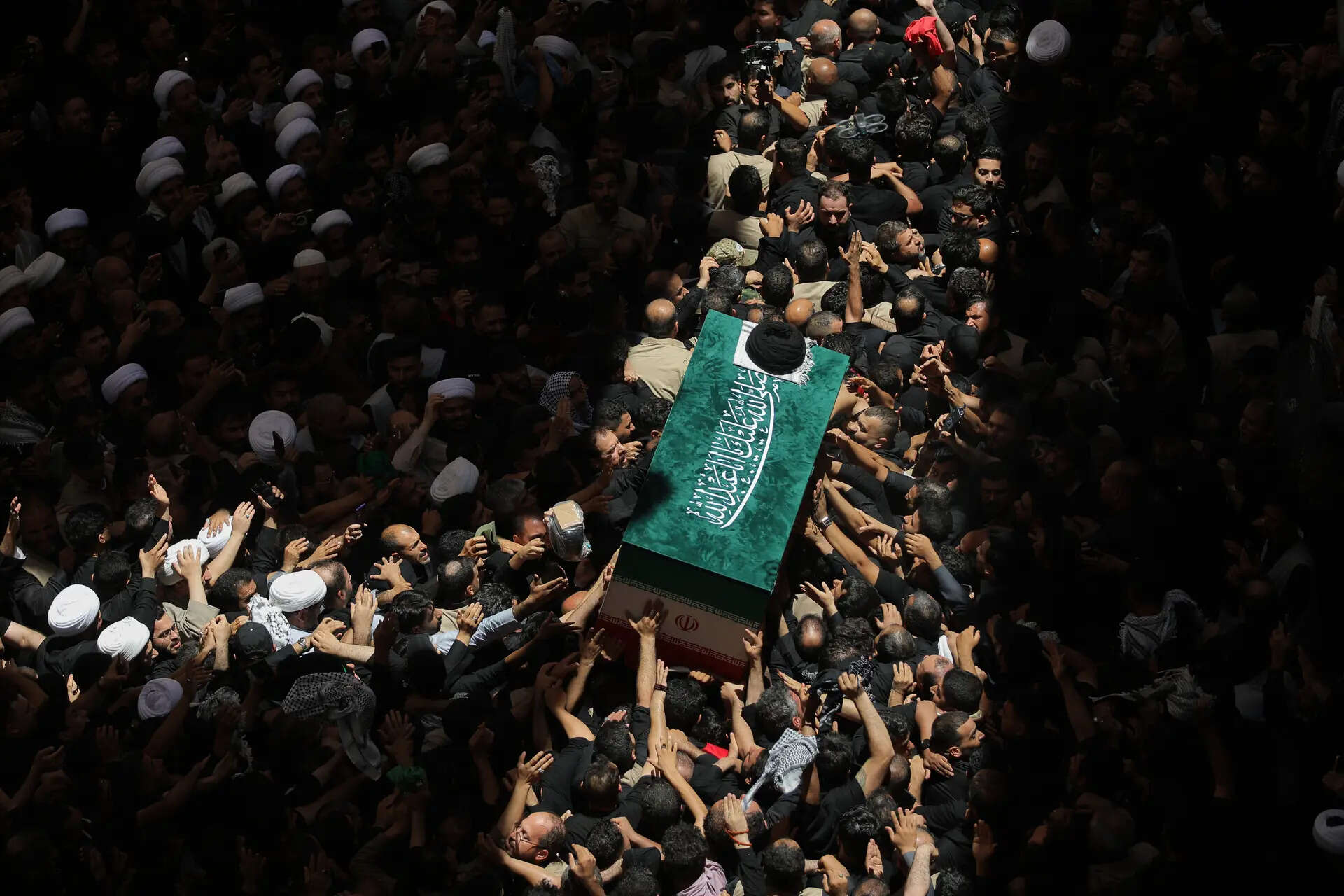
The burial of Ali Khamenei at the Shrine of Imam Reza in Mashhad—four months after the February 28 joint United States-Israeli kinetic strikes decapitated the senior echelons of the Islamic Republic—marks the conclusion of a deliberate, four-month operational freeze. In high-stakes geopolitics, a funeral is rarely just an act of mourning; it is an instrument of statecraft designed to project systemic stability during an acute constitutional crisis.
Conventional interpretations view this event purely through a religious or cultural lens, focusing on the massive crowds and the symbolic use of red flags. A rigorous strategic assessment reveals that the protracted delay between the Supreme Leader's death and his burial was a calculated operational pause. The state required this window to manage a critical three-part institutional imperative: absorbing the initial military shock, executing a legally complex transfer of absolute executive power, and recalibrating its asymmetric deterrent framework under the threat of renewed hostilities.
The Succession Function: Managing the Power Vacuum
Sovereign stability during an unexpected decapitation event depends on structural continuity rather than individual personalities. The Islamic Republic relies on a highly institutionalized, dual-legitimacy framework that balances absolute clerical authority (Velayat-e Faqih) with deep bureaucratic and military networks. The sudden elimination of the head of state introduces immediate systemic friction across this matrix.
[Kinetic Strike / Decapitation]
       │
       ▼
[Systemic Shock to Core Networks] ──► (IRGC Command / Clerical Bureaucracy / Intelligence)
       │
       ▼
[4-Month Operational Pause] ───────► (Stabilize Successor / Purge Breaches / Suppress Unrest)
       │
       ▼
[Public Burial & Legitimacy Ritual] ─► (Signal Regime Survival to Foreign & Domestic Adversaries)
The primary mechanism to counter this instability is the immediate activation of constitutional succession protocols. The rapid elevation of Mojtaba Khamenei to Supreme Leader in early March served as the primary mechanism to signal systemic continuity to the Islamic Revolutionary Guard Corps (IRGC), the conventional military, and foreign adversaries.
This transition encountered significant internal friction. The successor sustained severe injuries during the initial February 28 strikes on the Beyt-e Rahbari compound, which also claimed the lives of multiple family members and high-ranking officials. His subsequent four-month absence from public view created an acute communication bottleneck for the regime. In a system where the physical presence of the sovereign validates state authority, delegating public funeral rituals to secondary figures like First Vice-President Mohammad Reza Aref introduces distinct coordination costs:
- Erosion of Public Visual Authority: The inability of the new Supreme Leader to personally lead the funeral prayers broke decades of established ideological precedent, forcing the state to rely heavily on institutional state media broadcasts to project unity.
- Command Structure Ambiguity: A hidden commander-in-chief complicates the internal alignment of the IRGC's regional proxies, as these networks depend on direct, unambiguous loyalty structures.
- Vulnerability to Psychological Operations: The lack of verified public appearances by the successor allowed foreign intelligence services to exploit information asymmetries, forcing the regime to counter ongoing narratives regarding his operational capacity.
The Strategic Functions of Public Mobilization
Mass public mobilizations within authoritarian states are highly coordinated logistical maneuvers designed to achieve specific strategic outcomes. The multi-city funeral procession across Tehran, Qom, Iraq, and Mashhad served three operational functions.
Domestication of Geopolitical Risk
By framing the conflict as an existential defense of the nation rather than a preservation of the ruling clerical elite, the state effectively co-opted domestic dissent. Individuals who previously participated in anti-government protests faced a modified choice: align with the state against a foreign military threat or risk being categorized as active subversives during a period of martial law. The external shock transformed domestic political grievances into nationalist solidarity.
Intelligence Counter-Signaling
The scale of the crowds was used as a quantitative metric to signal regime resilience to Western and Israeli intelligence agencies. By demonstrating a high capacity for mass mobilization despite devastating kinetic damage to its central command facilities, the regime signaled that its internal security apparatus and societal control mechanisms remained fully functional.
Re-establishing Asymmetric Deterrence
The public display of the casualties—including the highly publicized deaths of the late leader's family members—was engineered to build domestic consensus for sustained asymmetric retaliation. The deliberate use of state-sanctioned revolutionary rhetoric calling for the targeting of foreign leadership figures served to establish a domestic mandate for future external operations.
Systemic Vulnerabilities and the Post-War Friction Point
The core limitation of the regime's current strategy lies in the severe degradation of its internal security architecture. The success of the February 28 strike demonstrated deep intelligence compromises within the state’s counter-espionage frameworks. Executing a mass public funeral involving millions of citizens during an active conflict introduces severe operational bottlenecks.
       ┌──────────────────────────────┐
       │ Intelligence Counter-Breech  │
       └──────────────┬───────────────┘
                      ▼
 ┌─────────────────────────────────────────┐
 │   Simultaneous Operational Challenges   │
 └──────┬───────────────────────────┬──────┘
        ▼                           ▼
┌──────────────┐             ┌──────────────┐
│  Logistical  │             │ Air Defense  │
│ Crowding out │             │ Stratification│
└──────────────┘             └──────────────┘
The first limitation is logistical crowding. Allocating vast security, intelligence, and paramilitary assets to manage crowd control and protect transport routes reduces the available operational capacity needed to detect and neutralize covert domestic actors.
This creates a second bottleneck in air defense stratification. Escorting the transport aircraft carrying the late leader's remains to Mashhad required dedicating front-line fighter aviation and advanced air defense batteries to a purely ceremonial task. This temporary relocation of assets created localized vulnerabilities within the broader defensive grid at a time when hostilities with the United States were flaring up along critical maritime corridors like the Strait of Hormuz.
Strategic Playbook
The regime must transition from symbolic crisis management to institutional reinforcement to ensure its survival.
First, the supreme leadership must execute a visible, highly managed public appearance by Mojtaba Khamenei within the next fourteen days. This appearance must be structurally designed to project physical and operational competence, effectively neutralizing foreign psychological operations and solidifying his standing among the IRGC command.
Second, the state must initiate an immediate, comprehensive counter-intelligence purge across all communication channels linked to the Beyt-e Rahbari. The precision of the February 28 strikes confirms structural vulnerabilities that cannot be mitigated by simple operational security adjustments.
Finally, Iran must leverage the current domestic unity generated by the funeral to finalize its shaky ceasefire framework with the United States. The regime must use its demonstrated social cohesion as a bargaining chip, trading a temporary reduction in regional proxy activity for concrete guarantees against further strikes on its leadership infrastructure. Failure to stabilize this relationship before the domestic cohesion of the mourning period fades will expose the regime's deep structural vulnerabilities to subsequent kinetic interventions.