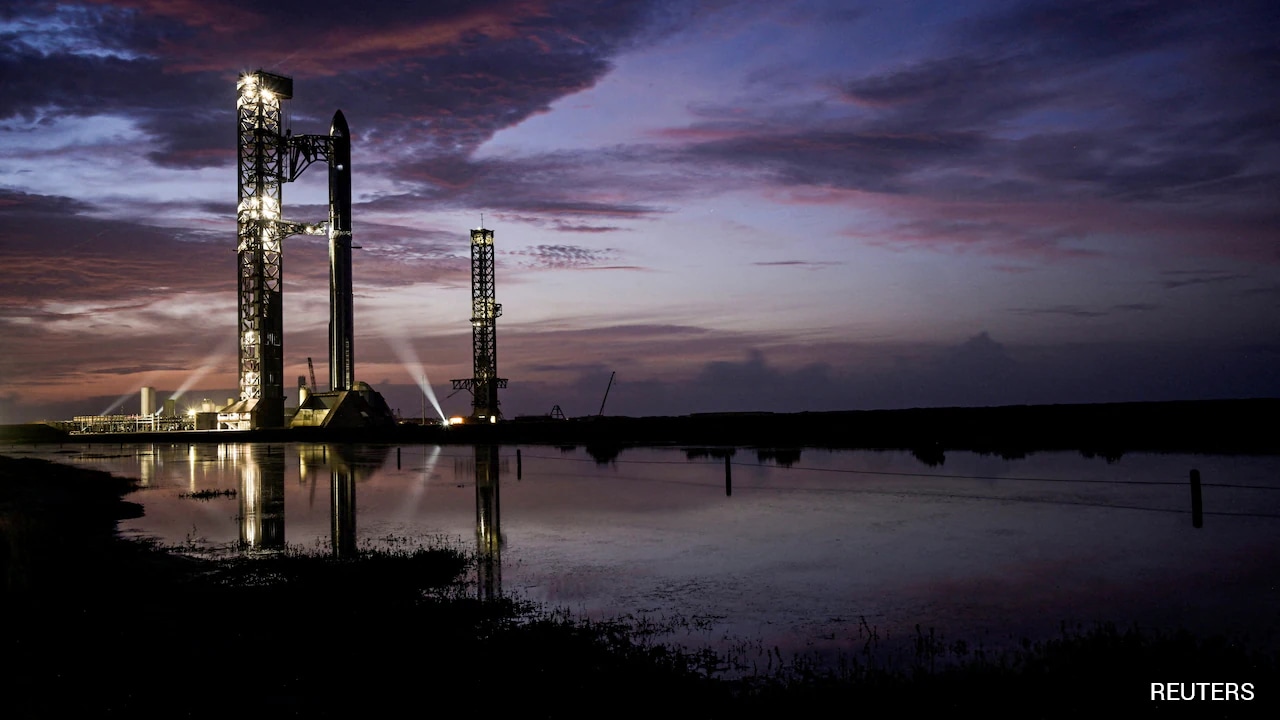
A flawless launch countdown that ends in a sudden plume of vapor and silent engines at $T-0$ is not a failure of engineering; it is the deliberate operation of a highly sensitive safety envelope. On July 16, 2026, SpaceX's 13th Starship flight test attempt aborted automatically at the exact moment of ignition. For a newly public company trading under the ticker SPCX, the subsequent 3% slip in aftermarket trading illustrates the tension between capital market expectations and the unforgiving physics of aerospace development.
Evaluating this abort requires discarding the narrative of a simple "glitch" and examining the systematic, algorithmic thresholds that govern the world's largest propulsion system.
The Core Failure: Raptor 3 Ignition Under-Performance
To understand the Starship Flight 13 abort, we must analyze the launch sequence's critical path. The Super Heavy Booster (Booster 20) utilizes 33 Raptor 3 engines. Lighting this many liquid oxygen (LOX) and liquid methane ($CH_4$) engines simultaneously requires a staggered, millisecond-precise startup sequence.
The mechanics of the abort unfold as follows:
[T-3 Seconds: Start Sequence Initiated]
       │
       ▼
[Manifold Pressurization & Spin Start]
       │
       ├─────────────────────────────────────────┐
       ▼                                         ▼
[29 Engines: Nominal Ignition]       [4 Engines: Startup Failure/Lag]
       │                                         │
       │                                         ▼
       │                            [Pressure/Speed Deviation]
       │                                         │
       ▼                                         ▼
[Thrust Asymmetry Threshold Exceeded] ──> [Flight Computer Triggers Abort]
                                                 │
                                                 ▼
                                    [T-0: Automated Shutdown & Prop Drain]
- The Ignition Profile: The flight computer initiates engine startup at approximately $T-3$ seconds. The 33 engines are not lit all at once; they are started in rapid, concentric pairs to prevent a massive acoustic overpressure wave from damaging the vehicle or the launch pad.
- The Telemetry Anomaly: Telemetry indicated that 29 engines successfully achieved ignition and began ramping up to thrust, but four engines failed to start or failed to reach the required startup pressure thresholds within the designated millisecond window.
- The Closed-Loop Interlock: The Starship flight software runs a continuous real-time comparison of chamber pressure, turbopump spin speeds, and fuel manifold pressures. If any engine falls outside a tight standard deviation during the transient startup phase, the automated system triggers a "hold".
Because the system detected that four engines were non-functional before the mechanical launch clamps released the rocket, the software executed a benign shutdown of the remaining 29 engines. This demonstrates the high reliability of SpaceX's software-defined safety interlocks: the system chose an immediate pad abort over a catastrophic engine-out ascent that could have destroyed the Pad 2 infrastructure.
The Strategic Mission Profile of Flight 13
Flight 13 represents a fundamental transition for the Starship program from a pure experimental vehicle to an operational utility platform. The mission profile contains two primary objectives that distinguish it from previous tests:
1. The V3 Starlink Deployment Mechanics
Unlike previous developmental flights, Flight 13 was configured to carry an active payload: 20 next-generation Starlink V3 satellites. Because the flight was designated as a suborbital trajectory—meaning the upper stage (Ship 40) would naturally reenter the atmosphere off the coast of Western Australia without requiring a deorbit burn—the payload deployment mechanism faced a unique test constraint.
The 20 satellites were designed to deploy during the short coast phase, activate their solar arrays, test cross-link laser communications, and then burn up in the atmosphere alongside the ship 20 minutes later. This represents an expensive but necessary risk run to validate the mechanical dispenser door under real flight dynamics.
2. The Optical Heat Shield Inspection
A primary structural bottleneck in Starship's rapid reusability loop is the integrity of its thermal protection system (TPS), which consists of roughly 18,000 hexagonal ceramic tiles. Six of the 20 Starlink V3 satellites on Flight 13 were retrofitted with external, high-resolution cameras.
Upon deployment, these satellites were positioned to perform a flyby optical sweep of Ship 40’s belly. This process mimics the Space Shuttle's historical Rendezvous Pitch Maneuver, providing high-fidelity data on tile erosion, cracking, or loss during the high-dynamic-pressure ascent phase.
The Micro-Economic Impact of the Post-IPO Era
The public listing of SpaceX under the ticker SPCX at $135 per share in June 2026 introduced an entirely new variable to the company's operational tempo: immediate public market feedback.
Historically, SpaceX treated launch pad explosions and aborts as cheap lessons in an iterative hardware-testing methodology. If a prototype exploded, the company cleared the debris, updated the CAD files, and rolled out the next hull.
The public markets, however, operate on a different risk-mitigation framework:
| Metric / Aspect | Pre-IPO Private Strategy | Post-IPO Public Reality |
|---|---|---|
| Risk Tolerance | High. High-velocity hardware testing favored speed over caution. | Moderate. Catastrophic pad failures carry heavy capital depreciation risks. |
| Market Volatility | None. Private valuations adjusted slowly during semi-annual liquidity rounds. | High. Intraday price movements react instantly to livestreamed anomalies. |
| Regulatory Oversight | FAA mishap investigations delayed launches without direct financial market consequences. | Delays threaten quarterly milestone achievements, triggering institutional selloffs. |
The 3% drop in SPCX stock to $131.11 following the Flight 13 scrub represents a temporary capital market overreaction to a healthy engineering outcome. The abort system functioned precisely as designed, preserving a multi-hundred-million-dollar launch vehicle and pad.
However, this market dip underscores a new reality: SpaceX must now balance its highly successful "fail fast, learn faster" philosophy with the predictable execution demanded by institutional Wall Street investors.
Operational Logistics: The Turnaround Plan
The path forward for Flight 13 is governed by clear, sequential operational steps.
First, the launch team immediately initiated propellant offloading, draining the 11.5 million pounds of sub-cooled liquid methane and liquid oxygen from both stages to render the vehicle safe.
Second, because the engine failure occurred at $T-0$ during active ignition, the hardware must be physically inspected. Elon Musk confirmed that two Raptor engines will be completely removed and replaced.
The turnaround process requires rolling the stack back to the Starbase assembly facilities, detaching the designated engines from the booster's thrust dome, plumbing in two fresh Raptor 3 units, and verifying their structural and electrical interfaces.
Given the modularity of the Block 3 Super Heavy booster design, this engine swap can be completed swiftly, positioning SpaceX for a second launch attempt in the latter half of July 2026. The software parameters will also be adjusted to account for the specific transient pressure signatures that triggered the shutdown, ensuring that the next countdown does not fall victim to overly conservative sensor thresholds while maintaining safety margins.