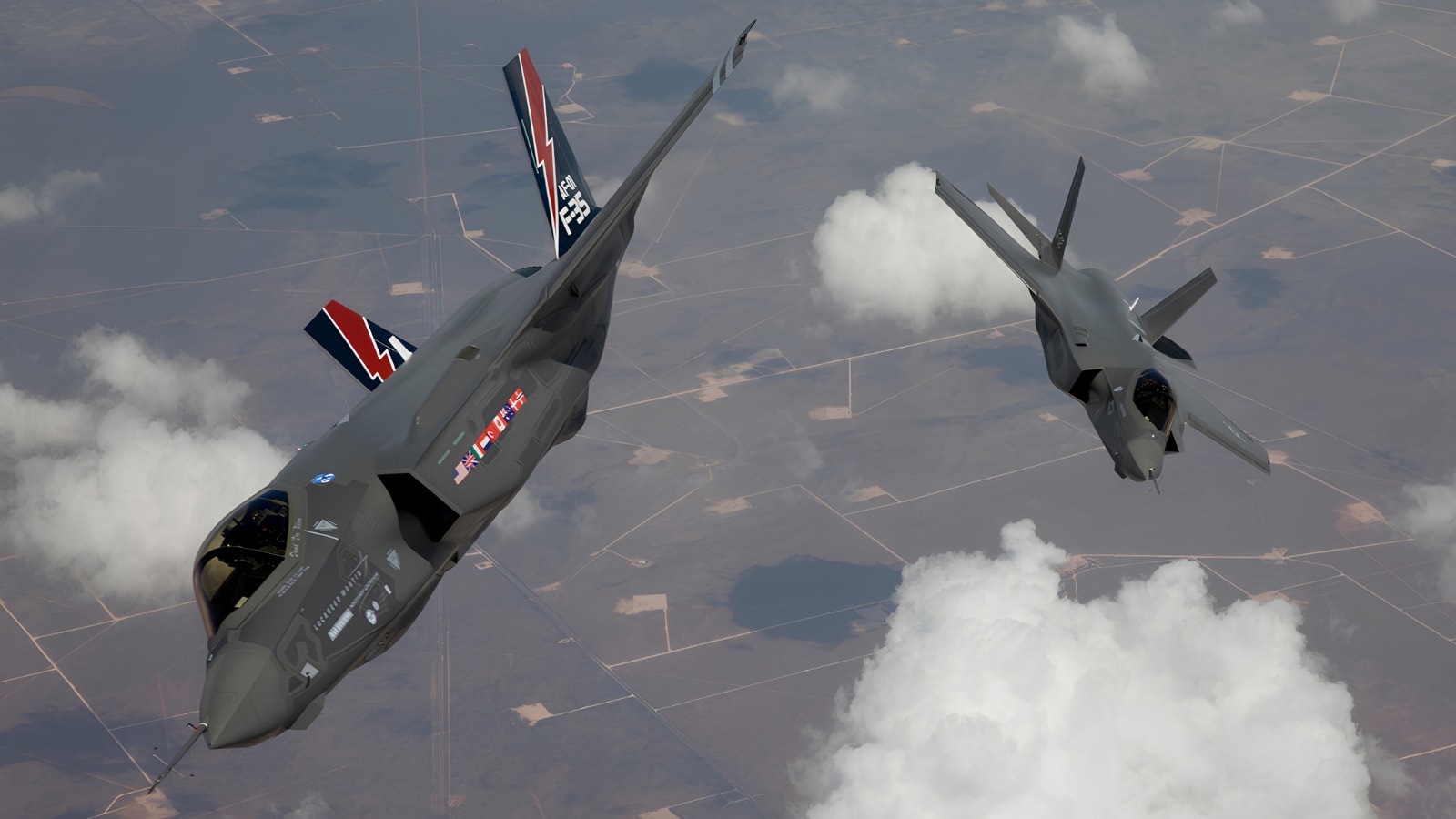
A decade-long procurement commitment for 850 fifth-generation fighter jets is not a simple purchasing transaction; it is an industrial lock-in mechanism that reshapes aerospace supply chains, alters fiscal flexibility for multiple presidential administrations, and transfers long-term operational risk onto the buyer. Standard coverage of a hypothetical Pentagon agreement with Lockheed Martin for 850 F-35 Lightning II aircraft reduces the story to a headline volume figure and a rough price tag. That framing misses the real mechanics of defense acquisition: multi-year contracting alters unit economics, supply-chain allocation, sustainment liabilities, and sovereign industrial leverage. This analysis establishes a structural framework to evaluate such a deal by separating known industrial and economic principles from educated hypotheses about contract terms, mapping cause-and-effect chains across production and sustainment, and defining the operational trade-offs facing defense planners.
Fact Versus Hypothesis in Multi-Year Defense Contracts
Because no public contract text or verified source document accompanies the headline reference, rigorous analysis starts by drawing a hard line between established defense-procurement mechanics and educated hypotheses. Treating an unverified headline or a simplified summary as settled fact is the fastest way to misprice strategic risk.
Known structural facts govern large-scale fighter procurement:
- Multi-year procurement authority: In United States defense acquisition, multi-year procurement (MYP) or block-buy structures allow the Department of Defense to commit funding across fiscal years for economic order quantities, provided statutory savings thresholds and congressional approvals are met.
- Lock-in through specialized tooling: Fighter aircraft production relies on bespoke jigs, composite curing autoclaves, mission-system software baselines, and cleared supply tiers that cannot be reallocated quickly without severe cost and schedule penalties.
- Lifecycle cost dominance: Across modern combat aircraft programs, acquisition cost represents only a fraction of total ownership cost; sustainment, depot maintenance, spare parts, propulsion overhauls, and software updates account for the majority of multi-decade expenditure.
- Sole-source dynamics: For a single-airframe fifth-generation platform like the F-35, competition occurs primarily at the subsystem, supplier, and sustainment-contract levels rather than at the prime airframe level.
Educated hypotheses fill the gaps where exact contract terms are unspecified:
- Economic order quantity discounts: A ten-year commitment covering 850 airframes would likely aim to lower recurring flyaway cost through predictable long-lead material ordering and stabilized factory cadence, though actual savings depend on inflation clauses, economic price adjustment formulas, and annual congressional appropriations.
- Fleet mix allocation: An 850-jet figure over ten years implies an average production rate of roughly 85 aircraft per year across variants (F-35A, F-35B, and F-35C) and potentially across U.S. services and allied or Foreign Military Sales partners, though exact annual delivery curves vary with supply-chain recovery and modernization blocks.
- Sustainment cost trajectory: Even if recurring production prices stabilize or decline on a per-unit basis, total fleet sustainment costs can rise if depot throughput lags fleet growth or if mission-capable rates fall short of operational targets.
The Four Pillars of An 850-Jet Acquisition Model
To evaluate a decade-long commitment of this scale without getting distracted by headline numbers, analyze the agreement across four operational pillars: industrial cadence, total cost structure, supply-chain elasticity, and modernization coupling.
1. Industrial Cadence and Learning Curves
Aircraft manufacturing obeys learning-curve economics—often modeled through Wright's Law—where cumulative production volume reduces direct labor hours per unit at a diminishing rate as workers, tooling, and processes mature. A ten-year horizon creates visibility for capital investment inside prime and tier-two facilities. Predictable demand lets suppliers purchase titanium, specialty alloys, electronics, and forgings in bulk rather than paying spot premiums or absorbing idle-capacity overhead.
The operational catch is that learning curves flatten over time. Once a platform has already passed its steepest early-production learning gains, additional volume yields smaller unit-labor reductions and more sensitivity to raw-material inflation, wage growth, and engineering changes. A ten-year schedule also exposes the production line to multi-year macroeconomic shifts, including interest-rate pressure on supplier working capital and labor bottlenecks in skilled aerospace trades.
2. The Cost Function of Ownership
Evaluating a fighter deal by flyaway price alone distorts fiscal planning. A rigorous cost function separates acquisition from lifecycle operations:
$$\text{Total Program Cost} = C_{\text{dev/mod}} + \sum_{t=1}^{T} \left( N_t \cdot P_{\text{unit},t} + F_t \cdot S_t \right)$$
In this formulation, $C_{\text{dev/mod}}$ represents non-recurring engineering, test, and modernization upgrades; $N_t$ denotes aircraft delivered in year $t$ at unit price $P_{\text{unit},t}$; and $F_t \cdot S_t$ captures the active fleet size $F_t$ multiplied by annual per-aircraft sustainment cost $S_t$ over horizon $T$.
Notice what happens as $F_t$ grows year after year: even if $P_{\text{unit},t}$ holds steady or inches down due to volume commitments, the cumulative fleet $F_t$ expands. Every delivered jet adds to the base requiring flight hours, engine maintenance, spare components, and software support. If annual sustainment cost per aircraft does not fall faster than the fleet grows, total annual defense budget pressure rises even as the contract looks like a bargain on paper.
3. Supply-Chain Elasticity and Bottlenecks
A ten-year commitment assumes the industrial base can bend without breaking. In practice, modern fighters depend on specialized sub-assemblers—suppliers of radar arrays, electro-optical sensors, flight-control actuators, thermal management systems, and propulsion components—where single-point or thin-margin suppliers are common.
Two structural tensions govern supply-chain elasticity:
- Throughput versus surge capacity: Optimizing a line for steady multi-year output minimizes waste, but it can leave little slack when an earlier backlog or component shortage delays deliveries. A backlog of undelivered jets ties up working capital and delays operational squadrons.
- Sub-tier fragility: Prime contractors manage system integration, yet sub-tier vendors often face acute skilled-labor shortages, obsolescence of legacy microelectronics, and capital constraints. Committing to 850 airframes does not automatically cure a bottleneck at a specialized castings or avionics supplier unless risk-sharing and lead-time buffers are built into the contracting model.
4. Modernization Coupling and Technical Debt
Fighter aircraft are flying software and sensor nodes, not static airframes. Over a ten-year window, threat environments, electronic warfare requirements, and data-link architectures evolve continuously. Locking in long-term production quantities while modernization packages are still maturing creates a classic synchronization problem: building airframes faster than upgrade hardware and software are certified can force expensive retrofits later.
Conversely, holding back production until every capability upgrade is finalized sacrifices volume efficiency and delays force structure modernization. Defense planners must balance configuration stability (which lowers build cost and simplifies training and spares) against upgrade readiness (which keeps the fleet relevant against evolving air defenses and long-range threats).
Hidden Cause-and-Effect Chains Standard Coverage Misses
Surface-level reporting typically treats a large procurement deal as a linear chain: larger order equals lower price equals stronger fleet. Real-world acquisition dynamics behave as feedback loops with second- and third-order consequences.
The Sustainment Lag Trap
When production deliveries accelerate over a ten-year deal, the operational fleet expands faster than depot repair capacity unless depot investment is funded on the exact same curve. This creates a bottleneck in spare-parts turn times and heavy maintenance slots. When parts wait in queues, availability drops, forcing commanders to cannibalize parts from other aircraft or fly remaining jets harder—which accelerates wear and further strains maintenance. A contract that optimizes flyaway price while under-funding sustainment infrastructure shifts the bill from the procurement line to readiness shortfalls.
The Fiscal Commitment Squeeze
A ten-year horizon spans multiple budget cycles and shifting strategic priorities. Committing large sums to fixed-wing strike fighters over a decade can crowd out competing investments in unmanned systems, air- and missile-defense munitions, space resilience, or cyber capabilities if top-line defense budgets flatten. Even when a deal promises predictable spending, fixed commitments reduce future budget agility when emerging threats require rapid reallocation.
The Sovereign and Industrial Leverage Shift
Multi-year volume commitments strengthen the prime contractor's revenue visibility and balance-sheet planning, while simultaneously deepening the buyer's reliance on that specific industrial ecosystem for decades of support. If performance-based logistics, technical data rights, or depot competition are not explicitly structured into the agreement, the buyer can face high switching costs and limited pricing leverage during future sustainment negotiations.
Operational Playbook for Evaluating and Executing the Deal
Whether acting as a defense policy analyst, an industry strategist, or a program evaluator assessing a deal of this magnitude, apply a disciplined sequence before drawing conclusions about its value.
- Audit the baseline before praising the discount. Separate true unit-cost reductions driven by economic order quantities and stable production rates from accounting shifts, inflation assumptions, or deferred costs. Confirm whether quoted figures cover airframes only, engines separately, or initial spares and training.
- Stress-test sustainment against fleet growth. Model annual sustainment outlays alongside projected cumulative aircraft counts over at least fifteen to twenty years, not just the ten-year delivery window. Look for explicit metrics tying contractor incentives to mission-capable rates and supply-chain turnaround times rather than delivery counts alone.
- Map sub-tier bottlenecks early. Identify high-risk subsystems—propulsion, mission processors, sensors, and specialized materials—where lead times are longest. Assess whether supplier capacity investments are funded upfront or left to sub-tier vendors operating under tight margins.
- Separate hardware cadence from software and upgrade risk. Verify how modernization baselines are sequenced with production blocks so newly delivered aircraft do not sit awaiting retrofit kits or face early software integration delays.
- Define clear exit, adjustment, and accountability gates. Ensure contract structures include transparent cost-reporting mechanisms, economic price adjustment guardrails, and clear remedies if delivery schedules slip or performance benchmarks are missed.
Limitations and Blind Spots of This Framework
No analytical framework eliminates uncertainty in defense acquisition. This model does not predict classified operational requirements, exact congressional appropriations behavior, or sudden geopolitical shocks that might accelerate or curtail demand. It also cannot substitute for line-item contract audit data when exact pricing formulas, incentive fees, and intellectual-property clauses are undisclosed. Treat the four-pillar model as a diagnostic lens to ask sharper questions and expose hidden trade-offs, not as a mechanical formula that outputs a single verdict.
Strategic Recommendation
Do not judge a ten-year, 850-aircraft agreement by the headline unit price or total order size; demand contract visibility into lifecycle sustainment economics, sub-tier supply-chain resilience, and modernization synchronization before treating the deal as a strategic win. For defense leaders and analysts, the decisive test is whether the agreement aligns long-term production stability with enforceable readiness outcomes and budget flexibility—otherwise, apparent upfront savings will be consumed by downstream sustainment costs and reduced strategic adaptability.