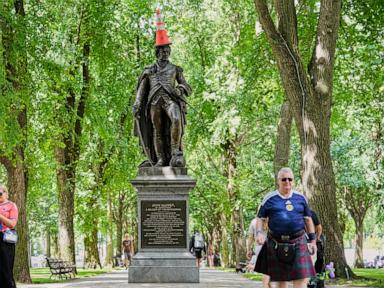
The unexpected elevation of an ordinary orange traffic cone from the streets of Scotland to an object of official municipal reception in Boston exposes the mechanics of decentralized cultural branding. Far from a mere curiosity, this event represents a masterclass in low-cost, high-context symbolic arbitrage. When grassroots sports fan cultures intersect with civic public relations, they bypass traditional diplomatic channels to manufacture immense social capital out of functionally worthless materials.
To understand how a plastic road safety marker achieved the equivalent of a diplomatic passport, we must analyze the structural mechanics of cultural transmission, the economic asymmetry of modern attention, and the systemic incentives for local governments to co-opt organic subcultures.
The Utility to Symbol Value Delta
At the core of this phenomenon lies a profound divergence between an object’s replacement cost and its symbolic valuation. In standard economic models, an item's worth is tied to its utility, scarcity, and production cost. A standard traffic cone possesses negligible financial value and negative aesthetic appeal.
The transformation of this object requires a specific process of cultural extraction and transplantation.
[Utility Asset: Traffic Cone]
       │
       ▼ (Contextual Extraction: Glasgow Street Humor)
[Regional Cultural Signifier]
       │
       ▼ (Translocation & High-Context Fan Bonding)
[Sacred Relic / Meme-Object]
       │
       ▼ (Municipal Validation: Boston Reception)
[High-Value Diplomatic Currency]
This translation occurs across three distinct phases.
1. Contextual Extraction
In its native Scottish environment, particularly in Glasgow, the traffic cone is not merely road furniture; it is a long-standing symbol of working-class irreverence. The persistent crowning of the Duke of Wellington statue with a traffic cone transformed a tool of municipal order into a monument to civic defiance. When Scottish fans traveled abroad, they exported this specific piece of conceptual vocabulary.
2. Translocation and High-Context Bonding
During the World Cup, the physical cone became a focal point for cross-cultural interaction between Scottish supporters and Bostonians. Within the high-arousal, low-barrier environment of international sports fandom, shared experiences require physical anchors to persist beyond the event. The cone served as a low-cost, highly visible totem of this alliance.
3. Municipal Validation
The final phase occurs when official institutions recognize the informal symbol. By organizing a formal welcome for the cone in Boston, municipal actors converted a private inside joke into public civic theater. This institutional rubber-stamping permanently locks in the object’s elevated symbolic valuation.
The Inverse Cost to Attention Ratio
Modern public relations operates on a scarce resource: authentic human attention. Traditional marketing campaigns expend significant capital to manufacture engagement, often yielding low trust due to the obvious commercial motives of the source.
The Scottish traffic cone campaign succeeded by exploiting the Inverse Cost-to-Attention Ratio.
- Financial Investment: Near zero. The cost of a plastic cone and transatlantic shipping.
- Trust Generation: Exceptionally high. Because the campaign originated from genuine peer-to-peer interactions, audiences did not perceive it as advertising.
- Media Multiplier: The sheer absurdity of treating a piece of plastic as an international dignitary provided a perfect narrative hook for news outlets, generating millions of dollars in earned media value for both cities.
The mechanism driving this efficiency is the preservation of organic origin. Had a tourism board manufactured a custom-branded "friendship cone" and shipped it with a polished corporate press release, the initiative would have failed. The absolute lack of professional polish in the original artifact is precisely what guaranteed its viral distribution.
The Bureaucratic Absurdity Multiplier
Why did Boston’s municipal leadership agree to treat a piece of Scottish road equipment with the dignity usually reserved for foreign ambassadors? The decision aligns perfectly with the strategic interests of modern city administration.
Local governments face a constant struggle to project warmth, accessibility, and cultural relevance. Traditional civic ceremonies are often stiff, expensive, and ignored by younger demographics. Participating in high-context, absurd humor allows a city to achieve several strategic objectives simultaneously.
First, it signals cultural intelligence. By actively participating in a joke initiated by its citizens and foreign visitors, the municipality positions itself as an in-touch, responsive entity rather than a cold bureaucracy.
Second, it builds cheap international goodwill. A formal sister-city agreement requires years of negotiations, legal reviews, and budgetary allocations. A "traffic cone alliance" achieves a similar level of positive bilateral press in forty-eight hours for the cost of a few municipal staff hours.
Third, it leverages the power of contrast. The juxtaposition of formal diplomatic protocols—podiums, official speeches, ribbon-cutting, and dignitary handshakes—with a scratched, dirty plastic cone creates a cognitive dissonance that is highly shareable on digital platforms.
Systemic Risks of Manufactured Absurdity
While the transatlantic journey of the Scottish cone represents a highly successful execution of micro-diplomacy, the strategy contains inherent structural limitations. Organizations and municipalities attempting to replicate this playbook must account for two primary failure modes.
The Dilution of Spontaneity
The value of a meme-object is directly proportional to its perceived authenticity. If a municipal government attempts to institutionalize this process—for example, by establishing an annual "international object exchange program"—the strategic value evaporates. Once the public detects a top-down structural framework behind the absurdity, the campaign transitions from a charming cultural anomaly to a transparent marketing gimmick.
The Risk of Contextual Misalignment
Not all local symbols translate cleanly across international borders. The Scottish traffic cone succeeded because its underlying subtext—good-natured, working-class humor—is universally accessible and non-threatening. Attempting a similar stunt with an object tied to more polarizing, politically charged, or poorly understood local traditions can result in severe public relations backlash.
The Strategic Playbook for Civic and Corporate Cult Branding
For entities looking to capture the lightning-in-a-bottle engagement of the Scottish traffic cone, the path forward requires a shift from active creation to strategic facilitation.
Do not try to invent the symbol. Instead, monitor the fringes of your community or fan base for existing, low-stakes inside jokes. When one begins to gain traction, resist the urge to immediately commercialize it. Instead, provide the logistical infrastructure to let the community scale it on their own terms.
When the time is right, use your institutional authority to validate the joke, keeping the tone strictly deadpan. The magic of the Scottish cone was not the object itself, but the seriousness with which the authorities treated it. Maintain the illusion of gravity, let the public enjoy the irony, and let the organic network do the rest of the work for you.

