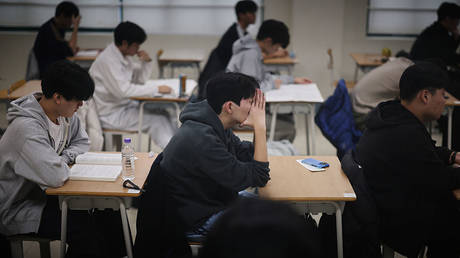
Silence. That is the first thing you notice in a Seoul study cafe at two in the morning.
Not the heavy, sleepy quiet of a farmhouse at dusk. A sharp, fluorescent silence. Every cubicle has a partition. Every desk has a warm task lamp. Hundreds of teenagers sit shoulder-to-shoulder with mechanical pencils, highlighters, and tablets, chasing decimal points that decide which university badge they wear, which corporate tower might interview them ten years from now, and whether their parents can exhale at dinner. Building on this idea, you can also read: The Quiet Bet on Steel and Sea That Could Redraw the World.
In South Korea, an exam is rarely just an exam. It is a collective breath held by an entire household.
So when news broke of an education minister stepping down in the wake of an artificial intelligence cheating scandal, a cold shock ran straight down the spine of the system. A minister resigning is a political earthquake in a country where public accountability carries sharp weight. Yet a ministerial resignation is also a tidy headline. A clean ending. A villain or a scapegoat is named, a bow is made before cameras, a letter is submitted, and the machine keeps humming. Analysts at Reuters have also weighed in on this trend.
Except this machine has a new kind of ghost in the gears.
What happens when the very tool built to help students learn becomes the shortcut that hollows out the point of learning—and when the adults in charge realize the rules were written for a world where cheating meant hiding notes under a ruler or whispering across a back row?
Let us be clear from the start. Because this reference headline arrives without a detailed archive in front of me, I am drawing on well-documented patterns in South Korea’s hyper-competitive exam culture, recent ministerial resignations tied to educational controversies, and the rapid collision between generative AI and high-stakes testing. Where I introduce specific people or scenes to show how policy hits flesh and blood, I am using hypothetical characters and metaphors to make an abstract institutional crisis visible.
Consider what happens next when a minister falls.
The Weight of a Single Number
To understand why an AI cheating scandal can topple a cabinet official in Seoul, you have to feel the air inside a cram school—a hagwon—in Gangnam or Mokdong on a rainy Tuesday.
Rain hits the double-glazed glass. Inside, the radiator ticks. A student named Ji-hoon—a hypothetical character standing in for thousands of high school seniors—stares at a practice essay prompt on his screen. His eyes burn. He has already spent four hours after school solving math problems and memorizing vocabulary lists. His mother left a peeled pear and a thermos of warm barley tea by his elbow before going to bed. She didn't say Don't fail. She didn't have to. The silence in the kitchen said everything.
Ji-hoon opens a generative AI chat window. He types his prompt. Within seconds, clean, structured paragraphs bloom on the glass. Clear topic sentences. Sharp counterarguments. Vocabulary that sounds like a university professor wrote it after a double espresso.
Nothing crashes. No alarm sounds. No red ink bleeds onto paper.
For decades, South Korea’s education system has operated on a brutal, transparent bargain: extreme effort in exchange for a measurable rank. The Suneung—the national college entrance exam—is famous worldwide for good reason. Flights are grounded or rerouted during English listening tests so no jet engine ruins a teenager's concentration. Police escorts help latecomers reach testing centers. The entire nation pauses for a single day of grading.
That system survives only if people believe the scoreboard is fair.
Think of the scoreboard as a suspension bridge over a wide river. Every student steps onto the planks trusting that the cables holding the deck are honest steel. If one plank rots, a person falls. If people start suspecting the cables themselves are fake, nobody trusts the bridge. Even a student who stayed up until three in the morning writing every word by hand starts wondering: Did the person who beat me by two points actually earn it, or did they prompt a machine at midnight?
Once that doubt takes root, meritocracy stops feeling like a ladder. It starts feeling like a trap for the honest.
Why a Minister Resigns
Politicians rarely resign over a single bad test. They resign when a scandal exposes a crack in a foundational promise.
When AI tools slip past proctors, university admissions essays, take-home assessments, or online test portals, the fallout hits an education ministry from three directions at once.
First comes legitimacy. If degrees, entrance scores, or academic evaluations lose credibility because automated systems generated the work, the ministry’s core mandate—certifying competence fairly—looks compromised. A minister stepping down acts as an immediate pressure valve, signaling to outraged parents, teachers, and lawmakers that leadership accepts responsibility rather than pretending nothing broke.
Second comes speed. Government policy moves through committees, public hearings, legal reviews, and school rollouts. Generative AI updates on weekly and monthly cycles. By the time a ministry drafts guidelines on "unauthorized digital assistance," students are already using voice assistants, hidden wearables, browser extensions, or multi-step reasoning prompts that leave no obvious copy-paste footprint. Watching an old rulebook get outpaced in real time is humiliating for any public official.
Third comes moral panic. In a society where educational rank shapes marriage prospects, housing dreams, and lifelong career tracks, any whisper of systemic cheating triggers intense anger. Parents worry their children are being cheated out of fair spots. Teachers worry they are being turned into amateur digital detectives instead of mentors. Students feel caught between an arms race they didn't start and a crackdown that may punish them unfairly.
A resignation satisfies the hunger for accountability in the short term.
Yet stepping down does not answer the harder question waiting on the minister’s desk.
A Metaphor Made of Glass
Picture a glassblower’s workshop. For fifty years, the master craftsperson has shaped molten glass using the same iron blowpipe, measuring thickness by eye and cooling each piece at the same steady pace. Every apprentice knows the rhythm.
One morning, a new furnace is lit beside the old one. The heat is higher, the glass flows faster, and the old gauge on the wall doesn't even register the temperature. Someone drops a piece of glass, and it shatters because the cooling schedule was built for a slower flame.
Shouting at the glassblower—or replacing the foreman—does not change the physics of the new furnace.
That is the trap of treating an AI cheating scandal purely as a story of bad behavior and political fallouts. Yes, students cheat. Yes, officials face intense heat when scandals erupt. And yes, AI detection software is notoriously flawed—flagging non-native phrasing, careful grammar, or neurodivergent writing styles as "machine-generated" while letting polished prompts slip right through.
If schools rely on clunky detectors, innocent students get accused of fraud based on probabilistic guesses. If schools ban all technology and retreat to paper-and-pencil isolation, they prepare students for an exam hall that looks nothing like the modern workplace, where professionals use AI every day to draft, code, analyze, and check blind spots.
Neither extreme works.
What Happens Inside the Classroom
Let us move away from ministries and press briefings for a moment and step into a high school humanities classroom in Busan.
A teacher—let’s call her Min-seo, another hypothetical character—is grading thirty essays on civic duty. Two years ago, she could spot plagiarism easily: a sudden jump from clunky phrasing to dense academic jargon gave it away. Today, students know how to ask an AI model to rewrite a draft in a casual tone, insert a minor grammar slip, and sound just like a seventeen-year-old.
Min-seo sighs, setting her red pen down. She isn't naive. She knows her students are exhausted. Many of them bounce from school to private academies until ten at night. When a teenager is running on five hours of sleep and terrified of disappointing everyone they love, a button that produces a passing paragraph in ten seconds looks less like a crime and more like a lifeline.
Here is my own confession, as someone who has watched learning environments wrestle with new tools and felt the quiet dread of falling behind: I find this whole moment unsettling. Not because technology is evil, and not because teenagers are uniquely corrupt. It is unsettling because we built schools around products—a five-paragraph essay, a solved worksheet, a multiple-choice score—at the exact moment in history when producing a plausible answer became nearly free.
When the answer is cheap, testing for the answer alone tells you very little about who actually understands the problem.
The Real Stakes Behind the Headlines
When people ask how students cheat with AI today, they usually picture a shortcut on a homework assignment. That misses the deeper shift.
The real danger isn't just someone getting a higher score on Tuesday's quiz. The real danger is cognitive atrophy—the quiet shrinking of mental stamina when you outsource every hard step before your brain builds the neural pathways to wrestle with friction.
Think about physical strength. If you use a forklift every time you pick up a box, your back doesn't get stronger just because the box moved. The box got to its destination, sure. Your muscles didn't.
Struggle is not a bug in education. Friction is where judgment grows. When a student wrestles with an ambiguous question, hits a dead end, rereads a paragraph three times, argues with a classmate, and finally finds words that capture what they mean, something permanent changes inside them. They learn how to think when nobody gives them a prompt.
If AI removes all the friction too early, students can graduate with high marks and fragile foundations—able to polish text, yet unsure how to judge whether a claim is true, ethical, or sound when the machine hallucinates a fake citation or misses a human nuance.
And what about fairness? Families with money can afford private tutors who teach ethical AI workflows, custom study plans, and deep coaching, while lower-income students may face harsher disciplinary crackdowns or less guidance. A cheating scandal doesn't just test integrity; it exposes every existing fault line in equity and trust.
Moving Past the Scapegoat
So what should happen after the headlines cool down and a new education leader takes the oath?
First, stop pretending a ban is a strategy. Rules matter—academic honesty has to mean something real, and blatant shortcuts during graded assessments deserve clear boundaries. Yet blanket bans without redesigning how we teach and evaluate are like putting a strip of masking tape over a leaking dam. Students will adapt faster than policy memos.
Second, shift the spotlight from final output to visible process. If a student submits a finished essay out of thin air, there is no trail of thought. If learning happens through staged drafts, oral defenses, live problem-solving, peer critiques, and transparent reflection on how tools were—or were not—used, the focus moves back to genuine reasoning. A teenager who can explain why they rejected an AI suggestion and chose a different argument has shown real intellect.
Third, lower the suffocating pressure cooker where shortcuts thrive. Cheating flourishes where stakes are all-or-nothing and exhaustion is normal. No policy fix on earth will beat human desperation if students believe one bad test score ruins their lives.
None of this is easy. Changing an exam culture that took decades to harden takes courage, patience, and honest debate—not just a press statement after a minister resigns.
The Last Light in the Room
Back in that Seoul study cafe, it is past two in the morning. Most of the cubicles have emptied out. A few students still sit hunched over glowing screens, rubbing their eyes, trying to hold onto one more formula or one more paragraph before morning.
Outside, the city streets are damp and quiet under streetlamps.
A cabinet minister can pack up a nameplate and walk out of a building. That part of the story has a clean exit door. The harder story stays right there on the desk—in the space between a blinking cursor, a tired mind, and the quiet question every student has to answer alone: What am I actually becoming while the screen types?


