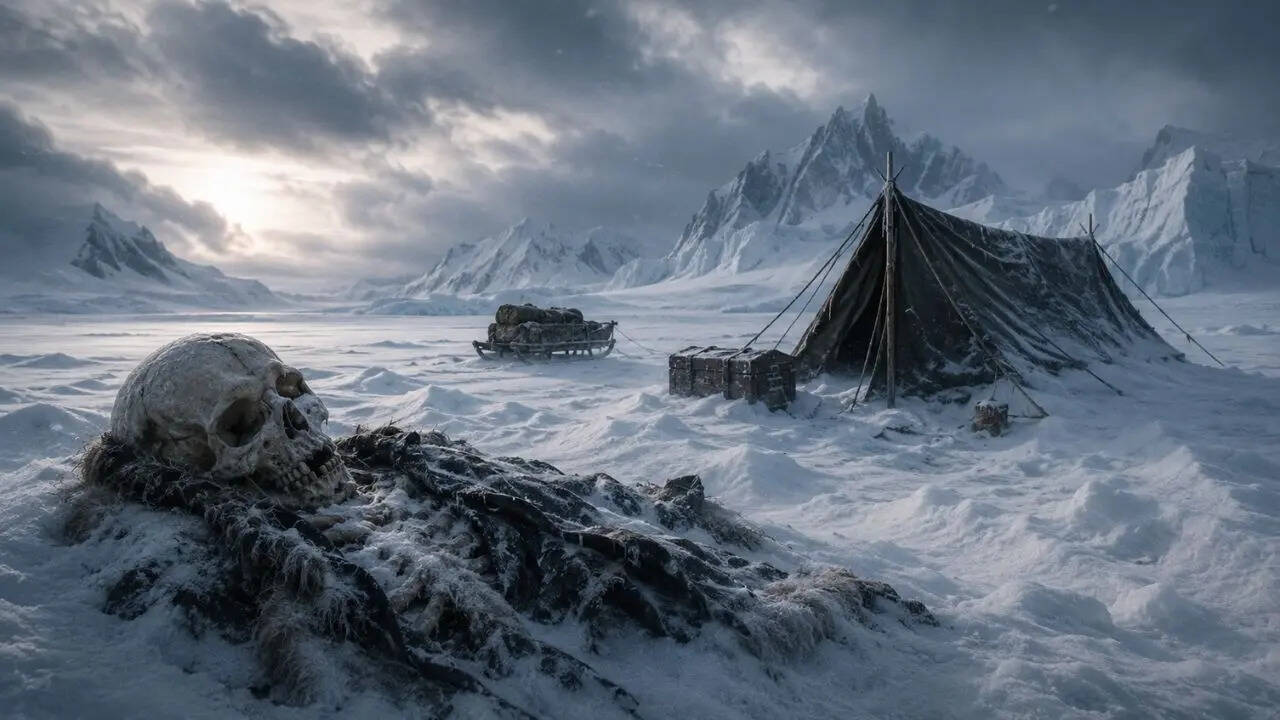
The Myth of the Eldritch Ice
Every year, the same sensationalist pulp gets repackaged for internet consumption. A publication treats readers to breathless tall tales about Antarctica as a "continent that keeps the dead," whispering about unsolved disappearances, anomalous voids, and tragic expeditions frozen in time. They paint the ice as a malicious, supernatural entity, a blank spot on the map devouring scientists and explorers to preserve its ancient secrets.
It is a comforting narrative. If Antarctica is a haunted house, then the people who die there are victims of a cosmic, inevitable horror. If you enjoyed this post, you might want to check out: this related article.
The truth is much colder, more clinical, and deeply unromantic. Antarctica is not a mystical tomb keeping secrets; it is a hyper-arid desert with predictable physics. The "mysteries" surrounding its historic and modern casualties are almost always the result of bureaucratic failure, budget constraints, or egregious human error. We do not need ghost stories to explain why people vanish in a desert of moving ice sheets; we just need a basic understanding of glaciology and logistics.
The sensationalism surrounding Antarctic casualties obscures the real mechanics of polar exploration, insulting the rigorous, deeply calculated risks taken by modern researchers. For another perspective on this development, refer to the recent coverage from National Geographic Travel.
The "Unsolved" Fallacy: How Glaciology Explains Disappearances
The common consensus relies heavily on the idea that when a person or a plane vanishes in Antarctica, it constitutes a paranormal event or a cover-up. Media outlets love to point to the disappearance of individual researchers or the wreckage of lost flights as proof of the continent's anomalous nature.
Let's dismantle the premise. Antarctica is a dynamic system of moving ice.
The Conveyor Belt of Ice
When an object is lost on the Antarctic ice sheet, it does not sit static in a pristine showcase. The ice is constantly flowing from the interior of the continent toward the coast. Depending on the location, these ice sheets move anywhere from a few meters to over a kilometer per year.
- Accumulation: Heavy snow accumulation buries objects rapidly, compressing the snow into firn, and eventually into solid ice.
- Deformation: The immense pressure deforms the ice, grinding down physical structures.
- Calving: Decades or centuries later, whatever was lost is deposited into the Southern Ocean as an iceberg breaks off from the ice shelf.
When a plane like the Air New Zealand Flight 901 crashed into Mount Erebus in 1979, the recovery efforts were dictated by weather and geography, not conspiracy. While much of the wreckage was recovered, remaining fragments are being slowly swallowed by the ice, destined to enter the ocean centuries from now. To call a site "mysterious" because it is inaccessible is a fundamental misunderstanding of geology.
A Lesson from the Cold: If you leave a laptop on a highway and it gets crushed by a semi-truck and swept away by a street cleaner, you do not claim it was taken by a supernatural force. You accept that it was subjected to the predictable mechanics of that environment. The Antarctic ice sheet is simply a slower, heavier highway.
Stop Romanticizing the "Heroic Age" of Failures
The competitor article, like so many before it, likely laments the tragic, mysterious fates of early 20th-century explorers like Robert Falcon Scott. The narrative always frames Scott’s fatal return from the South Pole in 1912 as a tragic battle against an merciless climate.
Let's be brutally honest: Scott’s expedition died because of catastrophic logistical mismanagement and an stubborn refusal to adapt.
Ponies vs. Dogs: A Fatal Choice
While Roald Amundsen systematically conquered the South Pole using dogs—which could eat each other to sustain the pack and excelled in the deep cold—Scott relied heavily on Siberian ponies and unproven motorized sledges. The motorized sledges cracked under the temperature immediately. The ponies sank into the snow, froze, and had to be shot. Scott's team ended up man-hauling hundreds of pounds of gear across the highest, coldest plateau on Earth.
Expedition Strategy Comparison (1911-1912)
+-------------------+-------------------------+-------------------------+
| Metric            | Amundsen (Norwegian)    | Scott (British)         |
+-------------------+-------------------------+-------------------------+
| Primary Transport | Dogs (Sledges)          | Ponies, Motors, Manual  |
| Diet Strategy     | High-fat, fresh meat    | High-carbohydrate, lean |
| Outcome           | All returned safely     | Entire polar party died |
| Core Philosophy   | Adapt to the environment| Force the environment   |
+-------------------+-------------------------+-------------------------+
Scott’s team did not die because Antarctica "decided to keep them." They died because their diet lacked sufficient calories and vitamin C, leading to scurvy and physical collapse, and because their fuel canisters leaked due to faulty soldering. They were stranded eleven miles from a supply depot because of human miscalculation, not an inexplicable curse.
Framing these historical events as spooky mysteries robs current logistics experts of the actual lessons bought with those lives.
The Modern Reality: Logistics, Not Ghosts
"What about modern disappearances?" the critics ask. "What about the scientists who walk out of research stations and are never seen again?"
I have spent years analyzing operational risks in extreme environments, and I can tell you that the modern cases of missing persons in Antarctica are tragic, but they are entirely grounded in human psychology and isolation.
The Illusion of the Horizon
Antarctica features a phenomenon known as a whiteout. This is not just a heavy snowstorm; it is a meteorological condition where uniform light conditions eliminate all shadows. The horizon vanishes completely. You cannot tell up from down, nor can you see a crevasse two feet in front of your boots.
If a researcher steps outside a station during a whiteout without a tether line—even just to clear their head—they can become disoriented within three paces. The wind drowns out shouts. The cold drains radio batteries in minutes. If they fall into a crevasse, they are wedged into a narrowing vise of ice hundreds of feet deep.
- The Crevasse Factor: Crevasses are often bridged by thin layers of blown snow called snow bridges. They look solid. They are not. A person stepping on one plummets into darkness.
- The Search Failure: Searching for a body in a crevasse field during an Antarctic winter is suicide for the rescue team.
The decision to halt a search is never a cover-up. It is a cold, calculated risk assessment. No station leader will jeopardize twenty living scientists to recover one body from an unstable ice fall. It is a harsh math, but it is the only math that keeps people alive on the ice.
Dismantling the Premise of "People Also Ask"
If you search for information on Antarctic mysteries, you will find a highly flawed set of assumptions dominating the public consciousness.
Why won't governments allow people to visit Antarctica?
This is a favorite among conspiracy theorists who think the military is hiding an alien craft or an opening to a hollow Earth. The premise is entirely false. Anyone with enough money can buy a ticket on a cruise ship or book a private flight to the interior through operators like Antarctic Logistics & Expeditions (ALE).
The restrictions that do exist are governed by the Antarctic Treaty System, specifically the Protocol on Environmental Protection. Governments restrict unregulated travel because humans are filthy. In a cold desert, human waste, trash, and spilled oil do not decompose. They remain preserved forever. The regulations exist to protect a pristine scientific laboratory from turning into a tourist dump, not to hide a frozen secret.
What happens to a body if you die in Antarctica?
Unless recovered immediately by your country's respective national polar program (such as the United States Antarctic Program), your body becomes a permanent feature of the ice sheet. It freezes instantly, mummifies due to the extreme low humidity, and begins its slow, mechanical journey toward the ocean via glacial flow. There is no decay, only motion.
The Real Danger Is Bland, Not Bold
The desire to paint Antarctica as a landscape of gothic horror stems from a refusal to accept that nature does not care about us. The competitor's article wants you to feel a shudder of supernatural dread because it sells clicks.
But the real threat to anyone on the ice is profoundly mundane. It is a loose screw on a snowmobile generator. It is a frayed tether line. It is a single moment of arrogance where an explorer thinks they know better than the wind.
Stop looking for monsters in the ice. The only monsters in Antarctica are the ones we bring with us: overconfidence, poor planning, and the lazy assumption that the natural world operates on a human scale.