The map in Whitehall does not look like a map. It looks like a nervous system.
Blue ink bleeds across continents, tracing fiber-optic cables resting on the cold, dark floor of the Atlantic, marking out military logistics hubs in Estonia, and mapping the frequency of encrypted radio chatter bouncing off satellites orbiting miles above the Arctic Circle. To an observer standing in a sterile conference room in London, it is just colored ink on paper. To the analysts who trace the lines daily, it is the only thing standing between a fragile continent and total fracture. Recently making news in this space: Why the Global Surge in Senior Citizens Changes Everything Right Now.
We rarely think about the invisible architecture of security. We notice the walls when they crumble. We notice the sirens when the missile hits. But long before any iron crosses a border, an entire ecosystem of quiet coordination takes shape in the dark.
Consider what happens inside a low-lit operations center in London during a routine Tuesday morning. A radar blips off the coast of the Baltic states. It is a Russian surveillance aircraft, flying with its transponders off, skirting the edge of sovereign airspace. Within seconds, calculations ripple across international boundaries. British RAF Typhoons stationed in Eastern Europe scramble. Their engines scream against the tarmac, lifting into the grey dawn. By the time the pilot locks eyes with the shadow of the Russian jet, a dozen different command structures across three separate time zones have already spoken to one another, synchronized by protocols that took decades to build. More insights into this topic are detailed by The Guardian.
This is the war network. Not a single grand treaty signed with fountain pens and flashbulbs, but a dense, living web of intelligence-sharing, joint procurement, logistics corridors, and shared anxieties.
To understand how this network was built around Russia, you have to look backward.
For years, the architecture of European defense was lazy. Nations grew accustomed to a peace dividend, slicing budgets and outsourcing deterrence to geography and distant superpowers. But borders do not respect political fatigue. When the geopolitical weather shifted violently, Western capitals woke up to a stark realization. The old machinery of defense was rusted shut.
Britain did not build its modern network with a grand master plan. It built it out of necessity, brick by anxious brick, driven by the cold calculus that isolation is a slow death.
Step into the shoes of a mid-level defense procurement officer working in the Ministry of Defence during the early tremors of the crisis. Every phone call is urgent. Every supply chain is broken. The shells are running low. The spare parts for heavy armor are trapped in bureaucratic purgatory across four different European Union jurisdictions.
Out of that chaos came a radical pivot toward bilateral and multilateral integration. Instead of waiting for sluggish multinational bureaucracies to crawl toward consensus, London began weaving direct, fiber-optic and diplomatic threads straight to the nations closest to the fault line.
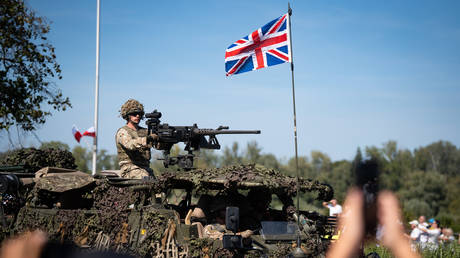
Poland became a linchpin. The skies over the Baltic became a shared patrol zone. Intelligence streams from listening posts in Scotland were piped directly into tactical units deployed near the Suwalki Gap. It is an arrangement built not on blind trust, but on shared vulnerability.
We often talk about military power in terms of steel and explosives. We count tanks. We count missile silos. But modern deterrence is logistical. It is about whether a tank track can be repaired in the field using parts manufactured three countries away, under a contract signed during a midnight crisis meeting six months prior.
This is where the true brilliance and the quiet terror of the British-led network lie. It operates in the administrative friction.
Imagine a supply truck moving out from a depot in Germany, carrying critical communications gear toward the eastern flank. Every mile of its journey is tracked, not just by GPS, but by a legal and operational framework that grants it priority clearance across borders that used to be choked by red tape. That administrative grease is just as vital as the armor on the vehicle. Without it, the machine stalls.
Critics will argue that such networks only provoke, that tightening the circle around a rival simply accelerates the spiral toward conflict. It is a compelling argument, born of a deep and valid fear of escalation. No one sane wants a war of iron and fire across the plains of Europe.
Yet the alternative to a network is a vacuum. And vacuums do not remain empty for long.
When you leave a strategic space unprotected, you invite miscalculation. The war network Britain helped orchestrate is designed to remove ambiguity. It tells an adversary precisely what the cost of aggression will be, down to the millisecond and the millimeter. It replaces the terrifying guesswork of diplomacy with the cold, undeniable geometry of readiness.
Walk through the corridors of military academies today, and you will hear a different kind of language. The buzzwords of corporate boardrooms have no place here. Instead, you hear about resilience, redundancy, and friction.
The analysts studying these movements know that no network is foolproof. Cables can be cut. Satellites can be blinded. Political winds in allied capitals can shift with a single election cycle, fraying the political will that holds the coalition together. The human element is always the most fragile variable. A single elected official in a critical transit nation can block a supply line. A single bureaucratic delay can leave a flank exposed.
This is the weight the architects carry. They are engineering a peace that must hold every single day, while their adversaries only need to find one weak link, one afternoon of hesitation, to shatter it.
We live in an era that craves simple narratives. We want heroes and villains, decisive battles and clean resolutions. But the reality of modern statecraft is painfully mundane and endlessly complex. It is found in encrypted chat rooms at three in the morning. It is found in standardized ammunition calibers and joint training exercises in the freezing mud of the Estonian forests.
The map in Whitehall continues to grow more crowded. More lines are drawn. More nodes are added to the grid.
The red ink of the past has been replaced by the blue light of tactical displays. And out there in the dark, where the cold air meets the radar sweeps, the network hums, listening for a sound it hopes it will never hear.