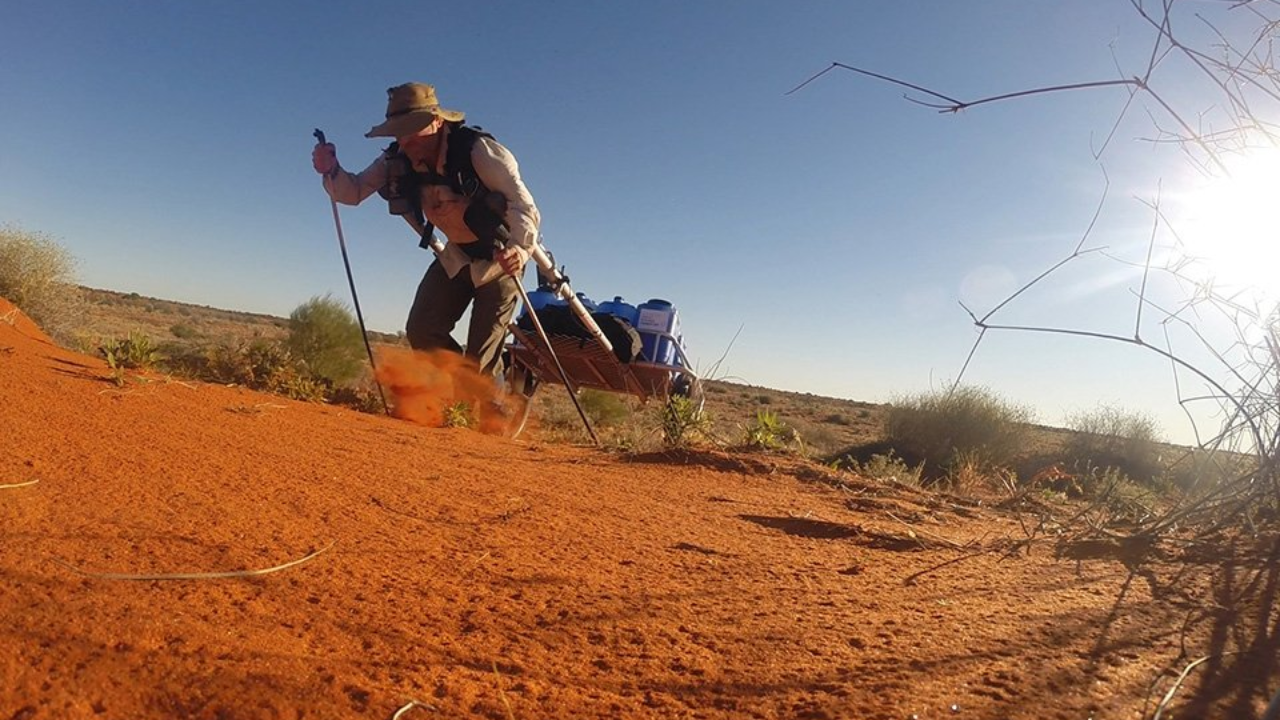
In 1984, Australian bushman Denis Bartell completed a twenty-four-day, 390-kilometer unaided foot traverse across the Simpson Desert, moving from Alka Seltzer Bore on the western fringe to Birdsville on the eastern edge without a backup vehicle. Popular accounts frame this expedition as a test of raw willpower, yet framing survival purely through the lens of psychological grit ignores the underlying logistical physics. Crossing an erg characterized by thousands of parallel sand ridges ranging from ten to thirty meters in height requires a rigorous calculus of mass distribution, thermodynamic equilibrium, and dead-reckoning accuracy. When mechanical support is stripped away, human mobility becomes an exercise in strict resource optimization where every gram of carried weight dictates operational range.
The Mass Optimization Function in Hyper-Arid Environments
The primary operational constraint of any unsupported desert trek is the physiological cost of carrying water. Human metabolic water requirements in high ambient temperatures dictate that mobility declines exponentially as backpack mass increases. Bartell's 1984 crossing required carrying provisions and water supplies sufficient for a multi-week window across terrain lacking potable natural sources. In other updates, read about: Why Safety at Malaysian Resorts Needs an Immediate Overhaul.
To model this constraint, expedition planners use a basic logistical equation where total pack weight is a function of daily caloric burn, baseline gear mass, and hydration volume. Every liter of water adds one kilogram of dead weight, which in turn accelerates metabolic expenditure and increases water loss through respiration and perspiration. This creates a negative feedback loop: carrying more water to survive a longer duration forces higher energy consumption, which demands more water ingestion.
In structured expeditions, minimizing baseline equipment mass is the single variable an explorer can control to break this loop. Bartell operated with minimalist gear tailored to outback conditions, eliminating non-essential mechanical or protective items. By stripping dead weight, the daily caloric deficit was managed within safe human physiological tolerances, preventing the rapid muscle catabolism that typically halts unsupported long-distance foot travel before the halfway mark. The Points Guy has also covered this critical topic in extensive detail.
Navigational Determinism Across Parallel Ridges
Navigating a dunefield like the Simpson Desert presents a unique topological challenge. The desert consists of thousands of parallel red sand ridges running north-northwest to south-southeast, stretching for up to eighty kilometers. From a navigational perspective, walking east-west across this terrain means constantly ascending and descending steep slipfaces, creating continuous lateral and vertical displacement vectors.
Without satellite navigation systems, dead reckoning relies entirely on compass bearings, celestial observation, and strict angle maintenance relative to the prevailing dune orientation. If a traveler drifts off bearing by even a few degrees over a span of several days, cumulative error compounds rapidly, leading to missed waypoints or severe miscalculations of distance covered. Bartell executed this traversal by maintaining a strict temporal and directional discipline, moving systematically from dawn until dusk, anchoring his direction of travel to the sun and compass rather than relying on visible tracks.
The mechanical nature of walking perpendicular to linear dunes forces a specific gait adjustment. Explorers must manage tendon strain caused by soft sand ascents and loose gravel or spinifex roots in the swales. The physical cost of ascending a thirty-meter sand ridge repeatedly over hundreds of kilometers degrades structural integrity in the knees and ankles, demanding meticulous pacing to avoid debilitating joint inflammation.
Temporal Discipline and Circadian Mechanics
Extreme endurance travel in arid zones operates on strict thermal windows. Ambient daytime temperatures during peak solar radiation create severe heat stress risks, forcing a rigid schedule. Bartell adhered to a routine dictated by the clock, initiating movement immediately after daybreak and continuing until dusk.
This temporal rigidity eliminates decision fatigue. In high-stress environments, cognitive degradation sets in due to sleep deprivation, caloric restriction, and thermal strain. By codifying daily operations into an unyielding schedule, the adventurer removes real-time tactical deliberation from the equation. Every hour is mapped to a specific output of kilometers traversed, rest intervals taken, and fluid intake consumed.
The operational rhythm creates a predictable metabolic expenditure curve. Starting at dawn capitalizes on the lowest ambient temperatures of the day, allowing maximum distance coverage before radiant heat peaks. Rest breaks are distributed symmetrically to match fluid replenishment cycles rather than arbitrary fatigue points, mitigating the onset of dehydration headaches and cognitive fog that impair navigational precision.
Risk Mitigation Without Mechanical Redundancy
A solo expedition devoid of escort vehicles removes the safety margin inherent in modern remote travel. In a vehicle-supported crossing, mechanical breakdown or injury triggers an immediate extraction protocol or access to cached supplies. Without a backup vehicle, every operational failure is terminal unless preemptively engineered out of the plan.
Risk management in this context relies on failure-mode avoidance rather than rescue availability. This involves calculating worst-case scenarios for water cache spoilage, sudden weather anomalies, or musculoskeletal injury. Bartell relied on prior outback familiarity, having mapped and driven vehicle trails across parts of the region in preceding years. This localized terrain intelligence provided mental maps of contingency options, reducing uncertainty in an environment where visual landmarks are homogeneous.
The absence of communication links meant that navigation errors could not be corrected via external telemetry. Every decision point—whether to push through a degrading physical condition or establish camp—required internal data evaluation. The psychological weight of total isolation forces an extreme form of self-reliance, where morale management becomes as critical as physical conditioning.
Operational Forecasts for Extreme Expeditions
Modern adventure logistics continue to rely on the foundational constraints established by early solo cross-country traversals. While satellite communication and lightweight composite materials have altered the gear profile, the biological limits of the human body remain constant. The fundamental trade-off between carrying capacity and metabolic cost cannot be engineered away by technology.
Future unsupported traverses in hyper-arid terrain will depend increasingly on precise metabolic monitoring and dynamic hydration strategies rather than raw gear reduction. As climate volatility increases ambient baseline temperatures across continental interiors, the margin for error in unassisted expeditions narrows further. Future planners must treat thermal load as the primary boundary condition, structuring distance milestones around physiological cooling thresholds rather than arbitrary daily mileage targets.