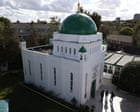
The institutional survival of religious and community infrastructure across a century depends on a precise balance of capital formation, architectural adaptability, and strategic public diplomacy. When London's Fazl Mosque marked its centenary, the milestone offered a rare empirical case study in how minority diaspora organizations establish long-term social capital in Western urban centers. Deconstructing the century-long operational trajectory of this institution reveals three primary structural pillars that allowed it to transition from a localized expatriate project into an enduring metropolitan landmark.
The Capital Structure and Funding Mechanisms
The genesis of any physical infrastructure project requires solving a severe initial financing constraint. In 1920, the land purchase for the Southfields site was executed for £2,223, followed by construction costs totaling £6,223. In contemporary economic terms, the acquisition of prime suburban real estate by a nascent, non-resident religious community presented an extreme liquidity challenge.
Rather than relying on sovereign endowments or commercial debt markets, the project utilized a distributed micro-philanthropy model. Funding was driven largely by voluntary contributions from the Ahmadiyya Muslim Community in Qadian, India. Crucially, historical records indicate a heavy reliance on non-liquid asset mobilization—specifically, women selling personal jewelry to fund a construction project thousands of miles away that most contributors knew they would never visit.
This financing architecture created an immediate psychological and organizational lock-in. Because the capital was derived from grassroots sacrifice rather than institutional patronage, ownership was decentralized across the global membership. This funding mechanism insulated the fledgling institution from the financial volatility and political conditionalities that typically accompany state-sponsored foreign religious builds.
Architectural Constraints and Municipal Integration
Physical longevity in urban planning is a function of zoning compliance, aesthetic harmonization, and spatial efficiency. Designed by Thomas Mawson and completed in 1926, the Fazl Mosque occupies a footprint optimized for a compact congregation rather than massive assembly, originally accommodating around 150 worshippers.
The architectural blueprint deliberately fused traditional Indo-Saracenic elements—such as a white exterior and a distinct dome—with the suburban vernacular of South London. This design choice mitigated the friction of municipal resistance. By maintaining a modest scale and pristine landscaping integrated with English roses, the structure avoided the adversarial zoning disputes that frequently afflict modern religious real estate developments.
Furthermore, the physical plant proved functionally elastic. Over the span of a century, the site adapted to shifting operational requirements without altering its core architectural identity:
- Serving as a localized community hub and prayer space during its initial decades.
- Functioning as an air raid shelter during the Second World War.
- Accommodating the international administrative headquarters and residential base for successive community leadership (Khilafat) after political displacement from Pakistan in 1984.
- Transitioning into a secular public utility center hosting blood drives and vaccination programs during municipal crises.
This multi-modal utility prevented the asset from becoming functionally obsolete during periods of demographic and societal stress.
Strategic Public Diplomacy and Risk Mitigation
Institutional longevity among immigrant and minority communities requires active management of external political friction. The mosque’s leadership employed a deliberate strategy of high-level civic engagement and transparent diplomacy to neutralize early twentieth-century skepticism toward non-Christian places of worship in the British capital.
In its formative decades, the institution engaged prominent political figures, diplomats, and intellectuals, hosting figures ranging from military leaders to visiting regional statesmen. By embedding itself within broader intellectual and diplomatic networks—such as hosting geopolitical discussions and lectures on self-governance—the institution framed its presence as a bridge for international discourse rather than an isolated enclave.
As demographic and political climates shifted over subsequent decades, the operational focus pivoted toward civic utility. Low-level friction, such as occasional neighborhood harassment, was countered not through legal litigation or political confrontation, but through symmetrical community outreach programs, open-house exhibitions, and large-scale philanthropic deployments (such as mass meal provisions for unhoused populations).
Operational Forecast
The operational durability demonstrated by London's oldest mosque over its first hundred years highlights a foundational rule for diaspora community assets: physical endurance is downstream of structural adaptability and financial independence. Institutions that tie their capital base to decentralized grassroots support while maintaining high operational elasticity across civic crises are structurally positioned to outlast shifting political regimes. Future governance models for minority religious infrastructure must replicate this dual-engine approach—combining uncompromising financial autonomy with proactive, secular public utility integration—to secure similar multi-generational viability.