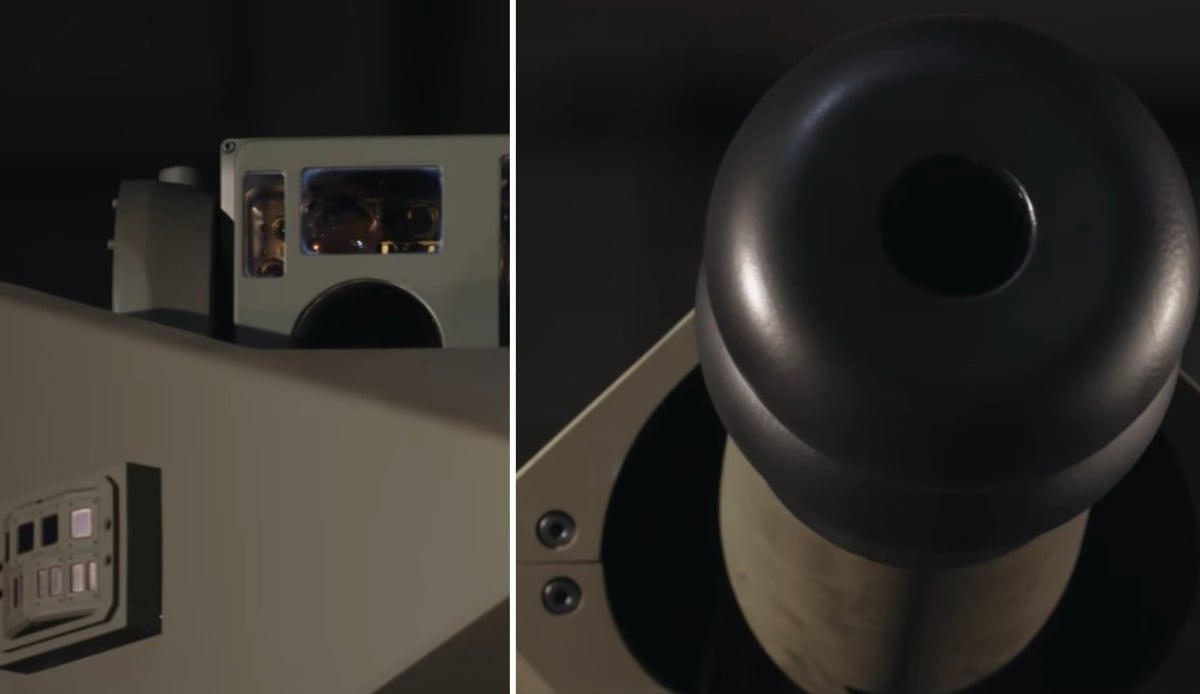
The United States Army has tried and failed five separate times since the 1980s to replace the M2 Bradley Fighting Vehicle. Billions of dollars vanished into canceled programs like the Future Combat Systems and the Ground Combat Vehicle. Now, the service is betting big on the XM30 Mechanized Infantry Combat Vehicle program to finally get the job done. Fresh promotional footage released by American Rheinmetall gives the public its clearest look yet at their contender, a highly modified variant of the KF41 Lynx. This new look reveals the front profile, the massive main gun, turret sensors, and the advanced running gear designed to haul American infantry into future conflicts.
Replacing the Bradley is not just a matter of building a newer tank. The iconic vehicle has simply run out of room to grow. Decades of bolt-on armor upgrades, electronic warfare suites, and active protection systems have pushed the original Bradley hull, power generation, and cooling capacity to their absolute limits. The XM30 program aims to sweep that baggage away. This is a head-to-head race between American Rheinmetall's Lynx and General Dynamics Land Systems' Wolf, and the stakes could not be higher for mechanical warfare. For a different look, read: this related article.
The Bold Move to a Two Soldier Crew
Traditional infantry fighting vehicles rely on a three-person crew consisting of a commander, a gunner, and a driver. The XM30 completely flips this established doctrine on its head. Both American Rheinmetall and General Dynamics are designing their vehicles around a strict two-soldier crew setup.
They sit side by side right behind the engine and transmission compartment. This leaves the entire rear section of the vehicle open for a full six-soldier infantry squad. By removing the third crew member, the vehicle saves significant internal volume and weight. Similar coverage on this trend has been shared by The New York Times.
This layout raises massive questions among armor experts. Operating an infantry fighting vehicle in high-intensity combat is exhausting. A two-person crew means the commander and driver must handle everything from navigation and target acquisition to drone monitoring, radio communications, and basic maintenance. If one crew member gets injured, the vehicle is essentially knocked out of the fight.
American Rheinmetall is addressing this problem by leaning heavily on automated systems and artificial intelligence. The vehicle uses a digital architecture to sort through sensor data and highlight threats automatically, reducing the cognitive load on those two soldiers. The system is built to act like a third crew member made of software. Whether this software can replace human eyes during a chaotic firefight remains a major point of debate among veteran tankers.
Firepower That Shrinks the Battlefield
The defining feature of the American Rheinmetall XM30 look is the massive unmanned turret. Unlike older designs, this combat module does not protrude down into the hull. This protects the crew from catastrophic ammunition explosions inside the cabin.
At the heart of this turret sits the Northrop Grumman XM913 50mm chain gun. This weapon is a massive leap forward from the 25mm Bushmaster cannon found on the current Bradley. The 50mm gun uses large ammunition designed to defeat enemy armored vehicles and light fortifications from distances well outside the reach of current infantry weapons.
The main gun is paired with a standard 7.62mm M240 machine gun for close-in targets. For heavier threats, a remotely operated weapon station can be mounted on the turret roof to hold a 12.7mm Browning M2A1 heavy machine gun.
Anti-tank capabilities are handled by a universal launcher mounted on the side of the turret. This launcher can fire standard TOW anti-tank guided missiles, next-generation CCMS-H missiles, or even loitering munitions. This blend of heavy autocannon fire, long-range guided missiles, and suicide drones gives the Lynx the ability to engage everything from low-flying helicopters to main battle tanks.
Layered Survivability and Active Protection
Heavy armor alone cannot protect a vehicle on modern battlefields filled with top-attack missiles and cheap first-person-view drones. The XM30 relies on a modular armor package. This allows mechanics to swap out damaged armor plates in the field or upgrade the vehicle's protection level based on the specific threat environment.
The real defense comes from the integration of the Elbit Iron Fist active protection system. The Army has already selected this system for its latest Bradley upgrades, and it will feature prominently on the XM30 under the designation XM251.
Iron Fist uses small radars mounted around the vehicle to detect incoming rocket-propelled grenades and anti-tank missiles. Once a threat is tracked, the system fires a small explosive countermeasure to detonate the incoming projectile at a safe distance from the hull.
The chassis itself rides on an advanced InArm hydropneumatic suspension system. Combined with six pairs of road wheels and composite tracks, this setup allows the heavy vehicle to glide over rough terrain while keeping the weapon systems stable. The use of composite tracks instead of traditional steel tracks cuts down on noise, reduces vibration, and saves a significant amount of weight, which translates directly into better fuel efficiency and speed.
How the Lynx Differs From the Wolf
The U.S. Army showed off physical design concepts for both the Lynx and the General Dynamics Wolf at the Michigan Defense Expo in Detroit. While both vehicles meet the exact same baseline requirements, their design philosophies show distinct differences.
The General Dynamics Wolf appears to use a slightly longer hull and a lower profile. It draws heavily on existing components from the General Dynamics global production network, specifically borrowing elements from the European ASCOD infantry fighting vehicle. The Wolf leans toward a simpler, more streamlined approach to the problem.
The American Rheinmetall Lynx is visibly taller and bulkier. It uses the international KF41 Lynx as a baseline but modifies it heavily to comply with strict U.S. military specifications. The Lynx looks like a hybrid between a traditional infantry fighting vehicle and a main battle tank.
The drive systems also highlight different choices. While both platforms are designed around hybrid-electric propulsion to power their extensive electronic suites, American Rheinmetall utilizes its own proprietary track and suspension components. General Dynamics appears to be utilizing composite tracks sourced from Soucy.
Breaking the Cycle of Canceled Programs
The Army's track record with vehicle procurement over the last forty years is painful. The Technical Infantry Fighting Vehicle, the Future Combat Systems, and the Ground Combat Vehicle were all canceled after billions of dollars were spent. The primary reason for these failures was requirement creep. The Army kept adding demands until the vehicles became too heavy, too expensive, or technologically impossible to build.
The XM30 program is different because the Army changed its acquisition strategy. Instead of demanding a perfect, futuristic vehicle from day one, the service focused on a Modular Open Systems Architecture. This means the core vehicle can be relatively straightforward, while its sensors, computers, and weapons can be easily unplugged and upgraded as technology evolves.
The acquisition timeline is moving fast. The first physical prototypes of both the Lynx and the Wolf are scheduled for delivery for military testing. The Army plans to evaluate these vehicles through intense live-fire and mobility trials over the next few years.
Current defense budget forecasts show the Army intends to purchase an initial batch of 108 vehicles by 2031 to equip its first operational units. If the program succeeds, the final order will scale up to several thousand vehicles to completely phase out the aging Bradley fleet.
The next step for defense observers is watching how these vehicles handle physical testing. Computer models and promotional footage look great, but the true test of the American Rheinmetall Lynx will happen in the mud and dust of military proving grounds. Keep a close eye on the upcoming mobility trials, as they will reveal whether a two-soldier crew can truly handle the realities of modern mechanized warfare.