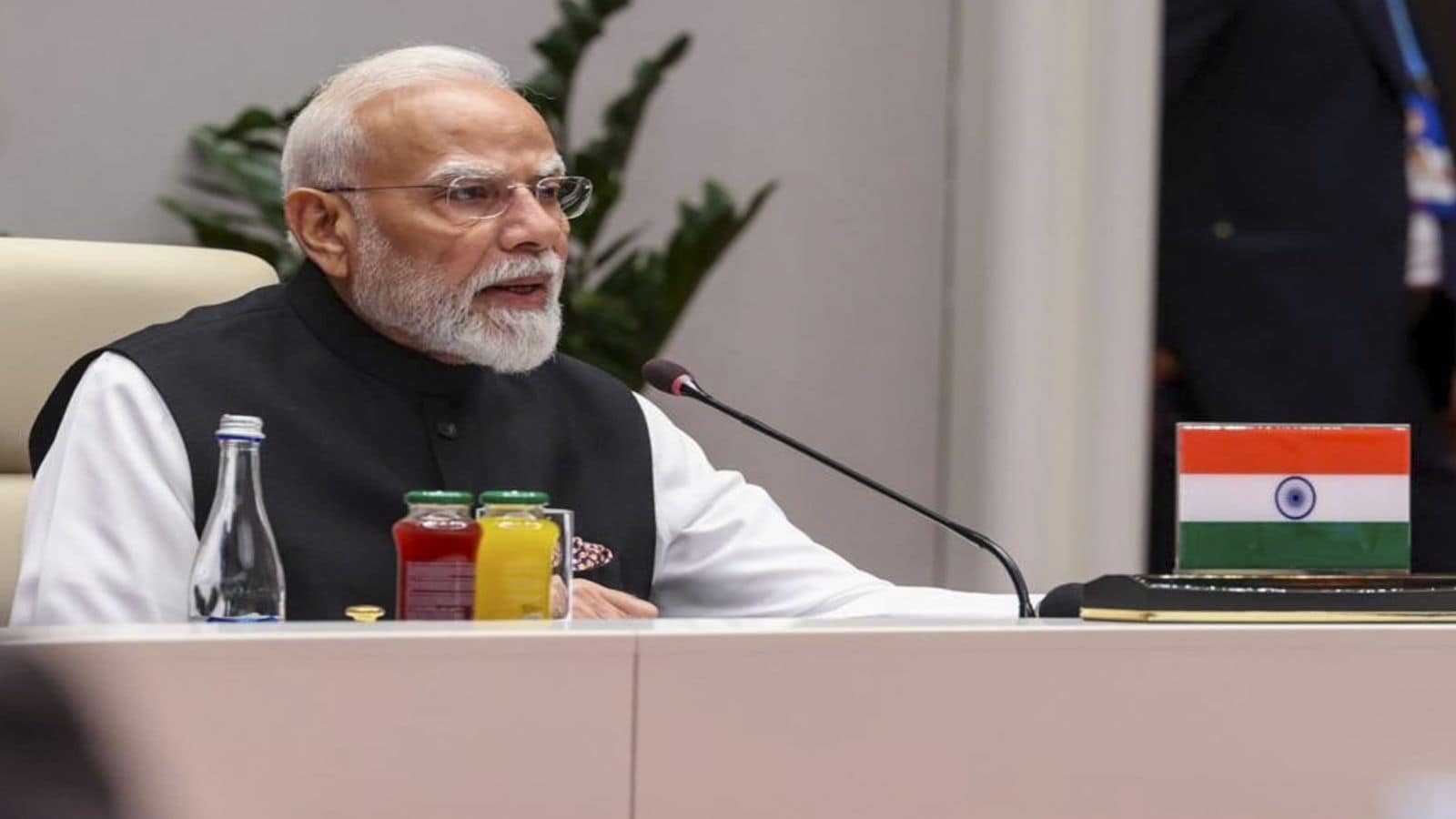
The air inside the summit hall always smells identical, regardless of the longitude. It is a sterile blend of pressurized oxygen, faint wool carpeting, and the nervous sweat of aides carrying heavy briefcases. Outside these insulated walls, the world breaks apart daily along jagged ideological faults. Inside, men in heavy suits smile for cameras that refuse to capture the trembling of their hands.
Prime Minister Narendra Modi walked into that room with a lightness that belied the weight on his shoulders. He did not look like a man trying to balance on a tightrope. He looked like a man who had built the wire himself.
Consider the room. To his left sit delegations from capitals that view each other through crosshairs. To his right, old allies whose patience wears thin with every independent economic choice New Delhi makes. Yet, as the cameras flashed, Modi found himself embraced by leaders who theoretically belong to entirely different gravitational pulls.
This is the great diplomatic magic trick of our era. How do you sit at the table with adversaries while breaking bread with partners, without ever once dropping your smile or your sovereignty?
To understand this dance, we have to look past the official communiqués. Those documents are written by committee to say nothing at all with maximum punctuation. Instead, watch the body language. Watch the deliberate pauses.
Years ago, standing on a dusty railway platform in northern India, I watched a station master manage three trains arriving on converging tracks simultaneously. He did not panic. He did not run. He simply understood the exact rhythm of the iron and the patience of the crowd. Foreign policy at the Shanghai Cooperation Organisation summit operates on that exact railway logic. India is not choosing a track. India is managing the entire junction.
The modern global order has fractured into anxious camps. Washington demands strategic clarity. Moscow expects historical loyalty. Beijing tests the boundaries of regional patience. Brussels preaches the gospel of multilateral rules while protecting its own markets. For a developing nation of one point four billion souls, buying into any single camp is a recipe for dependency. And dependency is just another word for surrender.
So, Modi talks to everyone.
When you listen to the critics in foreign think tanks, they call it hedging. They use clinical terms to describe a visceral survival instinct. They wonder aloud how a nation can champion the Global South while shaking hands with the architects of old Eurasian power blocs. They mistake multi-alignment for indecision.
They are wrong.
Indecision is freezing when the lights go out. Multi-alignment is keeping a box of matches in every pocket.
Step closer to the delegation rooms. Hear the murmur of translators wrestling with idioms that do not translate across cultural divides. Here, New Delhi's diplomats push a simple, unyielding narrative: security cannot be boxed into bilateral containment strategies. Terrorism does not respect borders, and economic growth cannot survive energy blockades. By showing up at the SCO table—sitting alongside nations with whom New Delhi shares a deeply complicated, often hostile border—India projects absolute confidence. You cannot isolate a nation that refuses to be cornered.
This is the invisible stake of the summit. It is not about signing a binding treaty on trade logistics or issuing a joint statement condemning distant conflicts. It is about spatial presence. In the high-stakes poker game of Eurasian geopolitics, if you are not at the table, you are on the menu.
Modi understands this better than most. He has turned strategic autonomy from a dusty doctrine of the Non-Aligned Movement into an aggressive, hyper-pragmatic commercial and security strategy. Buy oil where it is cheapest. Build technology partnerships where they are strongest. Keep open channels of communication with regimes that make Western diplomats choke on their mineral water.
Yet, this balancing act exacts a toll. Every handshake with a rival power sends a ripple of anxiety through allied capitals. Trust is an expensive currency, and spending it in multiple directions at once risks bankruptcy. Every time New Delhi refuses to join a chorus of western sanctions, an eyebrow raises in Brussels. Every time India deepens its defense intelligence sharing with Pacific democracies, a red flag waves in Moscow.
The tightrope walker does not look down. If he does, he falls.
Instead, Modi leans into the contradiction. He positions India as the indispensable bridge between a fading unipolar world and a chaotic multipolar reality. If the West wants to counter the weight of Beijing in Asia, it needs New Delhi as a heavy counterweight. If Eurasia wants economic integration without complete subordination to eastern manufacturing hubs, it needs New Delhi as a stabilizing anchor.
We often forget that foreign policy is fundamentally human. It is driven by the ego of leaders, the exhaustion of negotiators, and the desperate hope of citizens back home who simply want lower inflation, steady electricity, and a dignified life. When Modi shakes hands across a mahogany table in a city halfway across the world, he is not just playing chess with maps. He is buying time, space, and leverage for the shopkeeper in Ahmedabad, the software engineer in Bengaluru, and the farmer in Punjab.
The summit ends the way all such gatherings end. The motorcades roar to life. The flags are folded and packed into leather trunks. The leaders board their respective aircraft, flying back to realities that are just as messy as when they left them.
Back on the ground, the world remains unchanged and yet subtly shifted. The lines are still drawn. The rivalries still simmer beneath the ice. But India remains standing right in the center of the intersection, watching the trains come in from every direction, refusing to yield the platform.

