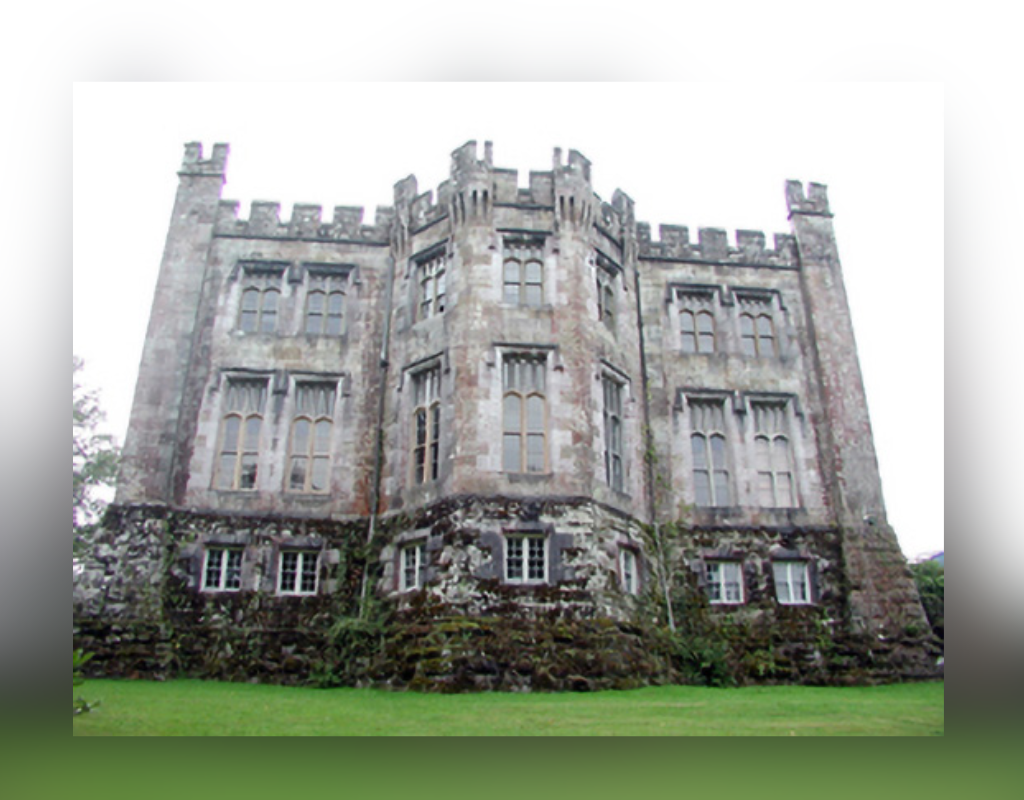
Ultra-high-net-worth real estate acquisitions follow predictable balance sheet logic rather than purely emotional impulses. When Meta Chief Executive Officer Mark Zuckerberg and Priscilla Chan acquired Strancally Castle in County Waterford, Ireland, for an estimated EUR 20 million to EUR 30 million, public discourse focused heavily on the novelty of a tech mogul owning a 19th-century Gothic-revival estate. Beneath the media narrative lies a calculated exercise in geographical diversification, asset shielding, and operational convenience relative to international corporate hubs.
Deconstructing the acquisition requires analyzing three core variables: capital allocation efficiency relative to total liquidity, regional corporate gravity, and historical estate liquidity constraints.
The Balance Sheet Mathematics of Mega-Scale Real Estate
To evaluate the true scale of the Strancally Castle transaction, the purchase price must be indexed against total net worth. Market estimates place the valuation of the 440-acre estate between EUR 20 million and EUR 30 million (approximately $22 million to $33 million). For an individual whose net worth exceeds $150 billion, this acquisition represents a negligible fraction of liquid or semi-liquid wealth—roughly 0.02%.
To contextualize this ratio, spending $30 million on a 440-acre historic European estate for a multi-millions earner is functionally equivalent to an individual with a $300,000 net worth purchasing a $60 coffee maker. It is an off-market transaction that registers as a rounding error on personal financial statements, proving that physical land accumulation at this tier serves as a low-risk portfolio stabilizer rather than a capital drain.
Furthermore, historical European agricultural and architectural assets operate under entirely different liquidity parameters than urban commercial real estate or suburban residential sprawl. Castles like Strancally—originally built in 1830 by architects James and George Richard Pain and previously restored by private equity figures—do not function as high-yield growth instruments. They function as long-duration store-of-value assets with high maintenance cost functions.
Corporate Gravity and Jurisdictional Footprint
Meta maintains its international headquarters in Dublin, Ireland, coordinating operations across Europe, the Middle East, and Africa. While the company's executive leadership resides primarily in the United States, managing a multinational enterprise with significant regulatory exposure in the European Union requires physical proximity infrastructure.
Strancally Castle sits in the Blackwater Valley in County Waterford, roughly 200 kilometers southwest of Dublin. This distance establishes a tactical geographical boundary. It provides absolute privacy and isolation while remaining within a short helicopter transit or drive of Ireland's primary regulatory, legal, and operational nodes.
Global technology executives face an increasing frequency of cross-border compliance hearings, parliamentary inquiries, and regional strategic summits within the European Union. Maintaining an independent residential base outside the capital city avoids the security vulnerabilities of commercial hotels while bypassing the bureaucratic friction of renting corporate hospitality complexes. The acquisition effectively internalizes the accommodation cost function for recurring European business trips, converting an external expense into a private appreciating asset base.
The Microeconomics of Historic Estate Stewardship
Purchasing an estate featuring cut-stone masonry, extensive riverfront acreage, and 19th-century structural engineering involves accepting a specific operational burden. Architectural properties of this scale require specialized preservation capital expenditures. The previous owners, who held the property for 25 years, completed substantial structural modernizations in the early 2000s.
By stepping into an already-restored asset, Zuckerberg avoids the initial capital expenditure risk of historical remediation—a process notorious for budget overruns and timeline friction. Instead, the ongoing financial commitment shifts entirely to maintenance overhead and estate staff administration.
This asset class also reflects a broader trend among ultra-high-net-worth technology founders acquiring historic landholdings in the British Isles and Western Europe. Similar high-profile transactions—such as Stripe co-founder John Collison purchasing Abbey Leix and James Dyson acquiring Ballynatray House in the same region—demonstrate a preference among tech industrialists for secure, tangible, land-backed assets insulated from public equity volatility.
The primary constraint of owning a 440-acre estate with a sprawling footprint is not acquisition cost, but operational latency. When the distance from a property's dining room to its kitchen requires a multi-minute walk, scaling domestic logistics demands dedicated institutional-grade property management teams.
The acquisition of Strancally Castle is a low-friction, high-privacy infrastructure play. It anchors executive physical presence near a critical international corporate hub while diversifying personal wealth into irreplaceable European land assets at an immaterial marginal cost.