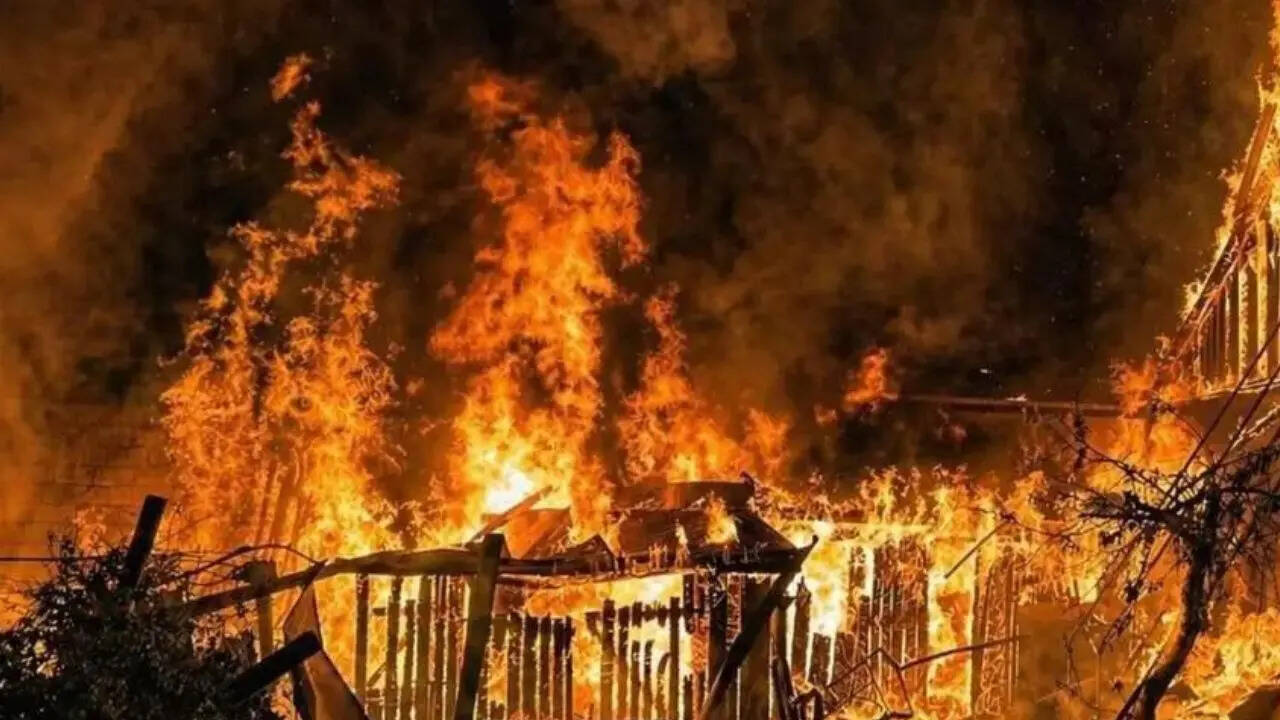
The operational architecture of the Russia-Ukraine war changed fundamentally when Kyiv decoupled its deep-strike capabilities from Western supply chains and political red lines. By deploying domestically developed, low-cost long-range unmanned aerial vehicles (UAVs) against Russian energy infrastructure—exemplified by simultaneous strikes on the Armavir oil depot, the Taganrog port tanker terminal, and the Feodosia storage facility—Ukraine has operationalized an asymmetric attrition strategy. This strategy does not seek immediate territorial recapture; instead, it targets the economic baseline and logistical mechanics that sustain the Russian war effort.
When Ukrainian President Volodymyr Zelenskyy declared that Kyiv is "rightly bringing the war back to where it came from," the statement was less a political posture and more a description of a precise economic cost function. By shifting the theater of operations up to 700 kilometers inside Russian territory, Ukraine is exploiting a critical vulnerability: the structural inability of the Russian Federation to defend a geographically dispersed hydrocarbon supply chain while maintaining front-line air defense density.
The Cost Asymmetry Equation
The primary mechanism of Ukraine’s deep-strike doctrine relies on an inverse cost ratio between offensive assets and defensive measures. This relationship can be modeled as an asymmetry coefficient:
$$A = \frac{C_{\text{def}} \cdot P_{\text{int}} + C_{\text{opp}}}{C_{\text{off}}}$$
Where:
- $C_{\text{off}}$ is the production cost of the attacking Ukrainian long-range UAV (typically $20,000 to $50,000).
- $C_{\text{def}}$ is the marginal cost of a Russian air defense interceptor missile (e.g., Pantsir-S1 or Tor-M2 missiles, costing $100,000 to $250,000 per engagement).
- $P_{\text{int}}$ is the probability of a successful interception.
- $C_{\text{opp}}$ is the opportunity cost of diverting air defense assets from active front-line sectors to protect civilian or commercial infrastructure.
Because the cost of the offensive vector ($C_{\text{off}}$) is an order of magnitude lower than the cost of kinetic interception ($C_{\text{def}}$), Russia faces a structural economic deficit regardless of tactical outcomes. If a $30,000 Ukrainian drone is intercepted by a $200,000 Russian missile, Ukraine achieves a net economic drain on Russian military reserves. If the drone evades interception and impacts a catalytic cracking unit or an oil storage silo, the return on investment scales exponentially, compounding direct capital destruction with systemic downtime.
The Three Pillars of Vulnerability
The tactical focus on Russian oil refining and storage infrastructure relies on three fixed industrial vulnerabilities that cannot be mitigated through rapid re-engineering.
- Geographic Dispersion and Fixed Position: Refineries, transshipment hubs like Taganrog, and strategic storage depots like Armavir are massive, static industrial footprints. They cannot be camouflaged, hardened comprehensively against kinetic impacts, or relocated.
- Component Customization and Sanctions Bottlenecks: Modern distillation columns and high-capacity pumps are highly specialized pieces of equipment. Due to Western technology sanctions, Russia cannot readily import replacement parts for Western-designed refinery components. A single successful strike on a fractionating tower can knock a facility offline for months, as domestic substitution or illicit parallel imports face long lead times.
- The Single-Point-of-Failure Risk: Hydrocarbon processing plants operate as continuous-flow systems. Damaging a single critical junction—such as the central control room, gas fractionation unit, or specialized blending facilities—paralyzes the entire operational line, forcing upstream production shutdowns and downstream logistics bottlenecks.
Logistics Deconstruction: The Armavir and Taganrog Vectors
Analyzing the geographical coordinates and functional profiles of recent strikes reveals a calculated effort to segment Russian logistics into isolated, high-friction zones.
[Ukraine Border]
       │
       ├──────► ~500 km ──────► [Armavir Oil Depot] (Inland Logistics Hub)
       │
       └──────► ~150 km ──────► [Taganrog Port Terminal] (Maritime Supply & Shadow Fleet)
The strike on the Armavir oil depot, located roughly 500 kilometers from the Ukrainian border in Krasnodar Krai, directly targets an inland logistical redistribution node. Facilities of this nature do not merely store fuel; they manage the throughput velocity of refined products destined for both civilian consumption and military distribution in the Southern Military District. By degrading inland storage capacity, Ukraine forces Russia to rely on direct-to-front rail or road transport from more distant refineries, increasing transport time and compounding fuel transport vulnerabilities.
Concurrently, the operation against the port of Taganrog in Rostov Oblast highlights the targeting of maritime infrastructure. Taganrog operates as a vital node for shallow-water transshipment and connects directly to the Sea of Azov and the Black Sea maritime corridors. Hitting a tanker within the port framework introduces three immediate systemic frictions:
- Insurance Risk Premiums: Commercial vessels operating within the Sea of Azov face immediate escalation in war-risk insurance premiums, disincentivizing private shipping firms from servicing Russian state contracts.
- Shadow Fleet Hardening: Russia relies heavily on a decentralized "shadow fleet" of aging, unflagged, or under-insured tankers to bypass Western price caps and export restrictions. Forcing these vessels into vulnerable, targeted ports creates a high-density target environment for long-range Ukrainian assets.
- Physical Port Bottlenecks: A damaged or burning vessel at a berth restricts port throughput, stalls loading schedules, and requires the diversion of local emergency services, interrupting the general pace of maritime cargo movement.
Structural Constraints of the Strategic Air Defense Dilemma
Every long-range drone launched by Ukraine forces the Russian General Staff to make a zero-sum calculation regarding asset allocation. The Russian air defense network—anchored by S-400 long-range systems, S-300 variants, and point-defense systems like the Pantsir-S1—was designed under a legacy doctrine that assumed a contiguous front line or localized high-value targets. It was not built to provide comprehensive point-defense coverage for hundreds of civilian industrial facilities spread across thousands of square kilometers.
This creates the Strategic Air Defense Dilemma:
                  ┌───────────────────────────────┐
                  │   Russian Air Defense Assets  │
                  └───────────────┬───────────────┘
                                  │
                 ┌────────────────┴────────────────┐
                 ▼                                 ▼
   [Option A: Deploy to Front Line]  [Option B: Deploy to Domestic Rear]
   • Protects troop concentrations   • Protects oil refineries & ports
   • Shields command centers         • Defends economic infrastructure
   • Vulnerable domestic rear        • Leaves front lines exposed to
     exposed to deep drone strikes     tactical aviation & artillery
If Russia chooses Option A, it maximizes protection for its advancing mechanized units, command structures, and supply hubs within Ukraine. However, this leaves the domestic rear completely vulnerable to long-range Ukrainian drones, allowing Kyiv to steadily erode the economic base funding the war.
If Russia chooses Option B, it pulls Pantsir and Tor systems back from the front lines to ring-fence hundreds of refineries, depots, and ports across Leningrad, Yaroslavl, Rostov, and Krasnodar Oblasts. While this improves the interception rate ($P_{\text{int}}$) around critical infrastructure, it creates immediate radar gaps along the front lines. Ukrainian tactical aviation, high-mobility artillery rocket systems (HIMARS), and short-range attack drones can then exploit these gaps to inflict heavy casualties on exposed Russian troops.
Geopolitical Counter-Pressures and Market Realities
The execution of this deep-strike doctrine does not occur in an economic vacuum. It interacts directly with global energy markets, shifting geopolitical alliances, and parallel global conflicts.
Throughout 2026, the global price of oil has experienced upward pressure due to concurrent geopolitical disruptions, notably instability involving Iran and shipping constraints in critical maritime chokepoints like the Strait of Hormuz. For Russia, these elevated global prices act as a financial buffer. Even as Ukrainian drone strikes successfully reduce Russia’s total refining capacity or disrupt specific export terminals, the higher per-barrel price of remaining exports partially offsets the capital losses.
This market dynamic creates a complex geopolitical friction point between Ukraine and its Western partners, particularly the United States. Western economic strategy has consistently sought to limit Russian oil revenues while avoiding major shocks to global oil supply that could trigger inflation. Ukraine’s targeted campaign against Russian refining infrastructure deliberately disrupts this balance.
By focusing primarily on domestic refining assets rather than crude oil export pipelines, Ukraine seeks to choke off domestic Russian fuel production—essential for military logistics—while forcing Russia to export more unrefined crude, which commands lower margins. However, when strikes hit export-oriented terminals like those on the Baltic Sea or the Black Sea, the immediate contraction in global market liquidity runs counter to Western economic stabilization goals, highlighting a distinct divergence in tactical priorities between Kyiv and Washington.
Limitations and Operational Friction Points
While the asymmetric attrition strategy provides Ukraine with a potent long-range lever, it possesses definitive operational boundaries and cannot be viewed as a standalone mechanism for military victory.
- Damage Scale vs. Repair Velocity: Drone strikes carrying relatively small payloads (typically 20kg to 50kg of explosives) often cause localized fires and superficial damage rather than catastrophic structural failure. If Russia can maintain an adequate supply of basic structural steel and legacy valves, simple storage depots can often be patched and brought back online within weeks, demanding a continuous, high-volume expenditure of Ukrainian drones to maintain the degradation effect.
- Technological Adaptability: The electronic warfare (EW) environment is highly dynamic. Russia possesses advanced EW capabilities capable of jamming GPS and GLONASS guidance frequencies. Ukraine has countered this by integrating optical terrain-mapping and fiber-optic guidance systems into its latest drone iterations to bypass electronic interference. However, as Russia deploys automated point-defense systems and localized spoofing arrays around key facilities, the technical barrier and cost for successful penetration will inevitably rise.
- Production Scaling Ceilings: Domestically produced drones require steady access to specialized components, including small internal combustion engines, guidance chips, and carbon-fiber airframes. Despite a decentralized manufacturing base and international crowdfunded supply routes, Ukraine's production capacity remains subject to energy blackouts caused by Russian missile strikes on its own domestic power grid.
Strategic Forecast
The trajectory of the conflict indicates that Ukraine will accelerate its targeting of Russian energy supply chains. Rather than erratic, isolated operations, the campaign is shifting toward coordinated, multi-vector strikes designed to overwhelm localized air defenses through saturation.
The immediate operational priority for Ukrainian planners will likely involve the systematic targeting of the Russian shadow fleet's support infrastructure in the Black and Baltic Seas. By rendering specific transshipment ports unusable or uninsurable, Kyiv can force a larger volume of Russian oil into closely monitored, conventional maritime channels where sanctions and price caps can be enforced more stringently by international regulators.
Concurrently, as Russia attempts to counter this threat by deploying localized electronic warfare screens and physical anti-drone netting around primary distillation towers, Ukraine's tactical evolution will rely on the deployment of autonomous, swarming UAVs utilizing edge-computing vision processing. This technical evolution will remove dependence on external satellite navigation during the terminal phase of flight.
The success of Ukraine's strategy will ultimately be measured not by the immediate visual impact of burning oil facilities, but by the measurable contraction of Russian domestic fuel distribution velocity and the forced redeployment of frontline Russian air defense assets into the interior of the Russian state.