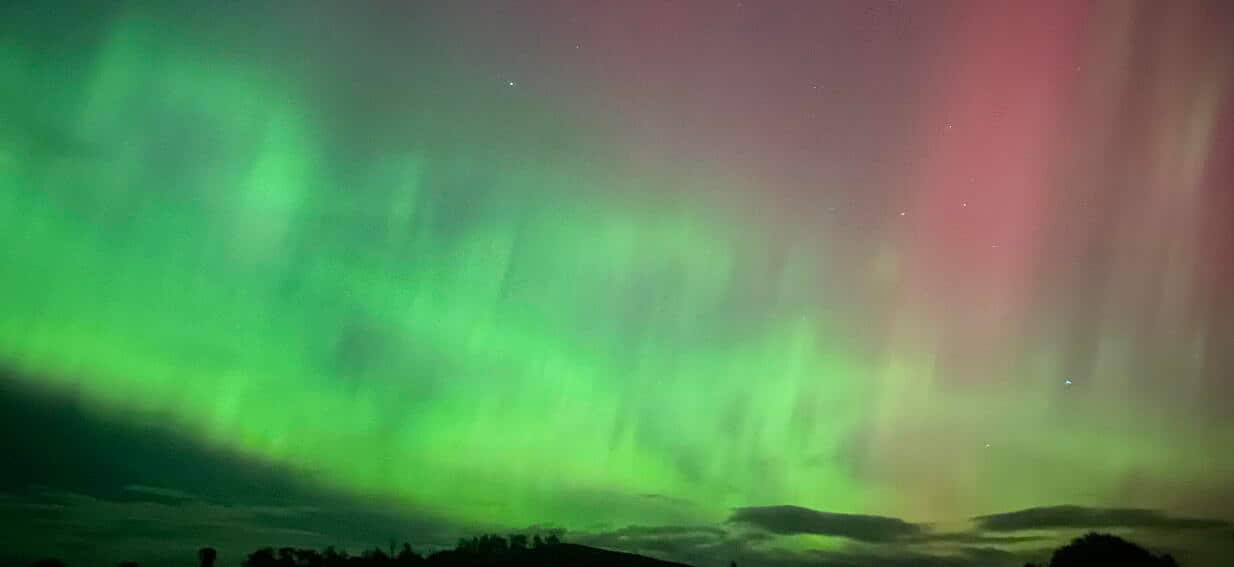
The internet gets a predictable twitch whenever a space weather alert drops. Headlines flash across news feeds warning that the aurora australis will light up Australian skies tonight, sending thousands of hopeful stargazers rushing to suburban beaches with their smartphones held high. Most of them head home cold, tired, and staring at a blank black screen. They blame bad luck. They blame the weather. The real culprit is a fundamental misunderstanding of how geomagnetic data works and why casual forecasts routinely oversell what the naked human eye can actually perceive.
If you want to catch the southern lights from Australian latitudes, you have to stop trusting sensationalized alerts and start reading raw telemetry. The physics governing these displays is unforgiving. When a coronal mass ejection erupts from the sun, it hurls billions of tons of magnetized plasma into the solar wind. For that energy to manifest as visible light over Melbourne, Adelaide, or Sydney, a very specific sequence of interplanetary mechanics has to align. A high Kp index—the standard metric used by weather apps to summarize global geomagnetic activity—is only part of the equation. Meanwhile, you can explore similar developments here: Why Ten New Branching Worms Inside Sea Sponges Change Marine Biology Forever.
The Vector Problem
Most weather reports treat the Kp index like a thermometer for the sky. That is a mistake. Kp is a three-hour quasi-logarithmic planetary average. By the time an app tells you the Kp index has spiked to 7 or 8, that data is already historical record, not a real-time guarantee.
The missing variable in nearly every mainstream forecast is the interplanetary magnetic field's southward component, known to space physicists as Bz. For an aurora to ignite outside of polar regions, the Bz vector must point south. If the Bz value is trending north, even a severe geomagnetic storm will bounce harmlessly off Earth's magnetosphere, producing nothing more than faint, invisible particle drift. When the Bz drops deep into negative territory—say, minus 10 nanoteslas or lower—it acts like an open valve, allowing solar wind energy to flood the upper atmosphere. Veteran chasers watch the real-time ACE or DSCOVR satellite feeds for Bz fluctuations, ignoring broad regional alerts entirely until that southward gate opens. To understand the bigger picture, we recommend the recent analysis by Science Magazine.
Geography and the Horizon Trap
Latitude dictates everything, yet casual guides routinely gloss over the brutal geometry of viewing the southern lights from Australia. Unlike the northern auroral oval, which dips cleanly over population-dense regions of Scandinavia, Alaska, and Canada, the southern oval sits stubbornly over the Southern Ocean and Antarctica.
Tasmania is positioned well enough to catch frequent displays during moderate activity, but mainland Australia is a different story. For a viewer standing on the Victorian coast or the South Australian cliffs, the aurora does not dance overhead. It hugs the southern horizon as a low, greyish arc or a faint ruby blush. If your southern view is choked by suburban streetlights, coastal fog, or the glow of a nearby town, you will see nothing.
To illustrate this constraint, consider a hypothetical observer parked at a suburban beach near Geelong with moderate light pollution. Even during a significant G3-class storm, the ambient urban skyglow will easily wash out the threshold luminescence of a low-elevation auroral arc. The human eye, relying primarily on cone cells in low-light conditions, struggles to register the subtle green and red wavelengths produced by excited oxygen atoms at 100 kilometers altitude.
The Smartphone Deception
Modern digital photography has fundamentally altered public perception of the aurora australis. When social media fills with vibrant purple curtains and neon-green pillars captured over regional Victoria, it creates an unrealistic baseline expectation for anyone walking out the door with only their eyes.
Image sensors in modern smartphones and mirrorless cameras integrate light over extended exposures, pulling faint photon counts out of the dark and rendering them in saturated relief. To the naked eye, that same display often registers as a smudge of slate gray or a milky, stationary haze. Acknowledging this gap between camera physics and human biology saves observers from profound disappointment. If you want to experience the southern lights authentically, you have to train your vision to look for texture and slow-pulsing vertical structure rather than expecting a cinematic light show right out of the gate.
Reading the Real-Time Feed
Throw away the static evening news forecasts if you want to master aurora tracking. The Australian Space Weather Forecasting Centre and international monitoring networks provide live telemetry streams that update every few minutes. Look past the generic color-coded maps and check three specific indicators: solar wind speed, density, and the aforementioned Bz orientation.
When the solar wind speed climbs above 500 kilometers per second and the Bz remains locked in a negative trajectory for a sustained window of 45 minutes, your probability of a sighting jumps exponentially. Combine those metrics with a local cloud cover satellite loop rather than a standard weather app prediction, pack heavy insulation because coastal midnight winds drop temperatures fast, and drive far enough south to drop your horizon below artificial glare. The physics does not lie, even when the mainstream forecasts do