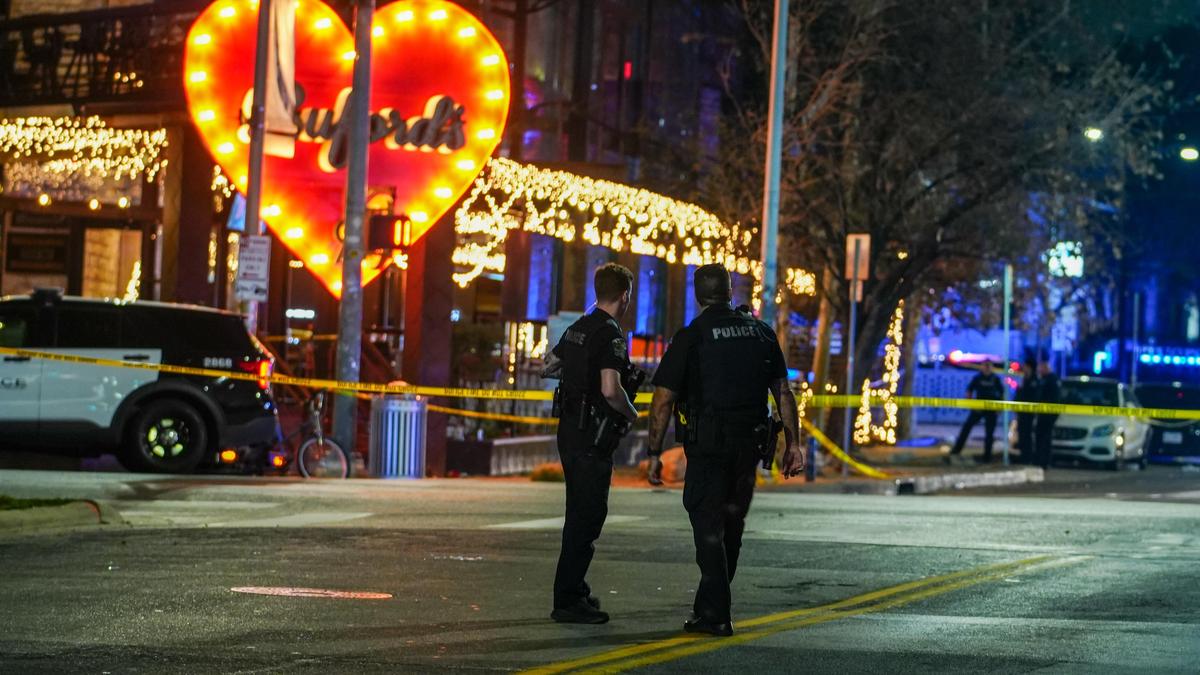
Standard reporting on the Austin shooting follows a tired, predictable script. Three dead. Fourteen wounded. A "senseless act of violence" on Sixth Street. The media focuses on the body count, the immediate chaos, and the inevitable calls for more boots on the ground. They treat these events like isolated thunderstorms—unpredictable, tragic, and beyond the reach of structural logic.
They are wrong.
The tragedy in Austin isn't a failure of policing or a sudden lapse in civic morality. It is the predictable outcome of "Density Without Security," a flawed urban planning model that prioritizes foot traffic and nightlife revenue while ignoring the physical architecture of crowd safety. If you are looking at the shooter’s motive, you are looking at the wrong variable. The motive is noise; the environment is the signal.
The Myth of the "Safe" High-Traffic Zone
City officials love to tout "vibrant" nightlife districts. They want high density because high density equals high tax revenue. But there is a mathematical breaking point where density transitions from an economic asset to a tactical liability.
In the security world, we look at crowd flow dynamics. When you cram thousands of people into a narrow corridor like Sixth Street, you create a "high-friction environment." In these spaces, the response time for emergency services doesn't just slow down; it hits a hard physical ceiling.
Standard news outlets ask: "Where were the police?"
The insider asks: "How could a medic even reach a victim through a wall of five hundred panicked bodies?"
We have built urban funnels that are designed for consumption but physically incapable of evacuation. By the time the first shot is fired, the architecture has already failed the victims.
Stop Calling It Senseless
The term "senseless" is a linguistic shield used by journalists who don't want to look at the data. Violent incidents in entertainment districts are rarely random. They are the result of specific, identifiable escalations that go ignored because the current surveillance model is reactive, not proactive.
We have thousands of cameras in these districts. Most of them are decorative. They are used to identify a suspect after the blood is scrubbed off the pavement.
A contrarian approach to urban safety demands a shift toward Behavioral Pattern Recognition (BPR). I have seen cities waste millions on high-definition cameras that do nothing but provide better footage for the evening news. If your tech isn't flagging "pre-incident indicators"—aggressive posturing, rapid grouping, or the "predatory gaze"—then your tech is just a digital witness to a murder.
The Fallacy of Increased Patrols
The immediate "fix" offered by politicians is always more police. It’s a placebo.
Adding twenty officers to a crowded three-block radius provides a sense of security, but it does not change the physics of a shooting. In a high-density crowd, an officer’s line of sight is obstructed. Their ability to return fire is neutralized by the risk of collateral damage.
The reality is that static policing is a relic. We are trying to solve 21st-century flashpoint violence with 20th-century foot patrols.
Instead of more badges, we need:
- Tactical Lighting Grids: Instantly flooding a conflict zone with high-intensity light to disrupt vision and de-escalate the physical environment.
- Modular Crowd Barriers: Retractable systems that can instantly segment a crowd to prevent a stampede—the "secondary killer" in these scenarios.
- Acoustic Triangulation: Not just ShotSpotter, which tells you where the gun was, but integrated systems that immediately trigger localized lockdowns.
The Alcohol-Violence Correlation Nobody Wants to Touch
Austin’s Sixth Street, like Bourbon Street or Broadway in Nashville, is an economy built on intoxication. We cannot act shocked when a space designed to lower inhibitions and increase aggression eventually explodes.
The industry consensus is to blame the individual "bad actor." The uncomfortable truth is that we have engineered "Aggression Accelerants" into the very fabric of our cities. When you combine high-volume alcohol sales, extreme noise pollution (which triggers the sympathetic nervous system), and physical overcrowding, you aren't running a bar district; you’re running a social experiment in combustion.
If we were serious about safety, we would discuss Saturation Limits. Just as a building has a fire code capacity, a street should have a kinetic capacity. Once the density reaches a certain threshold, the risk of a mass casualty event increases exponentially.
The Data Gap
The public is fed a diet of "crime rates," but crime rates are a lagging indicator. They tell you what happened last year. They don't tell you the Volatility Index of a specific Saturday night.
We have the technology to measure the "temperature" of a crowd in real-time using anonymized mobile data and sound sensors. We can see the tension building before the first punch is thrown or the first magazine is loaded. But we don't use it. Why? Because acknowledging the risk would mean slowing down the party, and the party is too profitable to stop.
Your Safety is an Illusion of Infrastructure
If you think you are safe because there is a cruiser parked on the corner, you are falling for the theater of security. True safety in an urban environment is a product of Environmental Design (CPTED).
Most of these districts were built for horse and buggies, not for ten thousand people with high-capacity firearms. We are trying to run modern, high-stress social interactions on hardware that is two hundred years old.
The tragedy in Austin isn't that someone decided to open fire. The tragedy is that we continue to invite thousands of people into a kill box and call it "nightlife."
Stop asking why the shooter did it. Start asking why the environment made it so easy for them to succeed.
Don't wait for the city to "fix" the violence. They are too busy collecting the tax revenue from the bars that fuel it. Your only real defense is an awareness of the physical trap. If the exit is blocked by a sea of people, you aren't at a party; you’re in a liability.
The next time you see a headline about a mass shooting in a crowded district, remember: it wasn't a surprise. It was an engineering certainty.